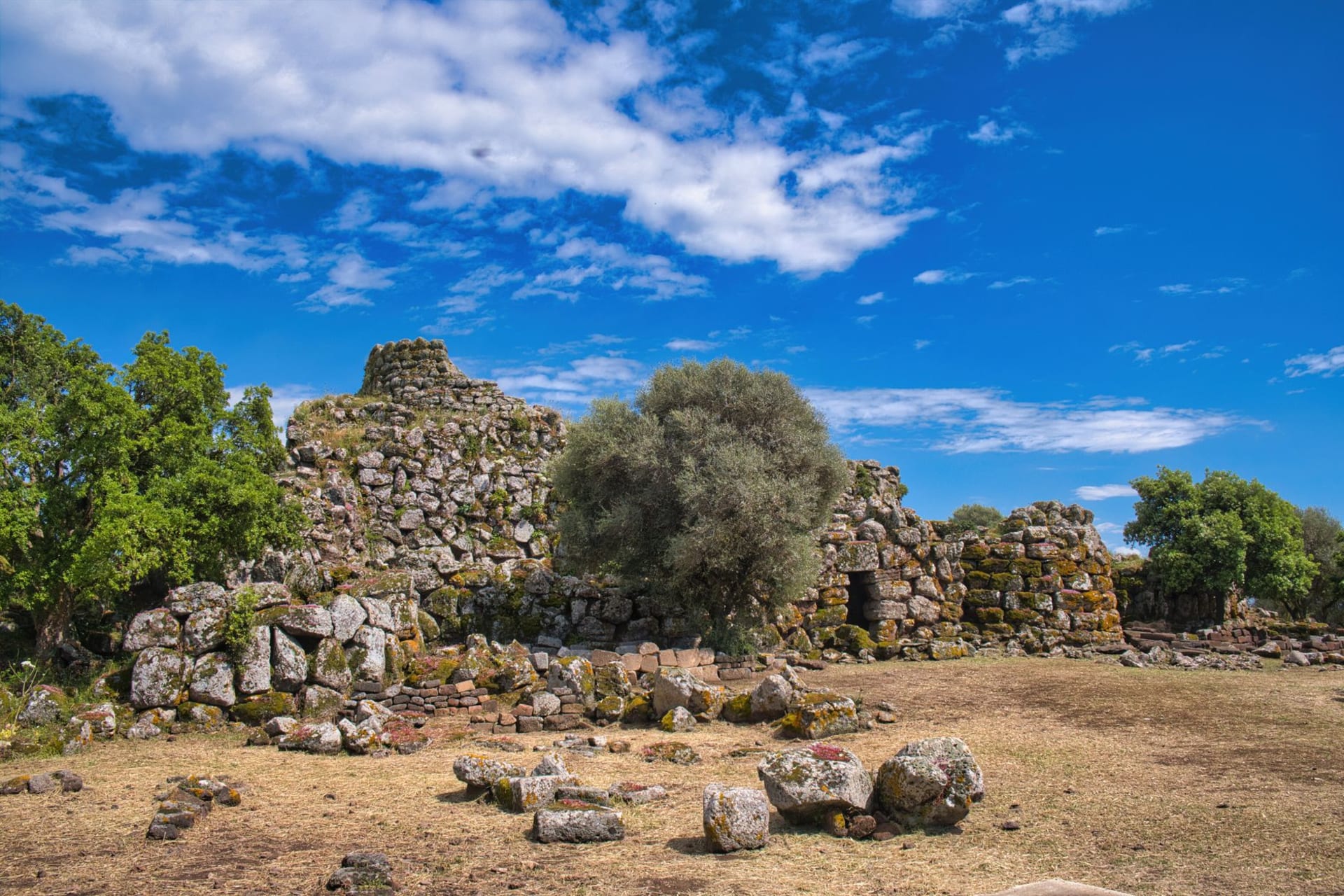
Su Nuraxi di Barumini
"I put my hand on a wall that was already ancient when the Romans were still a village, and the basalt was warm, and that did something to my sense of time."
Everyone comes to Sardinia for the coast, and I understand the impulse — the water at Cala Goloritzé could convert an atheist. But the thing I keep telling people about, to their visible boredom, is a pile of dark stones in the dry middle of the island, an hour and a half inland from Cagliari, near the unremarkable village of Barumini. Su Nuraxi is a nuraghe: a Bronze Age tower fortress, the largest and best-preserved of the seven thousand or so scattered across Sardinia, built around 1600 BC by a people who left no writing and whose name we do not even know. It is a UNESCO World Heritage Site, it is one of the most important prehistoric monuments in the Mediterranean, and on the morning we visited there were perhaps eleven other people there. Eleven.
A fortress older than history
You can only enter Su Nuraxi on a guided tour, which initially irritated me and quickly turned out to be the whole point, because without the guide the site is an enigmatic heap and with her it becomes a city. The central tower, built of enormous basalt blocks stacked without mortar, once stood perhaps eighteen metres high; around it, later inhabitants added a complex of four further towers linked by walls, and around that again sprawled a village of round stone huts that you can still walk through, ducking under lintels worn smooth by three and a half millennia of hands.
The construction is what undoes you. There are no arches — the people who built this hadn’t met the idea — so the chambers are roofed with corbelled domes, each ring of stone overhanging the one beneath until they meet at the top, a technique that should not hold and has held for three thousand six hundred years. Standing inside the cool dark of the central tower, looking up at that impossible spiralling ceiling, I felt the particular vertigo of deep time. The Romans, when they finally reached Sardinia, regarded these towers as ancient ruins. They were already old news to people we think of as antiquity.
The village that nobody visits
What I loved almost as much as the ruin was Barumini itself, the sleepy farming village beside it, which has resolutely declined to become a tourist trap despite sitting next to a world treasure. We ate lunch at a small place where the menu was whatever the kitchen felt like making, which turned out to be malloreddus — the little ridged Sardinian gnocchi — with sausage and saffron, and a carafe of Cannonau so dark it stained the glass. The owner asked where we were from, heard France, and immediately produced a digestivo of myrtle liqueur that he refused to charge for. Lia tried to insist. He waved her off as if the suggestion were faintly insulting.
That is the Sardinian interior in one gesture: stubborn, generous, indifferent to the coastal tourism that bankrolls the rest of the island. Su Nuraxi gives you the deep past; Barumini gives you the living present, and the two together make the best day I had on the island, beaches included.
When to go
Spring and autumn — April to early June, or September into October — because this is the parched interior and high summer turns the site into a furnace with no shade between the stones. Book the first tour of the day to beat both the heat and the few coaches that do come. Allow time for lunch in Barumini afterward; rushing back to the coast would be the real mistake.