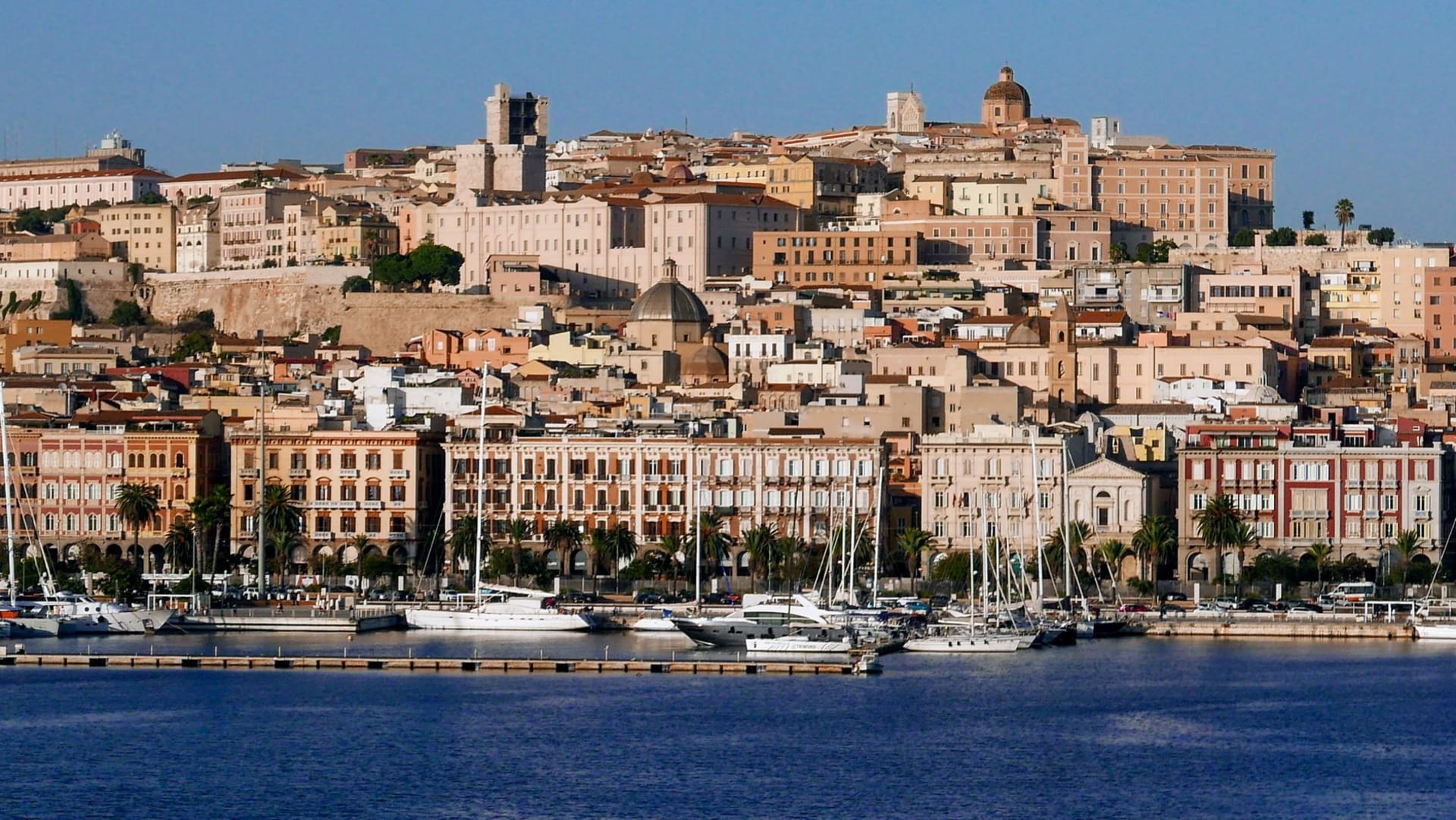
Cagliari
"The flamingos were standing in the lagoon right behind the Ikea. I chose to love this about Cagliari immediately."
I landed in Cagliari on a Tuesday in late May, and before I had even cleared the airport road I could see flamingos — a loose congregation of them standing pink and improbable in the salt lagoon beside the highway, completely indifferent to the traffic. This was my introduction to a city that would spend the next four days quietly dismantling my assumption that every Italian island capital is basically the same: sun, gelato, Vespa, repeat. Cagliari is older than that, stranger than that, and far too absorbed in its own rhythms to perform for tourists.

The Castello district sits on the highest of the city’s seven hills, and reaching it by one of the old bastioned staircases rather than by car reveals what the city actually is. The lanes up here are narrow and slightly steep and shadowed by medieval stone buildings that do not advertise themselves. The Cagliaritans who live here — students, pensioners, a few families with laundry on balconies — inhabit these streets with the comfort of people who have never had to think about being picturesque. There is a cathedral with a baroque facade and a crypt carved from the stone with a patience that makes you feel slightly guilty about the speed at which you move through the world. I sat in it for twenty minutes and heard nothing but pigeons and the distant sound of a motorino.
Below the Castello, the Mercato di San Benedetto runs across two floors of a postwar building and is the real center of Cagliari’s daily life. The fish floor downstairs is the place to arrive at eight in the morning: stalls of sea bream laid across crushed ice, bins of clams still in motion, and waxy golden lobes of bottarga — dried and pressed mullet roe — that smell of the open sea and something deeper, more mineral, more ancient. I bought a small piece and had it sliced thin over bread with olive oil at a bar around the corner. The taste was extraordinary: intensely saline, with a kind of lingering umami that makes you understand why the Phoenicians and Romans were so obsessed with this stretch of water.

The evenings belong to the Poetto, the ten-kilometer strip of sand south of the center where Cagliari does its passeggiata. It is not a tourist beach — it is a neighborhood beach, the place where people walk their dogs and elderly couples move slowly arm in arm and teenagers kick footballs in the low light. On the lagoon side of the road, the flamingos reconvene at dusk in numbers I found genuinely startling the first time. The city’s relationship with these birds feels casual and proprietorial, the way you feel about a feature of your neighborhood that visitors always make a fuss about.
The light in the evenings has a quality specific to this city’s position above the water. I went back to the Bastione di Saint Remy on my last night and watched the limestone and the terracotta and the sea all go golden at once. It lasted about fifteen minutes and I did not photograph it, which is a decision I have never once regretted.
When to go: May and June strike the ideal balance — warm enough for the beach and the lagoon light, not yet invaded by August’s exodus of Romans seeking somewhere cooler. October is also worth serious consideration: the market remains full, the city returns to itself after the tourist season, and the flamingo population at Molentargius reaches its autumn peak.