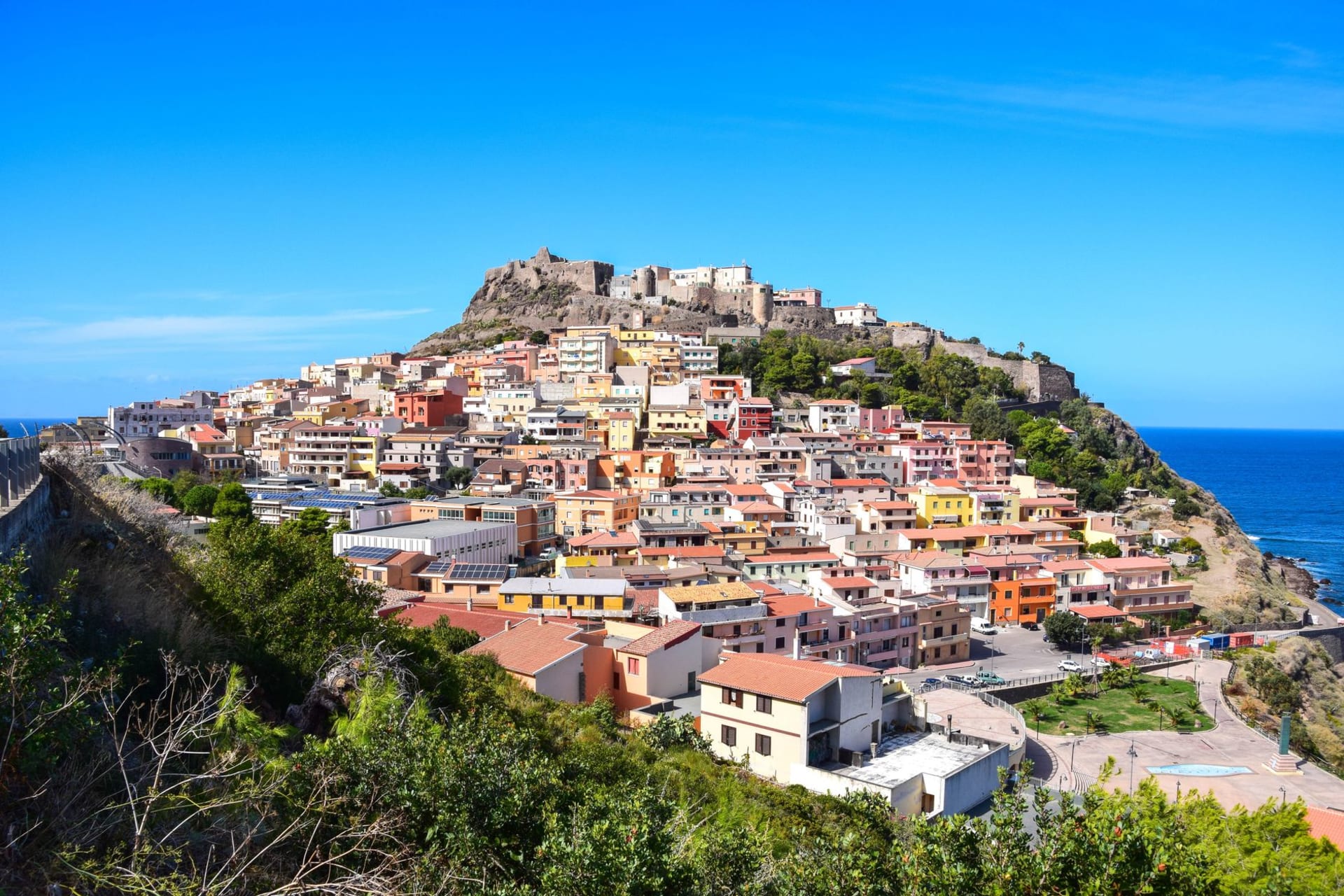
Most of Sardinia’s charming small towns come with a beach attached, which tends to dilute them into a kind of coastal genericness by August. Bosa doesn’t have that problem. It sits inland, tucked into a fold of the Planargia hills where the Temo river — the only navigable river on the island — makes its slow brown way toward the sea. The town climbs the opposite bank in layers of faded pink, yellow, and burnt orange, the colors of paint applied decades apart and never quite matched. Above everything, the Castello Malaspina squats on its basalt knob like something the Middle Ages left behind and couldn’t be bothered to reclaim.
Sa Costa and the Tanneries
The oldest neighborhood, Sa Costa, rises steeply from the river through a tangle of alleys barely wide enough for two people to pass without negotiation. At the water’s edge, a row of ancient concerie — tanneries — still faces the Temo, their wooden racks empty now but their stone walls stained dark with a century of use. A couple have been converted into small workshops where women still make the traditional lace that Bosa is known for, filet and aginetto patterns worked on small frames in doorways. I stood and watched for longer than was probably polite. The speed of it — fingers moving without apparent thought — was hypnotic.
Malvasia di Bosa
The wine is the reason I came and the reason I came back the next day. Malvasia di Bosa is produced in tiny quantities on the basalt hills around town from a grape variety that arrived here so long ago its origins are argued over. It’s amber-colored, dry, slightly oxidized, and tastes of almonds and salt and something I kept failing to identify. A local man at a bar near the castle told me it was the volcanic soil. I ordered a second glass to investigate. He ordered one too, and we discussed it with the seriousness the wine deserved. It pairs well with the bottarga from the Sinis peninsula nearby, which tastes of the sea in the same concentrated way the wine tastes of the land.
The Road to the Sea
Bosa Marina, four kilometers west, is where the Temo finally meets the ocean in a small resort town that’s pleasant without being remarkable. The drive getting there is the point: the SP49 coastal road between Bosa and Alghero runs for forty-six kilometers along cliffs above a sea that shifts from cobalt to green to pale turquoise depending on depth. There’s almost no development along it — just the road, the rock, and the water below. Lia and I drove it in late afternoon with the windows down. She slept for half of it. I pulled over twice to stand at the edge and look.
The Castle View
The walk up to Castello Malaspina earns its views the hard way — steep cobblestone, no shortcuts — but the 14th-century frescoes inside the small chapel at the summit are genuine and largely intact, which felt improbable for something this exposed and this old. The view from the walls takes in the river, the town, the coastal hills, and on clear days a sweep of sea that makes the climb feel less like exercise and more like a reasonable exchange.
When to go: April through early June for mild temperatures and flowers on the hillsides. Bosa’s Carnival in February is worth the cold — it’s one of Sardinia’s most theatrical, with the Giolzi mask tradition specific to the town. September is excellent: the malvasia harvest is underway, the crowd has thinned, and the light on those painted facades in the afternoon is extraordinary.