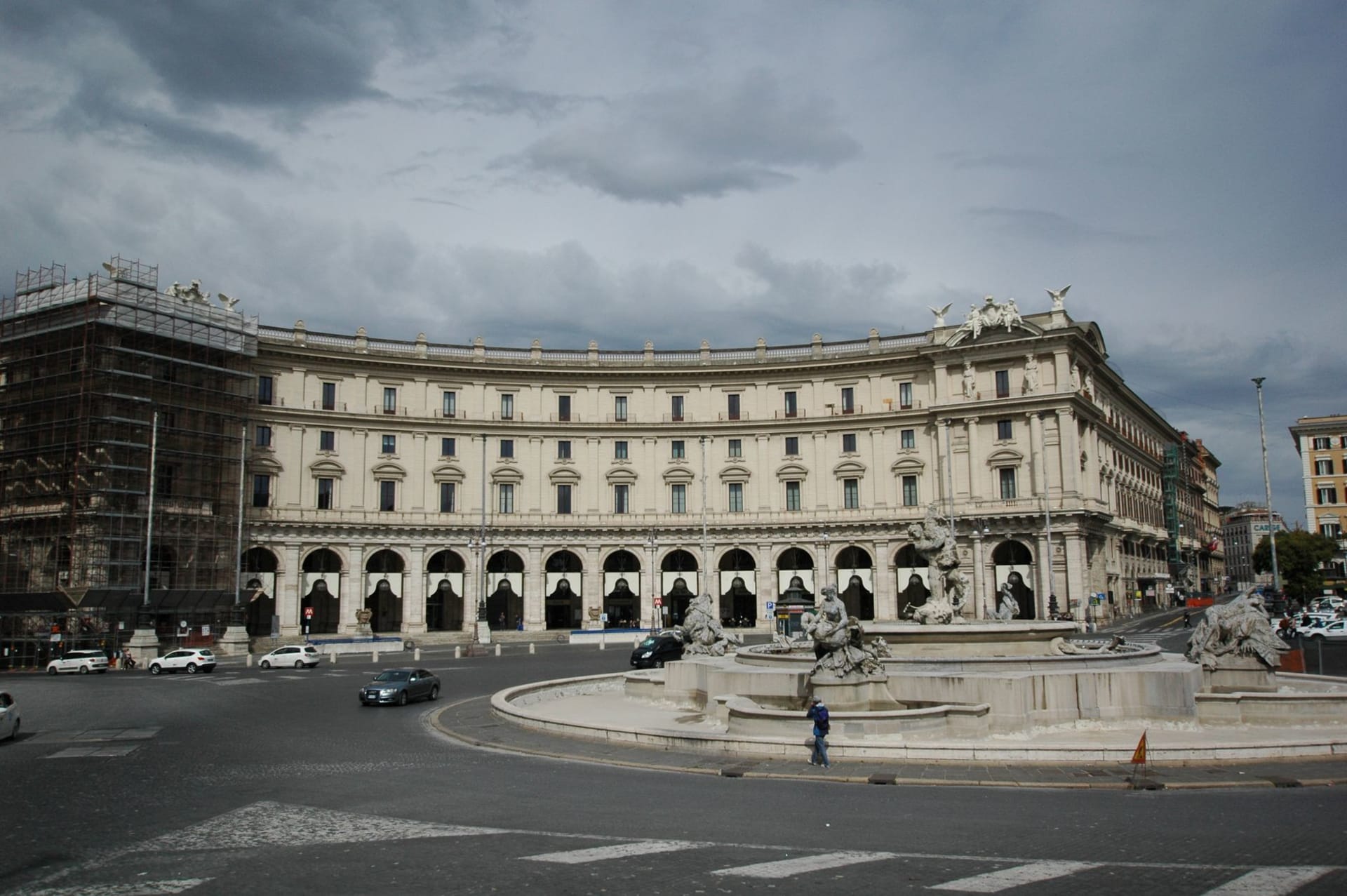
Piazza della Libertà
"The parliament of the world's oldest republic meets in a building that looks like it was designed to make you feel your own brevity."
There is a moment in every trip to a place you have over-researched when the thing you have looked at in photographs finally appears in three dimensions, and it either shrinks into ordinariness or exceeds itself. Piazza della Libertà exceeded itself. I came around a corner of the Contrada del Collegio, already slightly winded from the climb through the city gate, and the Palazzo Pubblico was simply there: Gothic, crenelated, built of white Istrian stone that catches the morning light with a particular clean intensity, its clock tower rising above the square in a way that manages to be both monumental and surprisingly human in scale.
The square itself is not large. Twenty seconds to walk its length, maybe thirty to cross it diagonally. But Piazza della Libertà operates on principles that have nothing to do with size: it is the functional and symbolic heart of a country that has been continuously self-governing since the fourth century, and the Palazzo Pubblico at its end is where the Grand and General Council — the parliament, seventy-five members, meeting six times a year — still convenes. The oldest parliament in the world, as the information panels repeat, apparently incapable of deciding whether to be amazed by their own claim.
The changing of the guard happens at the square’s entrance twice daily in summer, performed by the Guardia del Consiglio Principe e Sovrano in their nineteenth-century uniforms of green and red. I watched one ceremony in April when the schedule was reduced to once daily, at noon, and it was conducted with a formality that felt neither perfunctory nor theatrical but something in between — the practiced seriousness of people who know the ceremony is both tradition and performance and have decided to honor both aspects simultaneously. The small crowd that gathered to watch dispersed immediately after, revealing the square as it is for most of its day: a place where people stop, look at the palazzo, take photographs, and sit on the steps of the Liberty statue.
The statue itself — a marble figure representing Liberty, holding a sword and a scroll — stands at the center of the square on a low pedestal that visitors inevitably lean against while eating their gelato. It was installed in 1876 and has been doing civic duty in the square ever since, providing scale, providing symbolism, providing a convenient place to sit. I liked that. The monuments that get used as furniture have earned their spot in the city.
In the evening, after the tour groups had retreated to their buses, the piazza changed tone entirely. Local families came out, children ran around the statue, a couple sat on the palazzo steps eating piadina from paper wrappers. The floodlights came on and the stone of the palazzo went warm and amber. It is one of the better public spaces in Europe, not because it is grand but because it is genuinely used.
When to go: Early morning before ten for the cleanest light and the fewest people. The changing of the guard in summer runs twice daily and is worth timing around if you’re curious, though it takes only minutes. Evening from seven to nine in summer is when the square has the most authentic local energy.