Europe
San Marino
"A country the size of a neighborhood — and somehow more sovereign than most."
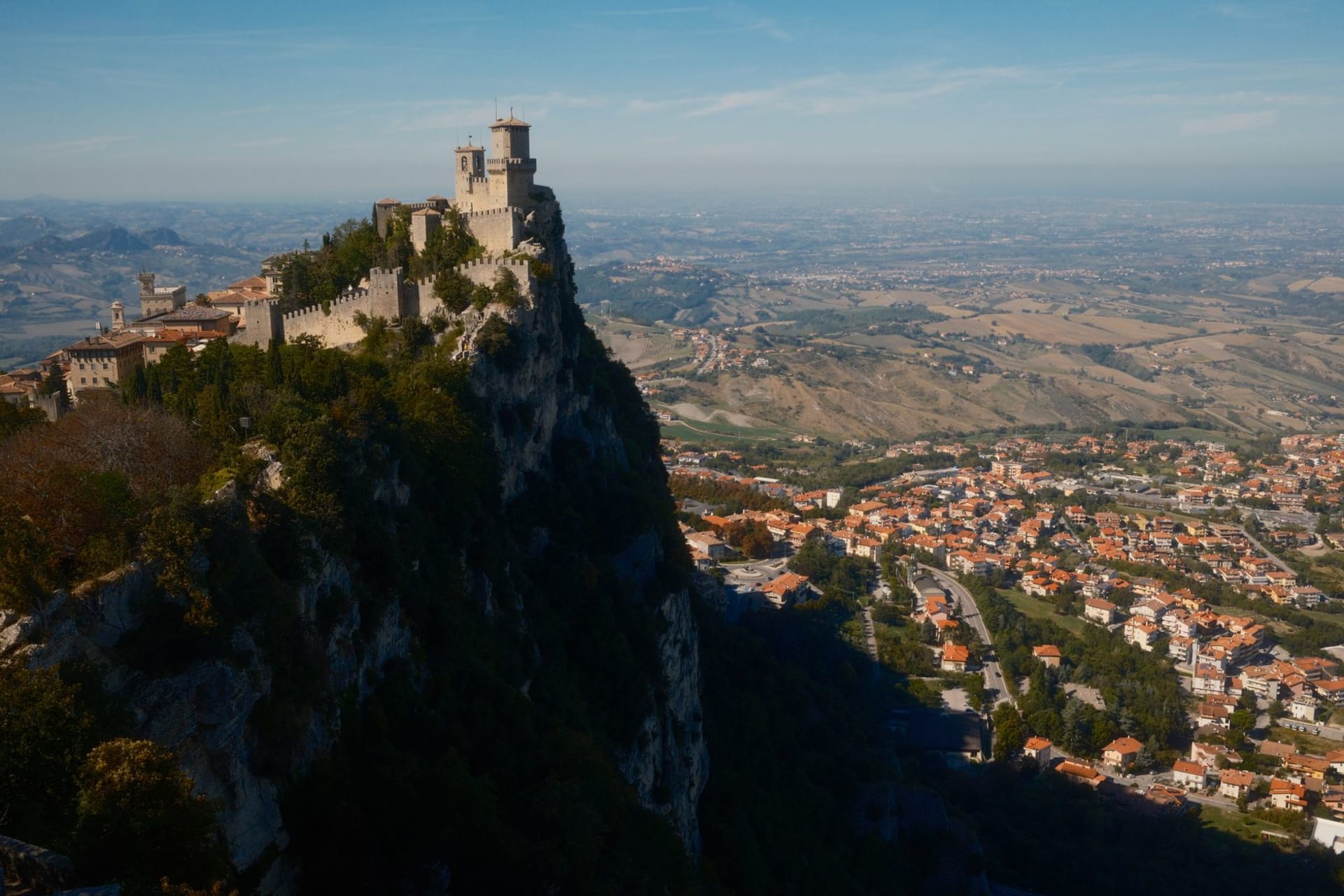
I arrived on a bus from Rimini that took forty minutes and deposited me at the bottom of a cable car. Within a hundred meters of stepping off, I had technically crossed an international border, passed through customs without being stopped by anyone, and entered a country smaller than some French communes. San Marino doesn’t announce itself the way other European microstates do. There’s no Monaco glitter, no Liechtenstein Alpine grandeur. It’s just a very old, very vertical town on top of a mountain, looking down at the Italian Adriatic coast like it has been doing since 301 AD.
The three towers — Guaita, Cesta, and Montale — are the thing everyone comes to see, and they don’t disappoint even for a traveler who has developed a healthy suspicion of medieval battlements. From the Cesta tower, the view stretches across the Romagna plain to the Adriatic, and on clear days you can supposedly count eight different countries. I believed it. What you can definitely see is how this ridge became a refuge — how a community of stonecutters and masons could look down at the chaos of the Italian peninsula for seventeen centuries and feel quietly smug about their choices. The oldest parliament in the world still meets here. There is something almost comical about that — a micronation the size of a mid-sized park, running its own army of less than a thousand, printing its own stamps, minting its own euro coins that collectors will trade handsomely for. I bought a set because I couldn’t help myself.
The historic center, a UNESCO site, is compact enough to walk in a morning, but don’t rush through it. The lanes between the towers hold a few genuinely good alimentari and enotecas where you can get a proper plate of piadina with squacquerone and eat it on a rampart watching the light go orange over the sea. The local aperitivo, Titano Mirtillo — a blueberry liqueur — is unabashedly tourist-oriented and thoroughly delicious. I drank two.
When to go: Late April through June, or September and October. Summer weekends are genuinely overcrowded — the tour buses from Rimini can stack up and turn the main street into a slow shuffle. On a Tuesday in May the place breathes, the light on the limestone is extraordinary, and you might have a tower to yourself for ten minutes.
What most guides get wrong: They treat San Marino as a half-day stop, a novelty between Rimini and Florence. That framing misses the point. This is a functioning country with its own history, its own legal system, its own complicated relationship to Italian identity — it has existed continuously since the fourth century, which is more than can be said for most of the empires that tried to absorb it. Come for a full day. Have lunch. Walk the full length of the walls at dusk. Let it be a place, not a checkbox.