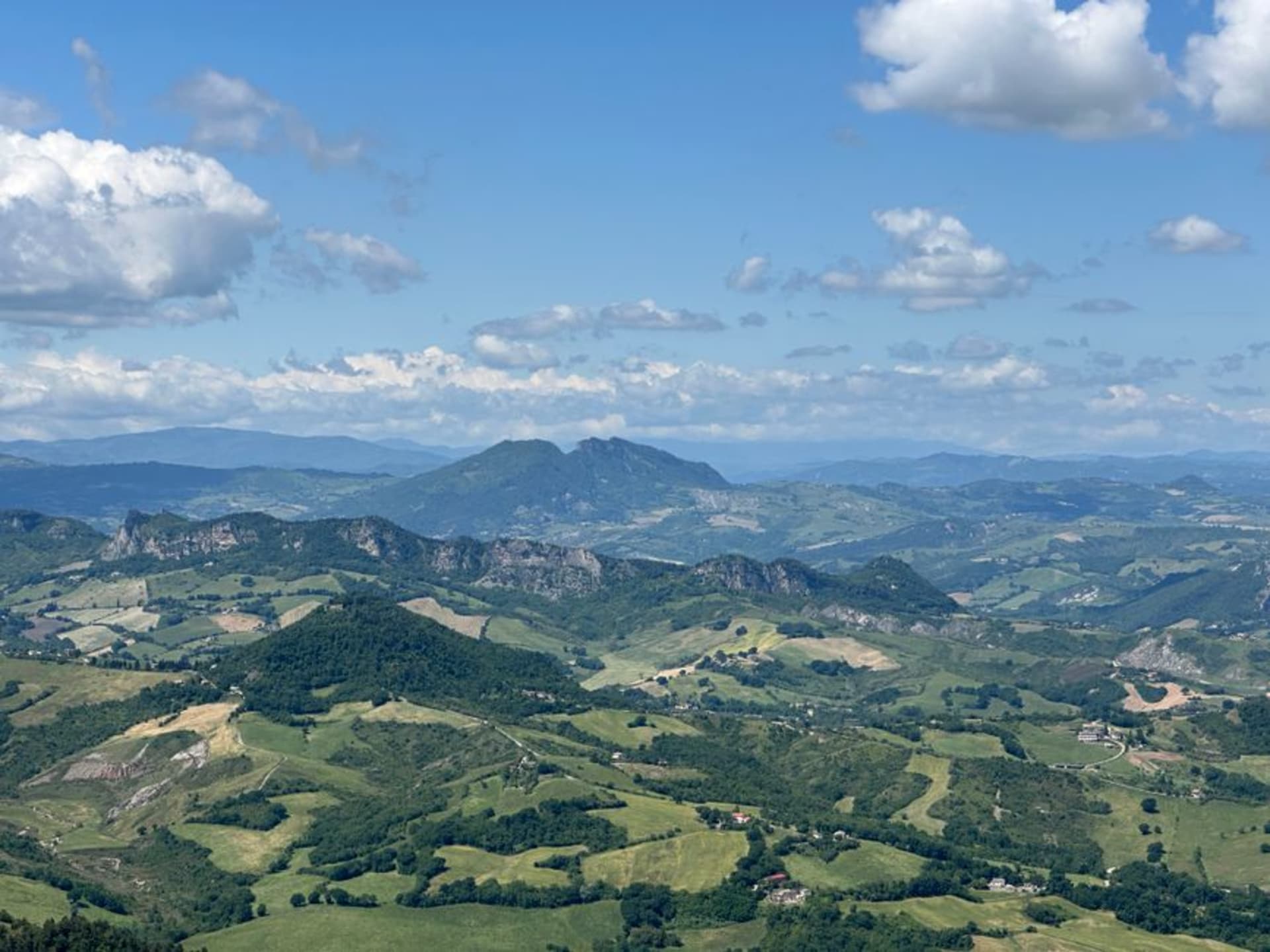
Pianello
"We got lost on a farm track outside Pianello, and neither of us minded, because getting lost there just meant more of the same green quiet."
A rural hamlet in the castello of Chiesanuova where rutted farm tracks and grazing sheep matter more than any monument.

I’m not sure Pianello has ever had a tourist ask for directions before us, and honestly that’s the whole appeal. It sits inside Chiesanuova, itself the least visited of San Marino’s nine castelli, up on the western side of the country where the land softens into rolling farmland instead of cliff. We went looking for a hiking trail we’d read about online, more out of curiosity than any real plan, and ended up spending an afternoon walking dirt tracks between fields with absolutely no schedule to keep.
The hamlet itself is barely a hamlet — a scatter of farmhouses, a small chapel, a few working farms with dogs that came out to bark at us and then, having made their point, wandered off entirely uninterested. What Pianello actually offers is the countryside around it: low stone walls, sheep grazing on slopes that catch the afternoon sun at an angle that makes everything look slightly gilded, hedgerows thick enough that you lose the road behind you within a few minutes of walking. Lia, who grew up partly in rural France, kept saying it reminded her of home, which I think surprised her more than it did me — San Marino gets filed away in most people’s heads as one tiny walled city, and nobody expects it to have a corner that feels like the French countryside.

We did, in fact, get lost — the trail markers around Pianello are inconsistent at best, sometimes a painted stripe on a fence post, sometimes nothing at all for half a kilometer — and ended up on a track that dead-ended at someone’s private orchard. An older man came out, more curious than annoyed, and once he understood we were just wandering rather than trespassing on purpose, walked us back to the right path himself, pointing out a spring where he said the water was better than anything from a bottle. We drank from it. It was, in fact, very good, cold enough to ache in your teeth, and I’ve thought about that small kindness more than I’ve thought about most of the towers up on Monte Titano.
There’s genuinely nothing to “see” in Pianello in the way a guidebook means the word — no monument, no view famous enough to have a name. What there is instead is a version of San Marino that never makes it into anyone’s itinerary: quiet, agricultural, a little scruffy at the edges, populated by people who’ve farmed this same stretch of hillside for generations and don’t much care whether anyone visits.

When to go: Weekday mornings in spring, when the fields are green, the tracks aren’t muddy, and you’re unlikely to meet another walker for hours.
Keep exploring
More from San Marino
 san-marino
Piazza della Libertà
The crenelated heart of the world's oldest republic — where the government still meets, the guard still changes, and the view still earns its postcard status.
Explore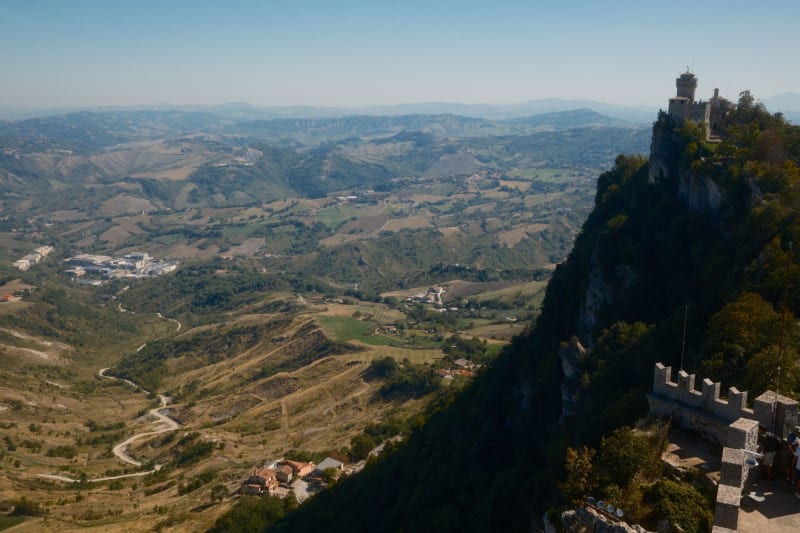 san-marino
Serravalle
San Marino's largest and most modern town — where the real population lives, shops, and quietly ignores the tourists on the ridge above.
Explore san-marino
Acquaviva
San Marino's smallest municipality by area — a hillside of olive groves and quiet lanes where the republic's agricultural roots are still visible.
Explore san-marino
Borgo Maggiore
The real gateway to San Marino — a Wednesday market town at the foot of the cliff that most visitors rush past on their way up.
Explore san-marino
La Cesta
The highest of San Marino's three towers holds a museum of ancient weapons and views that make everything else feel small.
Explore san-marino
Chiesanuova
The quietest of San Marino's nine castles, a green shoulder of hill in the southwest where the republic forgets to perform for tourists.
Explore