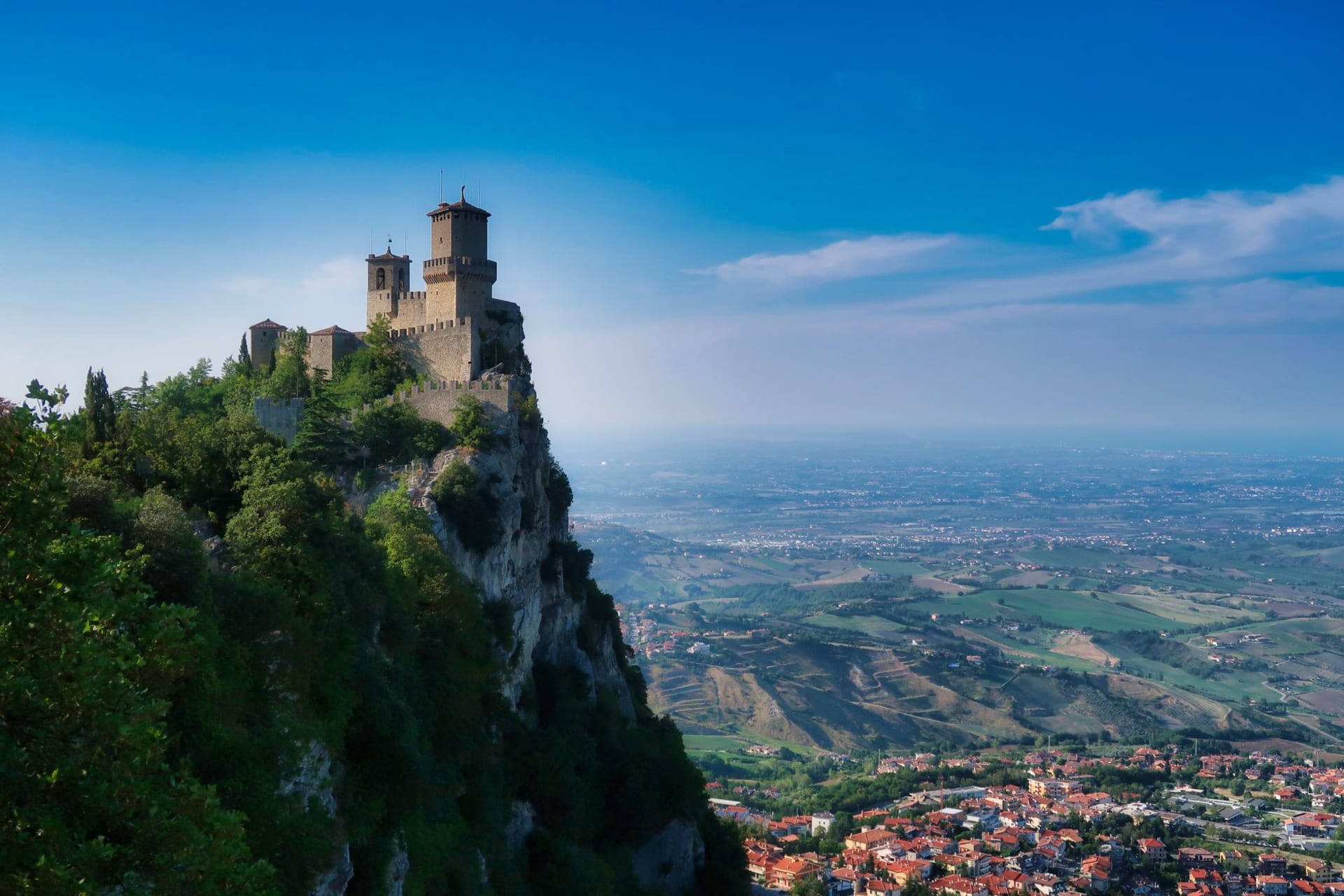
La Cesta
"The crossbow collection is excellent, but it's the wind that you remember — a cold, insistent push that reminds you exactly how high up you are."
La Cesta sits at the southern peak of Monte Titano, higher than Guaita and more remote, reached by following the wall path south past the second gate. The walk itself is half the point: a stone path that runs along the outer rampart with a drop on one side that encourages you to pay attention to your footing. I made it on a Tuesday in late April, when the hawthorn was in flower and the limestone smelled faintly of warm dust, and I had the path almost entirely to myself for the full fifteen minutes it took to reach the second tower.
From the outside, La Cesta is arguably the most dramatic of the three towers — twin turrets rising from a narrow cliff edge, the walls built directly on the living rock. You enter through a low arch and climb a steep spiral stair into the Museum of Ancient Arms and Armour, which is considerably better than its tourist-brochure reputation suggests. The collection occupies the tower’s several floors and includes crossbows, halberds, early firearms, suits of armour, and the kind of grimly practical tools that remind you medieval warfare was an intensely local, exhaustingly manual business.

The crossbow exhibits held me longest. San Marino has a living crossbow tradition — the Federazione Balestrieri still competes, and the annual crossbow tournament draws teams from across Italy. Looking at the medieval examples in the cases, the precision of their manufacture feels startling for the era: laminated bow arms, intricate trigger mechanisms, the whole thing built to a tolerance that suggests these were not improvised weapons but specialist tools made by dedicated craftsmen. Beside one fifteenth-century example the card noted it had belonged to a Sammarinese family for three generations. The thought of three generations of one family in this small republic, each passing down the same crossbow, made the place feel less like a museum and more like an interrupted domestic story.
The view from the top of La Cesta, in every direction, is the real payoff. To the east the Adriatic appears as a long silver line. To the north you can see Guaita and Montale arranged along the ridge. To the south and west the hills of the Montefeltro begin their fold into Umbria. The horizon is vast and the wind is cold even in spring — a steady pressure from the south that makes you lean slightly and grab the parapet and feel, briefly, the precariousness of standing at the highest point of a country barely larger than a town.

On the way back along the wall path I passed two Italian hikers who had apparently not realized there was a museum inside and were debating whether to turn back and pay admission. I told them the crossbow collection alone was worth it. They went. I continued to Montale, another twenty minutes south, following a ridge that felt increasingly quiet and increasingly old.
When to go: La Cesta is part of the combined tower ticket and worth making the walk for even if you skip the museum. Spring mornings before eleven offer the best conditions: low crowds, cool air, and the light coming from the east across the Adriatic. The museum itself is a good option in August when the midday heat makes outdoor wandering unpleasant.