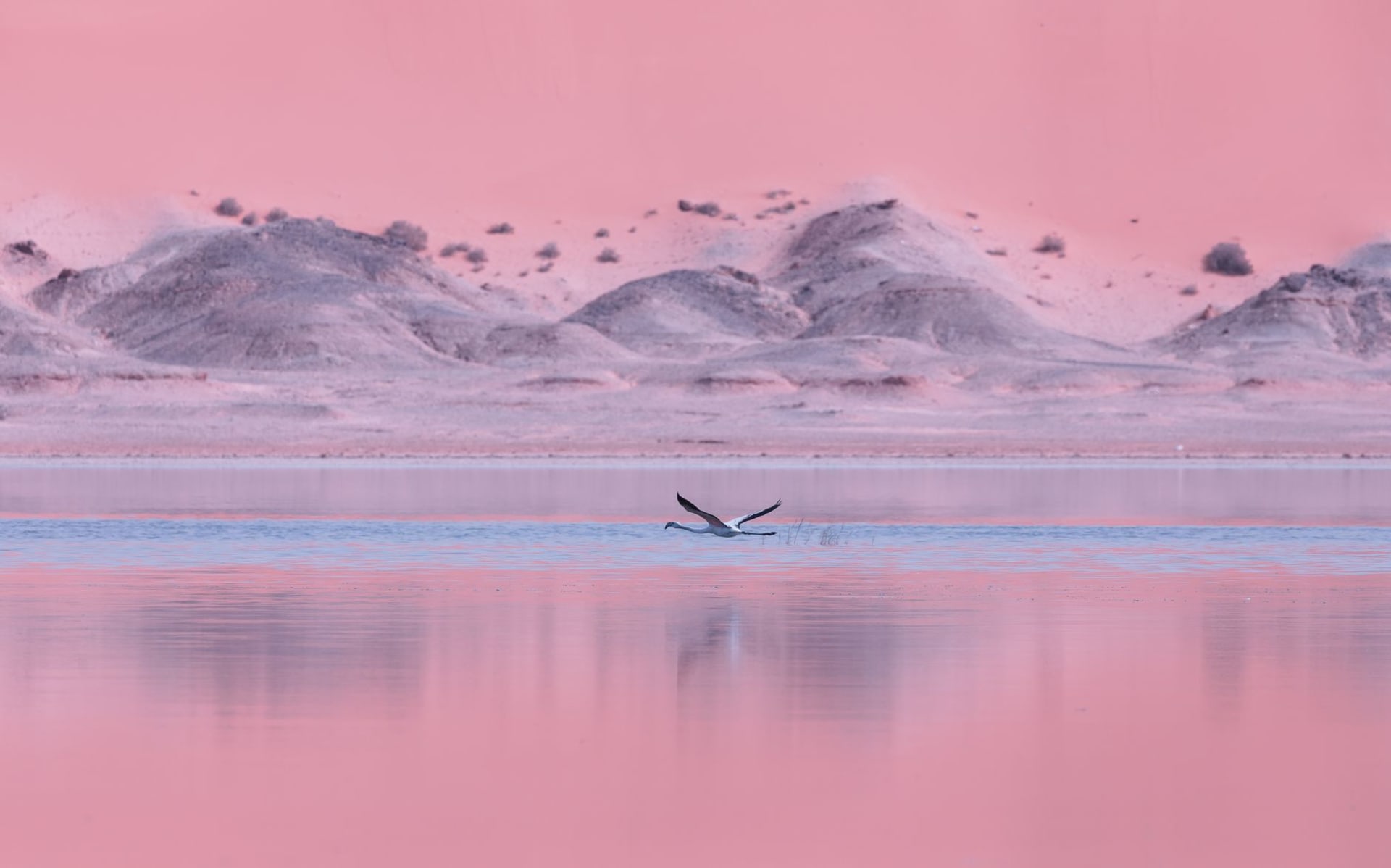
Chott el Jerid
"I kept stopping the car. Not to photograph — I just couldn't believe it was real."
There is a road that crosses Chott el Jerid, Tunisia’s great salt lake, and the experience of driving it at midday in winter is a specific and slightly hallucinatory thing. The causeway runs for 30 kilometers above a surface that is bone-white in some sections, pink in others, tinged green where biological crusts form in the shallow brine, and blue where it reflects the sky in the flooded margins. The mirages are not metaphorical: real columns of distorted air shimmer above the salt crust, bending the horizon into shapes that would be embarrassing to describe to someone who hadn’t seen them.
I stopped the car repeatedly. There was nothing to photograph that would explain the scale or the light quality. The lake covers 5,000 square kilometers, is rarely more than a meter deep, and receives so little rainfall that the salt concentration in the water approaches saturation. In summer it dries to a white crust that crunches underfoot and smells faintly of sulphur and mineral earth. In winter, shallow water spreads across it, and with the right morning light it becomes a mirror so perfect and so enormous that you lose the horizon line entirely — sky and ground become one continuous surface, and the causeway road appears to float in the middle of nothing.

The Star Wars connection is unavoidable and mostly beside the point. George Lucas filmed scenes for A New Hope nearby — the moisture farm set near Nefta is a pilgrimage site for certain visitors — but what makes the chott remarkable has nothing to do with science fiction and everything to do with the alien quality that was, presumably, why the location scouts chose it. The light here does things to color that normal environments don’t. The white salt intensifies the blue of the sky to an almost painful saturation, and at dawn or dusk the transitions between pink and orange and purple happen across such a wide expanse that they feel planetary rather than local.
The towns at either end of the crossing have their own character worth exploring. Tozeur to the west has an old medina built in distinctive yellow Jerid brick, laid in geometric patterns that create textured facades unlike anything else in Tunisia. The traditional irrigation system — seguias, or channels, dating back centuries — feeds the palm gardens, and walking through them in the afternoon is walking through a continuously engineered ecosystem. Kebili to the east is smaller and rougher, its market more agricultural and less tourist-oriented. I ate lunch there at a place with plastic chairs and a wood-burning stove: lamb and potato stew thick enough to stand a spoon in, served with flat bread and a small glass of harissa on the side. I ordered a second bowl.

Traditional salt-gathering used to be practiced here in large quantities; the seasonal hydrology that floods and dries the chott in cycles is a living system, and local guides can explain the mechanics and show the old extraction sites where the salt workers once cut into the white crust.
When to go: March to May, or October to November. The midday summer crossing is dramatic but severe — above 45°C with no shade and no exit for 30 kilometers. Winter floods increase the reflective effects dramatically. Sunrise crossings at any time of year require getting up in the dark, which is categorically worth it.