
Arborek
"The boy jumped off the dock and landed in the middle of six mantas. He did not even look down."
A matchbox island where women weave bark-fiber bags under the eaves and manta rays circle below the jetty every morning.

Arborek is a village on a sliver of land so small that if you took a running start from the school at one end, you could probably throw a coconut into the sea at the other. I arrived by wooden speedboat from Kri Island on a Thursday morning with two other travelers and no particular plan, and was immediately offered a guided tour by a twelve-year-old boy who announced his services from the jetty with the professional calm of someone who had been doing this for years. His name was Ahmad. The tour took fourteen minutes. Arborek is very small.
The island has been home to a settlement of the Arborek people for generations — fisher folk who built on stilts over the lagoon and developed a particular expertise in weaving traditional bags called noken, made from the bark fibers of a local tree. The women weave under the open-sided eaves of their houses, fingers moving with a speed and precision that looks effortless until you try the simplest pattern in a workshop and produce something that resembles a fishing net damaged in an accident. I bought a small bag from a woman named Mama Rosa, and the transaction involved a great deal of price negotiation, a cup of sweet tea, and resulted in both of us satisfied.

The real reason most boats stop at Arborek is the manta cleaning station. A ten-minute swim from the village jetty, there is a shallow patch of reef — about five to six meters deep — where manta rays come to have parasites cleaned from their gills and skin by small wrasses. We swam out in the early morning and were told to hang still at the surface, not to dive down, not to kick toward the mantas. Then the first one came — a large reef manta, wingspan perhaps three and a half meters, banking in slow circles over the reef while the wrasses worked at its gills. Then another. Then three at once, crossing each other’s paths in a kind of slow aerial ballet reduced to blue water. The mantas were utterly unbothered. We were, by every reasonable measure, extremely bothered.
The village runs its tourism with a genuine community structure. The park entrance fees collected here go directly to the village, the guides are all local, and the guesthouse beds — there are a handful, in family homes — are a functioning part of the local economy rather than an external enterprise. Ahmad, it turned out, was saving his guide fees for school supplies. He told me this without self-pity, just as a statement of how things were organized. He also charged me slightly more for the second manta swimming trip because I had asked too many questions on the first one. Fair.

The afternoon light on the island hits the stilted walkways at an angle that turns everything gold, and the children spend a significant portion of it either jumping from the highest points they can reach or fishing with lines so simple they seem to require no equipment at all — just a string, a hook, and the unending patience of people who have grown up on islands. I watched them for an hour and thought about how much of fishing is really just an excuse to look at water.
When to go: Manta rays are present at Arborek year-round, but sightings are more consistent from November through April when the plankton blooms that attract them peak. Arrive early — 7 to 8 a.m. at the cleaning station gives the best chance before the site gets crowded later in the morning. Overnight stays in village homestays are possible and give you the quieter hours before and after the day-trip boats arrive.
Keep exploring
More from Raja Ampat
 raja-ampat
Batanta
The forgotten fourth island — all waterfall hikes and bird calls and not a single dive boat competing for your attention.
Explore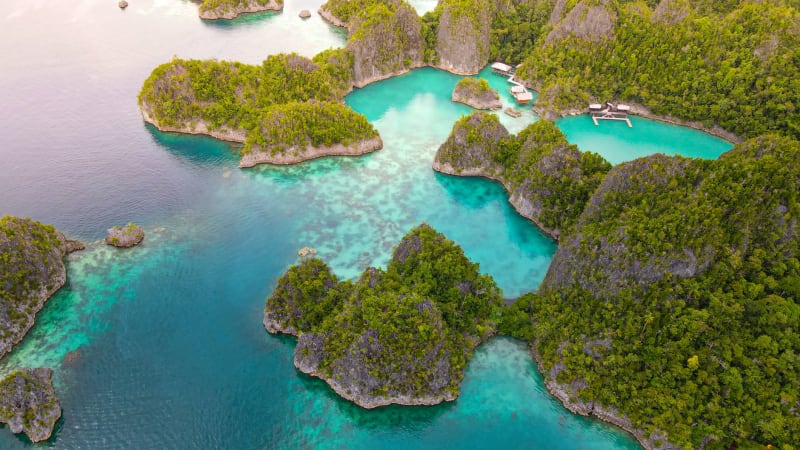 raja-ampat
Fam Islands
A forgotten string of islands north of Waigeo where the reefs have never learned to expect a diver and the sky at night earns its reputation.
Explore raja-ampat
Gam Island
One of Raja Ampat's largest islands, where you trek into the forest at dawn to find the red bird-of-paradise dancing in the canopy, then drift over reef the rest of the day.
Explore raja-ampat
Kri Island
The world record holder for fish diversity — 374 species counted on a single dive at the cape that started it all.
Explore raja-ampat
Mansuar Island
A small island of two villages, a jetty reef, and a jungle lake where ancient hands once painted the cliffs above the water.
Explore raja-ampat
Misool
The southern edge of the known world, where jellyfish drift through sunlit lakes and reef walls drop into absolute darkness.
Explore