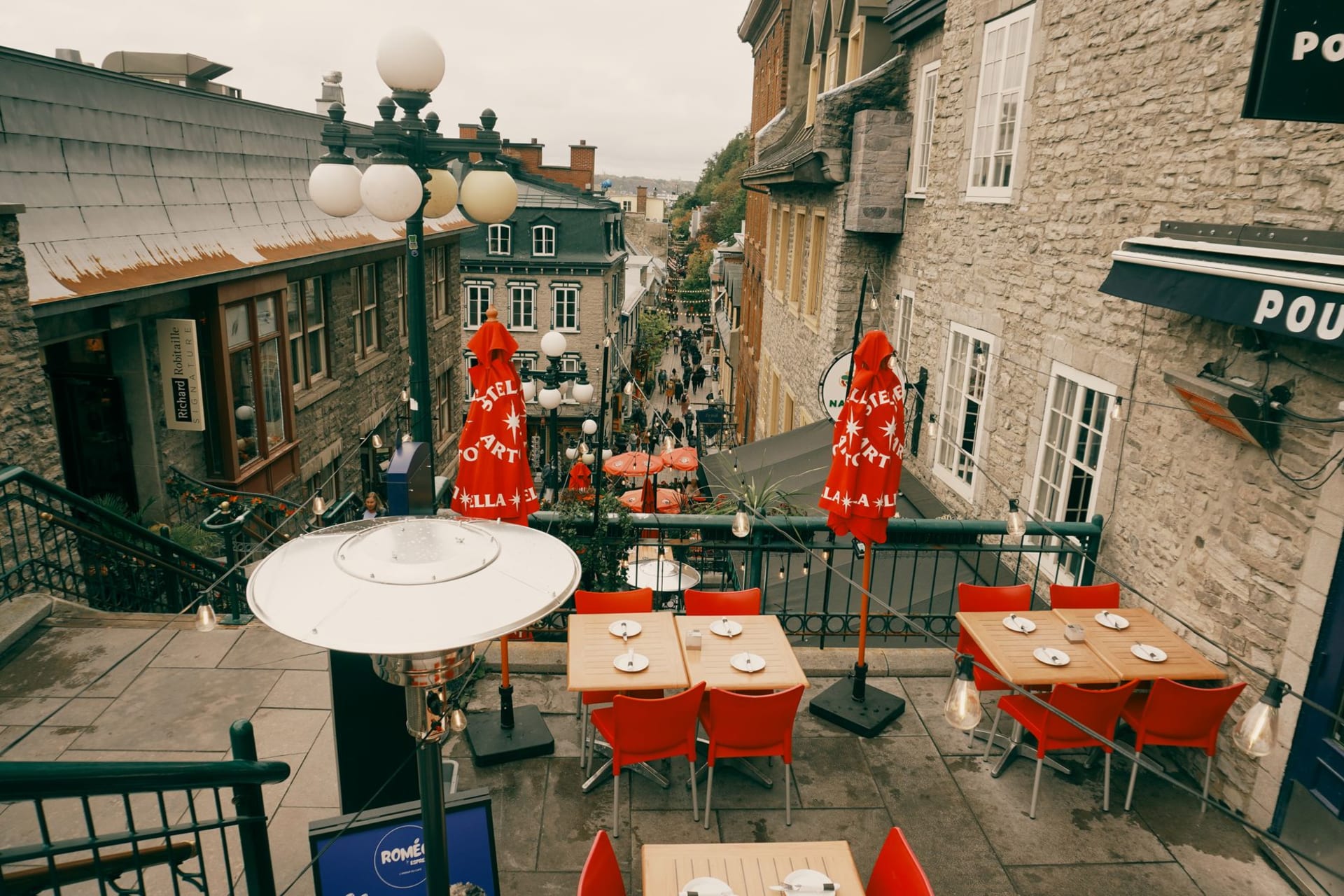
Place Royale
"Every stone here has been argued over in French — and that, somehow, is the point."
I found Place Royale on my second morning in Quebec City, following the staircase down from Haute-Ville into Basse-Ville just as the light started doing something extraordinary to the stone. The square sits at the foot of the cliff — a tight arrangement of 17th-century buildings around a bronze bust of Louis XIV, the oldest commercial district in New France. Standing there at eight in the morning before the tourists arrived, I could almost believe four centuries had compressed into overnight. The air carried the St. Lawrence with it: cold, mineral, slightly industrial, the smell of a working river rather than a scenic one.

The Fresque des Québécois mural on a building at the corner of the square stopped me for a long time — a trompe-l’oeil painting of Quebec City residents across four centuries, stacked in imaginary windows and doorways, life-sized and oddly moving. There is something tender about a city that celebrates itself this way, painting its past onto its present without apology. Inside the Église Notre-Dame-des-Victoires, the small stone church that anchors the square, the interior was quiet enough that I could hear the candles. The ceiling painting — primitive, devout, utterly sincere — looked like something a child with real feeling had painted, which is not an insult.
The neighbourhood around Place Royale, Petit-Champlain, is the famous one: the narrow street with its boutiques and sugar shacks and restaurants with low doorways. Guides call it the oldest commercial street in North America, and perhaps that is true, though the boutique situation reminded me more of somewhere in Alsace than anywhere genuinely ancient. But there is a restaurant — L’Échaudé, on Rue Sault-au-Matelot, a couple of blocks from the square — where I ate a tourtière at lunch that made me understand why Québécois cooking needs no apology. Dense, deeply spiced, served with ketchup aux fruits maison, it was the kind of food that makes you suspicious of complexity.

At night, Place Royale empties out between the dinner rush and becomes something else entirely. I sat on the steps near the church for an hour listening to the river and watching the lights of Haute-Ville blink on above the cliff. There is a reason this city was founded here — the defensibility, the river crossing, the natural harbour — and standing below the cliff at dusk, I felt that reason somewhere specific in my chest.
When to go: May through October for walking weather and outdoor events. The Fêtes de la Nouvelle-France in August transforms Place Royale into a living tableau of 17th-century New France, with actors in period costume and music everywhere. In winter the square quiets dramatically and becomes genuinely haunting — worth it if you’re already there for the Quebec Winter Carnival.