Péribonka
"Péribonka is the village that gave Quebec its founding story of staying — and staying, when you see the land, starts to make a certain sense."
The riverside village that inspired Quebec's founding literary myth of survival on the land — now a quiet stretch of farmland, museum, and one of the great wild blueberry regions in North America.
I hadn’t read Maria Chapdelaine before arriving in Péribonka, which the woman at the museum front desk seemed to find mildly scandalous, in the gentle way Quebecers express scandal. The novel — written by Louis Hémon, a Frenchman who spent a single winter here as a farmhand in 1912 before dying in a train accident the following year, never seeing his book published — became one of the foundational texts of Quebec identity: a story about a young woman choosing to stay on the hard agricultural frontier rather than leave for the city or for New England, and about the land itself as a kind of covenant. Péribonka, where Hémon actually lived and worked, has leaned into that legacy fully, with a museum built on the farm where he boarded, log buildings preserved from the period, and a reconstructed sense of exactly how remote this stretch of the Lac-Saint-Jean frontier still was a century ago.
The village sits where the Péribonka River meets the northeast corner of the lake, and the museum grounds run right down to the water — the same water Hémon would have looked at while writing, the same fields still under cultivation on the surrounding farms. Walking the grounds in early evening, with hayfields catching the last light and the river moving quietly past, I understood the appeal of the novel’s central choice in a way that reading it afterward only confirmed: this is unglamorous, difficult, genuinely beautiful land, and staying on it is not an irrational decision.
Beyond the literary pilgrimage, Péribonka and the surrounding parish are wild blueberry country in the most literal sense — the sandy, acidic soil left behind by the glacial lake that once covered this entire basin is close to ideal for the plant, and the fields around the village turn a deep, dusty blue by late July. I stopped at a roadside stand run by a farming family who let me pick a small basket myself before selling me a much larger one they’d already harvested, on the reasonable theory that I’d be slower and less thorough than they were. They weren’t wrong.
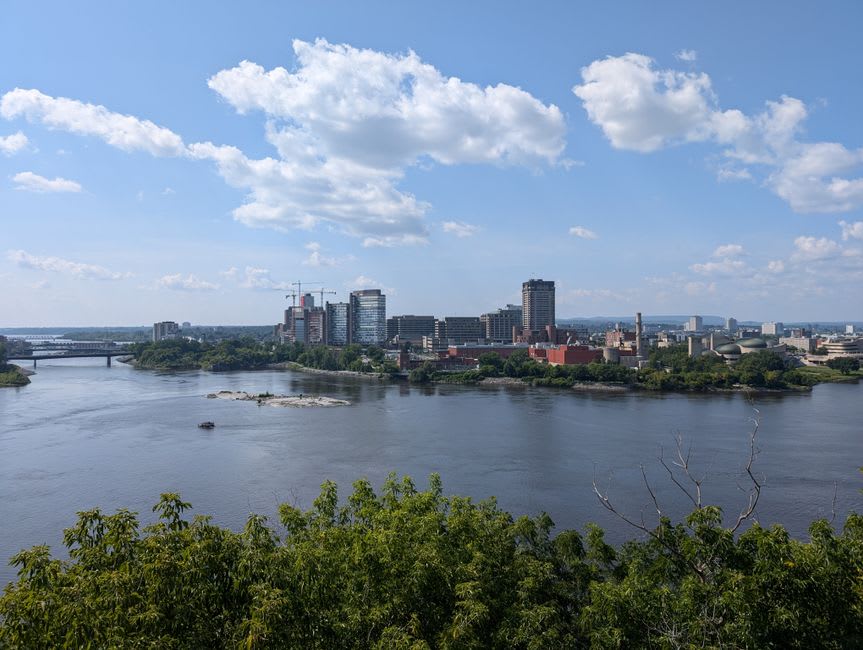
The river itself, a major tributary feeding Lac-Saint-Jean from the north, offers quiet canoeing and a scenic drive upstream toward the Réserve faunique des Laurentides, but most people come to Péribonka for the same reason Hémon’s readers have for over a century — to see, in person, the specific stretch of land that convinced a whole province of its own story.
When to go: Late July through August for peak wild blueberry season and the warmest weather for canoeing the river. The Musée Louis-Hémon is open May through October.