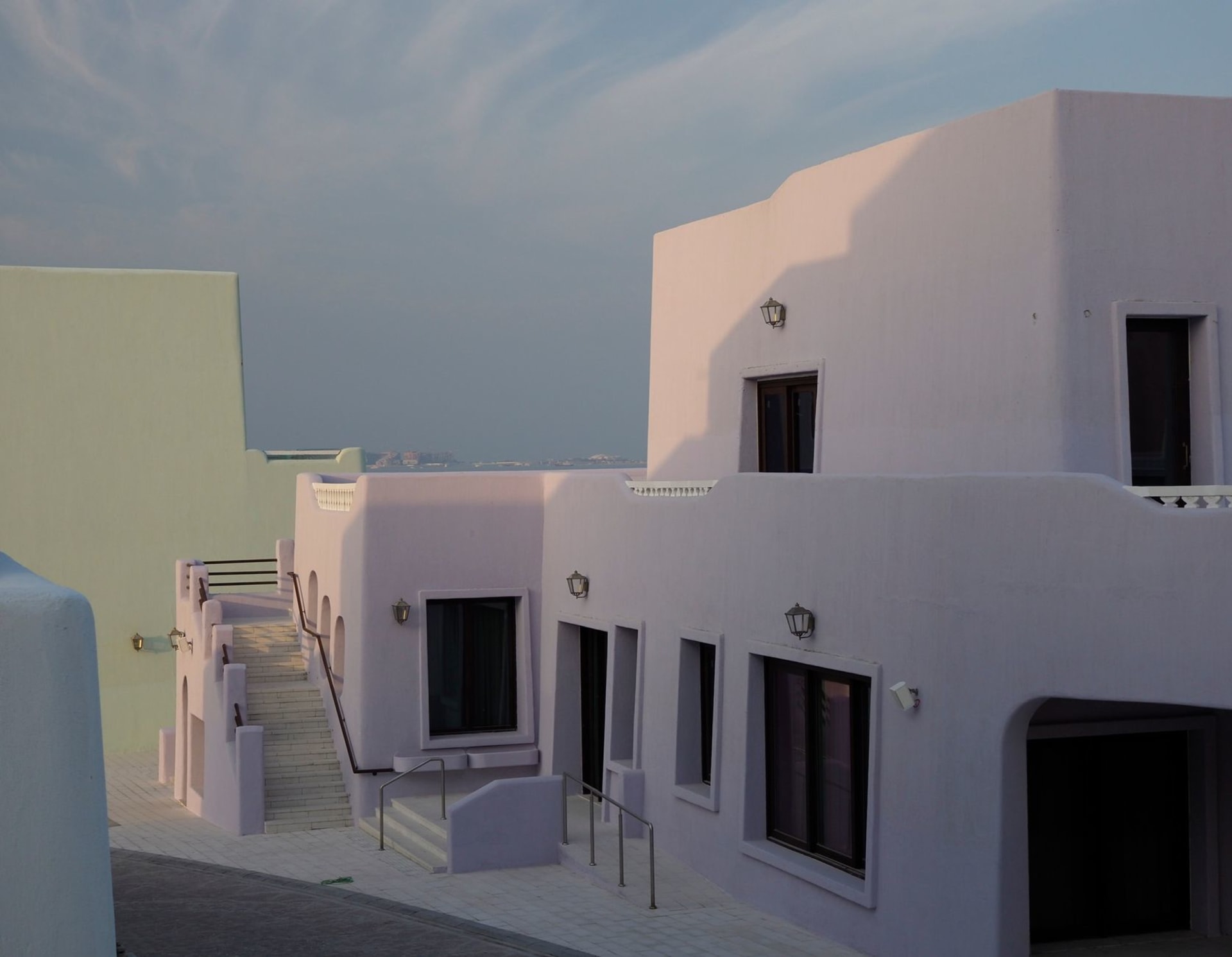
Al Wakrah
"Al Wakrah is what Doha might have looked like if someone had pressed pause fifty years ago and just left things alone."
I drove south from Doha on a Friday afternoon, the highway unusually light of traffic, and turned off toward the coast at Al Wakrah before I had really planned to. I had seen it on the map and noted it as a possible detour, and the afternoon light was doing something with the clouds over the Gulf that made me want to be near water. What I found was a town that had somehow retained enough of its pre-oil character to feel genuinely different from the capital — smaller, slower, built at a scale where you could walk its length in twenty minutes and not feel like you had walked through a planning document.
The old souq by the harbor is compact and low, with arched doorways and rough plaster walls that have been restored without being sanitized. A few of the stalls were open: a man selling dried fish, a woman with trays of gold jewelry under glass, a spice merchant who gave me a small sachet of dried lemon and waved off my attempt to pay. The wind-tower houses along the seafront — their badgir towers designed to catch the prevailing breeze and funnel it down into the rooms below — are some of the best-preserved examples of traditional Gulf domestic architecture still standing in Qatar. The towers are square and slatted, and in the afternoon sun they throw a pattern of shadow across the courtyard walls that changes minute by minute.

The harbor was quiet, a handful of wooden dhows moored alongside a newer concrete quay, their hulls painted in the pale blues and greens that fishermen across the Arabian Gulf seem to have settled on as the correct color for a working boat. An older man was mending a net on the dock with a focus that made it clear he was not performing the activity for anyone’s benefit. I sat nearby on a low wall and watched the Gulf for a while. The water here is shallow and intensely turquoise in good light, the kind of color that makes you wonder if it can really be a sea.
I ate a late lunch at a small restaurant that appeared to have no signage in any alphabet I could read, where a laminated menu with photographs led me to a fish biryani that was served in a pot big enough for three people. The rice had absorbed the spices deeply — saffron and cardamom and something else I couldn’t name, the fish falling apart, the whole thing fragrant with rose water. A ceiling fan turned overhead. Someone’s radio played a song I couldn’t identify. The restaurant was half full, all men, all eating with the absorbed silence that good food tends to produce.

Al Wakrah has a newer development zone — the Al Wakrah Mall, wider roads, the residential sprawl that comes with every Qatari town’s expansion — but the old waterfront has been insulated from the worst of it. The town has a FIFA Women’s World Cup stadium now, Khalifa International, a few kilometers inland, which brings occasional visitors who would otherwise never pass through. Most of them don’t stop. Their loss.
When to go: November through March, when the seafront air is genuinely pleasant. Friday afternoons have a relaxed quality as families come out after midday prayers. The fish restaurant strip is best at lunch. Combine with a drive along the southern coastal road toward Mesaieed for a full afternoon out of the city.