
Marvão
"Marvão sits so high above everything that I stopped checking my phone for a signal and just started looking at Spain instead."
A walled village balanced on a granite crag in the Alentejo, so high and so close to the border that on a clear day you can watch Spain from the ramparts.
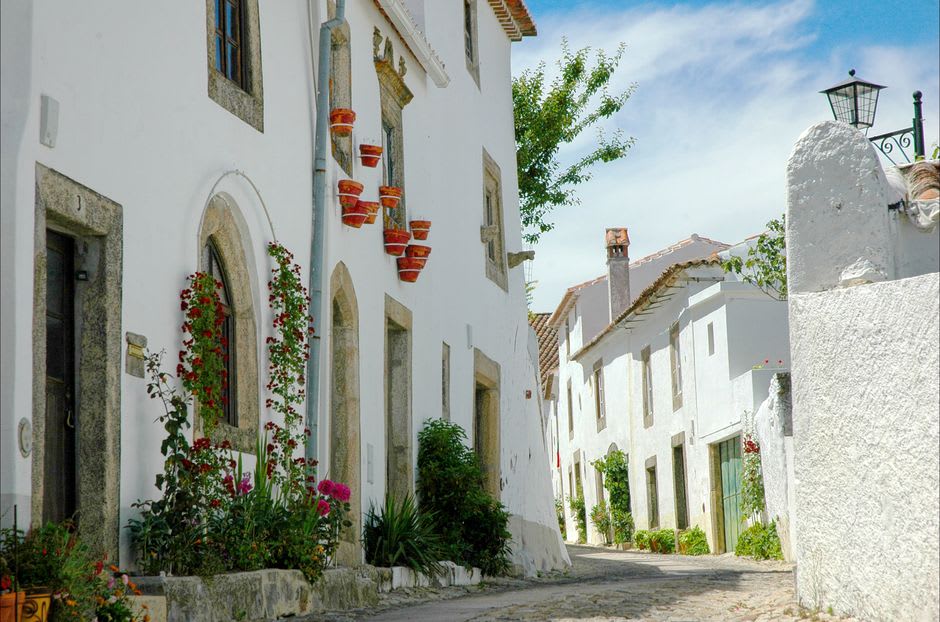
The road up to Marvão switches back so many times that I lost count somewhere around the eighth turn, climbing through cork oak forest until the village suddenly appeared above me, wedged onto its outcrop of granite like it had grown there rather than been built. At over eight hundred meters, this is one of the highest points in Portugal’s interior, and the effect on arrival is almost vertiginous — narrow cobbled streets barely wide enough for a car, whitewashed houses with wrought-iron balconies, and at nearly every gap between buildings, a sudden view falling away hundreds of meters to the Alentejo plain below. I parked outside the walls, because driving inside them felt like a genuinely bad idea, and walked in through one of the medieval gates into a village so quiet at midday that my footsteps echoed.
Standing on the Edge of Two Countries
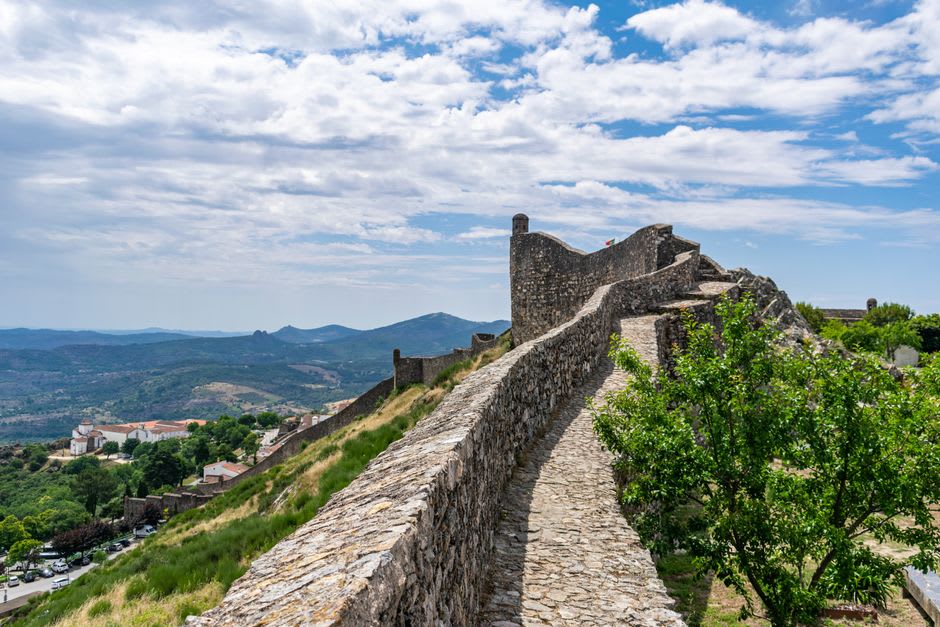
I climbed up to the castle that crowns the village, a Moorish-founded fortress rebuilt and expanded over centuries specifically because whoever held Marvão could see an enormous stretch of the frontier in every direction — this stretch of the Alentejo has always been contested ground between Portugal and Spain, and the castle’s whole reason for existing is that visibility. Standing on the ramparts, the wind strong enough to make my jacket snap, I could see clear across the plains into Spain, the Serra de São Mamede rolling away in one direction and, in the other, nothing but flat gold country all the way to the horizon. An old local man sunning himself on the wall told me you can sometimes see storms forming over Spain a full day before they reach Marvão, which felt like the kind of thing only someone who’d lived their whole life at this altitude would know to watch for.
A Village That Empties at Night
What struck me most was how few people actually live in Marvão now — barely a few hundred, in a village built to hold many times that, and by early evening the streets belonged almost entirely to cats and a handful of remaining residents sitting in doorways. I ate dinner at a small tasca serving migas, that Alentejo bread dish soaked in pork fat and garlic, alongside a black pork chop from the local acorn-fed pigs, and the owner told me the village had been slowly emptying since the 1960s as young people left for the coast or for France. It gave the whole place a strange, beautiful melancholy — a fortress this well preserved, holding onto so little of what it was built to protect.
When to go: Late September or October, when the Alentejo heat has broken and the visibility across the plains toward Spain is at its sharpest — summer haze can blur the view that makes this place worth the climb.