
The westernmost tip of Europe, where waterfalls drop straight into the Atlantic and hydrangea hedges turn every road into a blue-and-green corridor.
The plane to Flores is small enough that you feel every gust off the Atlantic, and for a few minutes before landing you get the money shot for free: a wall of green cliffs streaked with white, waterfalls running down volcanic rock like the island is leaking. I’d read the name meant “flowers” and assumed some marketing embellishment, the way every place claims to be paradise. It isn’t an embellishment. By the second day of driving the single ring road, I stopped being able to tell where one hydrangea hedge ended and the next began — blue, violet, sometimes a washed-out pink, mile after mile of it lining fields that drop straight to black cliffs and grey ocean. There’s a specific quiet here, the westernmost inhabited point in Europe, where mobile signal drops out in the valleys and nobody seems bothered.
Two Lakes in One Crater
The thing everyone comes for, rightly, is Lagoa Funda and Lagoa Comprida, twin crater lakes sitting in the same collapsed volcano, separated by a thin ridge you can walk in about ten minutes. I got there early enough that mist was still sitting on the water, and the miradouro above gives you both lakes at once — one round, one long and narrow, both a green so deep it looks painted on. I sat on a rock wall eating a pastel I’d bought in Santa Cruz that morning, watching a local farmer move a handful of cows along the crater rim like this was the most ordinary commute in the world, which for him it was.

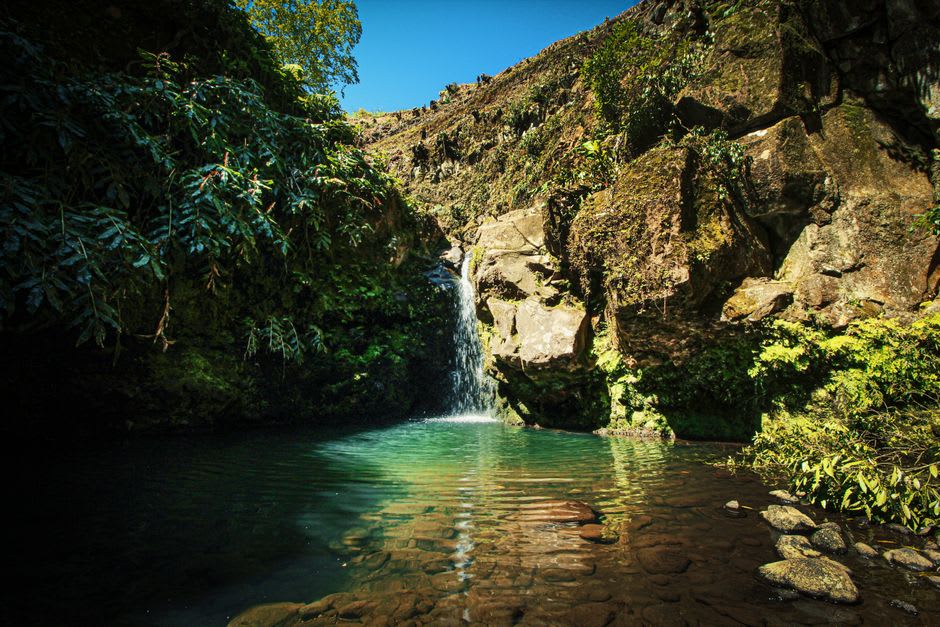
The waterfalls deserve their own paragraph, because Flores has an absurd density of them for an island this size — Poço do Bacalhau, Ribeira Grande, dozens more unnamed on maps that just show as blue lines dropping off cliffs. At Poço do Bacalhau I swam in a pool fed by a waterfall thin enough to look decorative from a distance and cold enough up close to knock the breath out of me. An old islander fishing nearby laughed at my reaction and told me, in the particular Azorean Portuguese that swallows half its consonants, that his grandkids swim there every summer without flinching. I believed him and felt appropriately soft.
What stays with me isn’t any single viewpoint but the rhythm of the place — narrow roads, stone walls, cows, hydrangeas, then suddenly a cliff and the entire Atlantic. Flores doesn’t have Madeira’s polish or São Miguel’s infrastructure. It has almost nothing, actually, beyond a few guesthouses and honesty-box farm stalls, and that emptiness is the whole point.
When to go: June through August, when the hydrangeas are in full, absurd bloom and the crater lakes are least likely to be wrapped in fog — outside that window the island retreats into cloud and rain for weeks at a time.