Nafplio
"Nafplio is what happens when four civilizations build on top of each other and somehow get the proportions right."
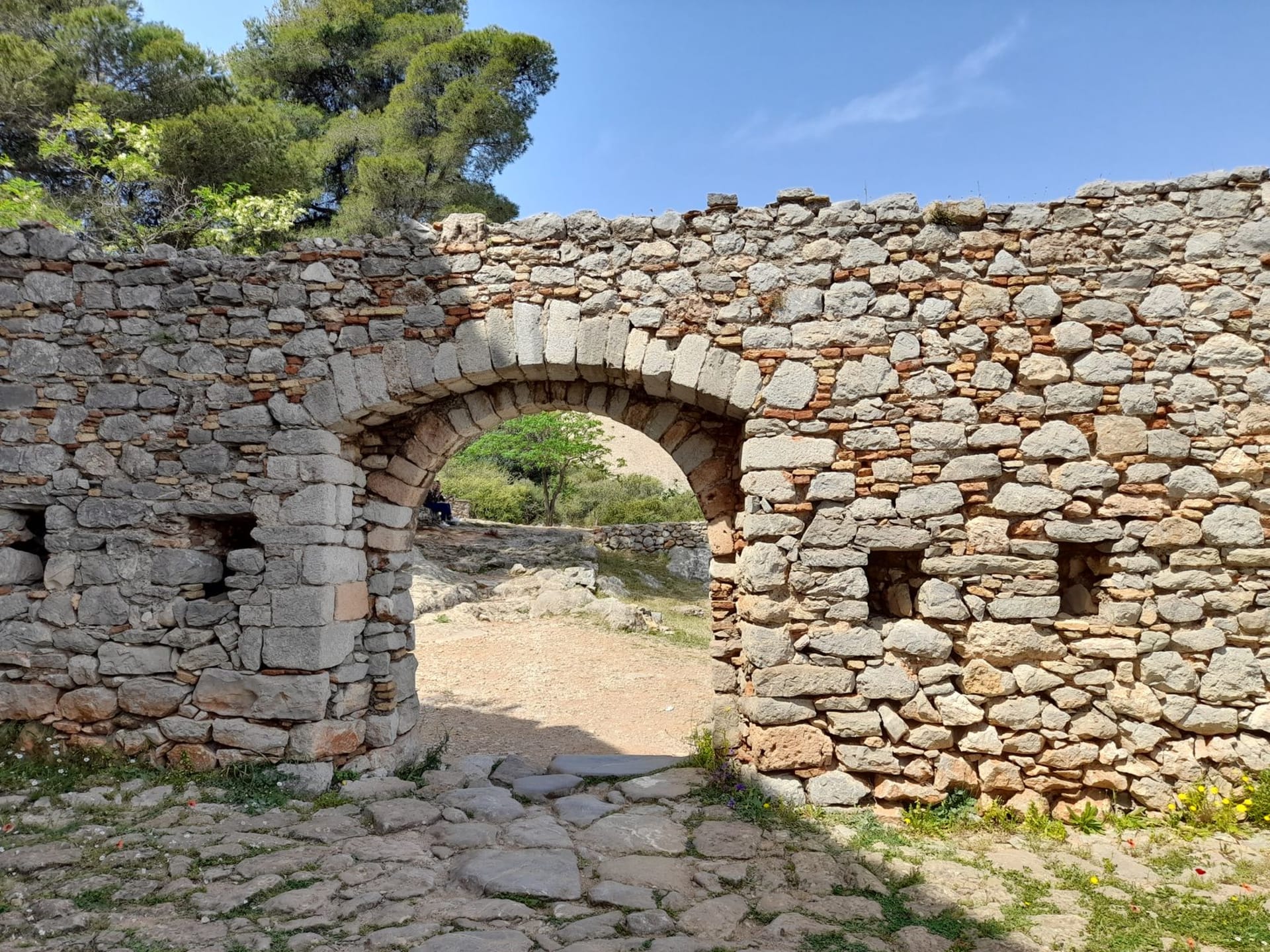
I arrived on the overnight bus from Athens at half past five in the morning, stepping into a town that smelled of salt and jasmine and diesel from a fishing boat heading out of the harbor. The light was pale, pre-dawn, the kind of blue-grey that makes stone buildings look like they belong to a dream. I sat on a bench near the waterfront with a coffee I’d found at a bakery already open for the fishermen, and I watched the Acronauplia fortress materialize slowly above the old town as the sky brightened — its Venetian walls turning first amber, then terracotta, then a deep burnished orange. Nothing moved but a cat working its way along the seawall.
Nafplio was Greece’s first capital after independence, and the town carries that civic dignity without making a performance of it. The old town unfolds in a compact grid of Venetian mansions and neoclassical facades, their painted shutters bleached by decades of Aegean sun to shades of sage and pistachio. The alleyways are narrow enough that laundry strung between buildings overhead makes you feel you’re walking through a tunnel of domestic life. On one corner I found an Ottoman fountain — marble, still functioning, still cold — tucked between a taverna and a phone shop as though its six hundred years of standing there required no explanation.

The Bourtzi sits in the middle of the harbor on a small island — a Venetian fortress that once protected the town and now floats there looking decorative, its silhouette part of every photograph taken from the waterfront. I preferred looking at it from shore, usually from a table at one of the waterfront cafes where the menu listed loukoumades alongside Nescafé frappé. I ate the honey-drenched fried dough balls at eight in the morning and felt no shame. The food in Nafplio rewards a slow approach. The morning market on Staikopoulou Street sells things I wanted to carry home: small jars of thyme honey from the hills above Argos, dried figs in their own syrup, and amygdalota — the almond paste sweets specific to this part of the Argolid, subtly scented with rose water, sold in paper bags by a woman who seemed to regard any purchase under half a kilo as a personal affront.
For dinner I found a fish taverna on the harbor where the grilled bream came to the table with nothing but olive oil, lemon, and oregano, and the owner — an elderly man with hands like a craftsman’s — brought a carafe of rough local white wine without being asked. That wine had a mineral sharpness that went exactly with the fish and probably would not have survived being bottled.

Above the old town, Palamidi fortress crowns the ridge and requires 999 steps to reach — a fact locals mention with a particular satisfaction. I went up before the heat, my thighs complaining by step four hundred, and found at the top a view that took in the entire Argolic Gulf in one sweep: the water bright and still, the opposite shore a soft smudge of purple hills, the town below small and precise as a model. I understood why the Venetians and the Turks and the Greeks all fought over this place. The harbor command alone was worth building a fortress for.
When to go: Nafplio is excellent almost year-round. May and October are ideal — warm enough to sit outside in the evenings, cool enough to climb Palamidi without suffering. July and August bring more visitors and heat but the town is compact enough to absorb them gracefully. The Easter celebrations here, with candlelight processions through the old town, are among the most moving in the Peloponnese.