Monemvasia
"Monemvasia looks impossible until you see it, and then it just looks inevitable."
The first view of Monemvasia from the causeway road stops you. The rock — a monolithic chunk of limestone roughly two kilometres long and three hundred metres high, attached to the mainland by a narrow causeway — simply should not have a medieval city on it. But it does: the lower town clings to the water-level shelf at the rock’s southern face, invisible from the mainland, its rooftops invisible until you’re almost through the single gate that gives the town its name. Monemvasia means “single entrance.” The Byzantines called it the Gibraltar of the East. I called it the most extraordinary piece of urban geography I had ever seen in person, which is saying something after two weeks on the Peloponnese.
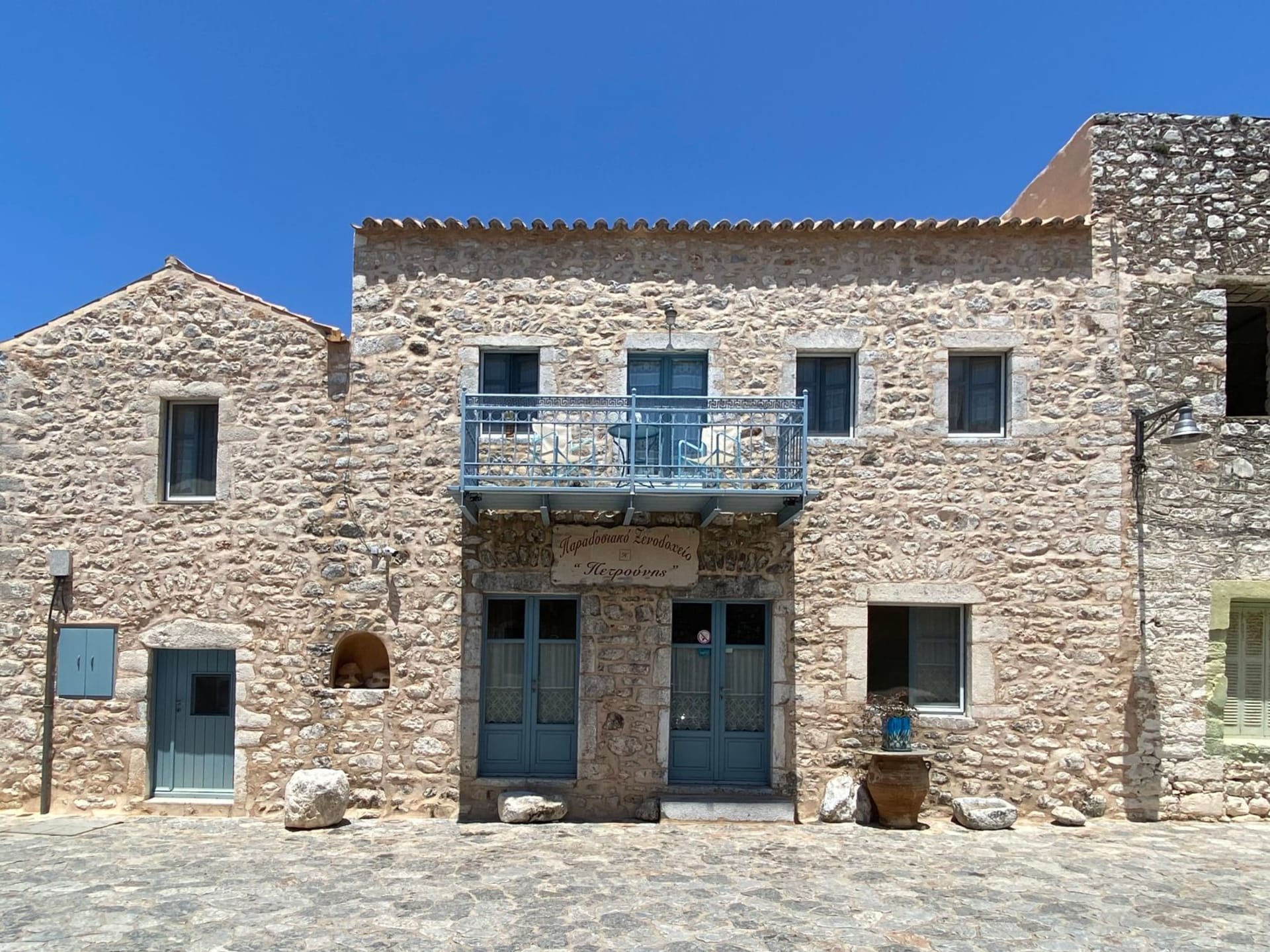
You leave your car in the parking area outside the causeway gate — no vehicles enter — and walk through a tunnel in the wall that is barely wide enough for two people to pass. Then you are inside, and the logic of the exterior dissolves entirely. The main street runs along the base of the rock, lined with Byzantine churches, Venetian mansions converted to guesthouses, and small shops selling the malmsey wine that Monemvasia exported across medieval Europe under the name Malvasia. The street is cobbled and narrow and completely silent by nine in the morning after the day-trippers from Sparta and Athens haven’t yet arrived.

The Church of Christos Elkomenos — Christ in Chains — is the largest in the lower town, its interior holding a carved iconostasis of considerable beauty and, behind it, an icon said to have been painted by Luke the Evangelist. I’m not qualified to confirm that provenance, but I spent twenty minutes in front of it anyway. The church was cool and dark and smelled of beeswax candles and old stone. An elderly woman in black was praying in one of the side chapels. I sat in a wooden pew and tried to understand what it meant for a community to have been attending this church continuously since the Byzantine period.
The upper city — the acropolis of the rock itself — is reached by a steep path that most visitors skip, and most visitors are wrong. The ruins up there are extensive: the remains of palaces and barracks and a great Church of Agia Sofia, its dome still partially intact, perched at the cliff edge with a view that takes in the Laconian coast for fifty kilometres in both directions. I sat on the cliff wall with my feet dangling above a two-hundred-metre drop to the sea and ate a piece of loukoumi — the rose-flavored Turkish delight that’s been made in Monemvasia for centuries — that I’d bought in the lower town. The wind was fierce. The sea below was dark blue and absolutely calm in the shelter of the rock’s shadow.

Staying overnight transforms the experience. By seven in the evening, the day visitors have gone back to their cars and the town contracts to its actual permanent population — a few dozen people, mostly elderly — and a handful of guests in the converted mansions. The restaurants along the main street serve local catch: sea bream, red mullet, octopus in wine. The light on the sea goes orange, then rose, then grey. The town is lit by small lamps set into the walls and the effect is somewhere between theatrical and ancient. I sat outside my room with a glass of the local red until eleven, and the only sounds were the water and a cat that seemed to own the street.
When to go: May and June before the summer crowds peak, or September and October after they fade. Monemvasia in August is crowded and the accommodation — there isn’t much of it — books out months in advance at high season prices. A midweek visit in shoulder season is ideal. Easter is spectacular: the Good Friday epitaphios procession through the lower town by candlelight is one of the most beautiful things in the Peloponnese.