Castleton
"The mountain is still moving. Slowly, imperceptibly, but moving — and the village doesn't seem to mind."
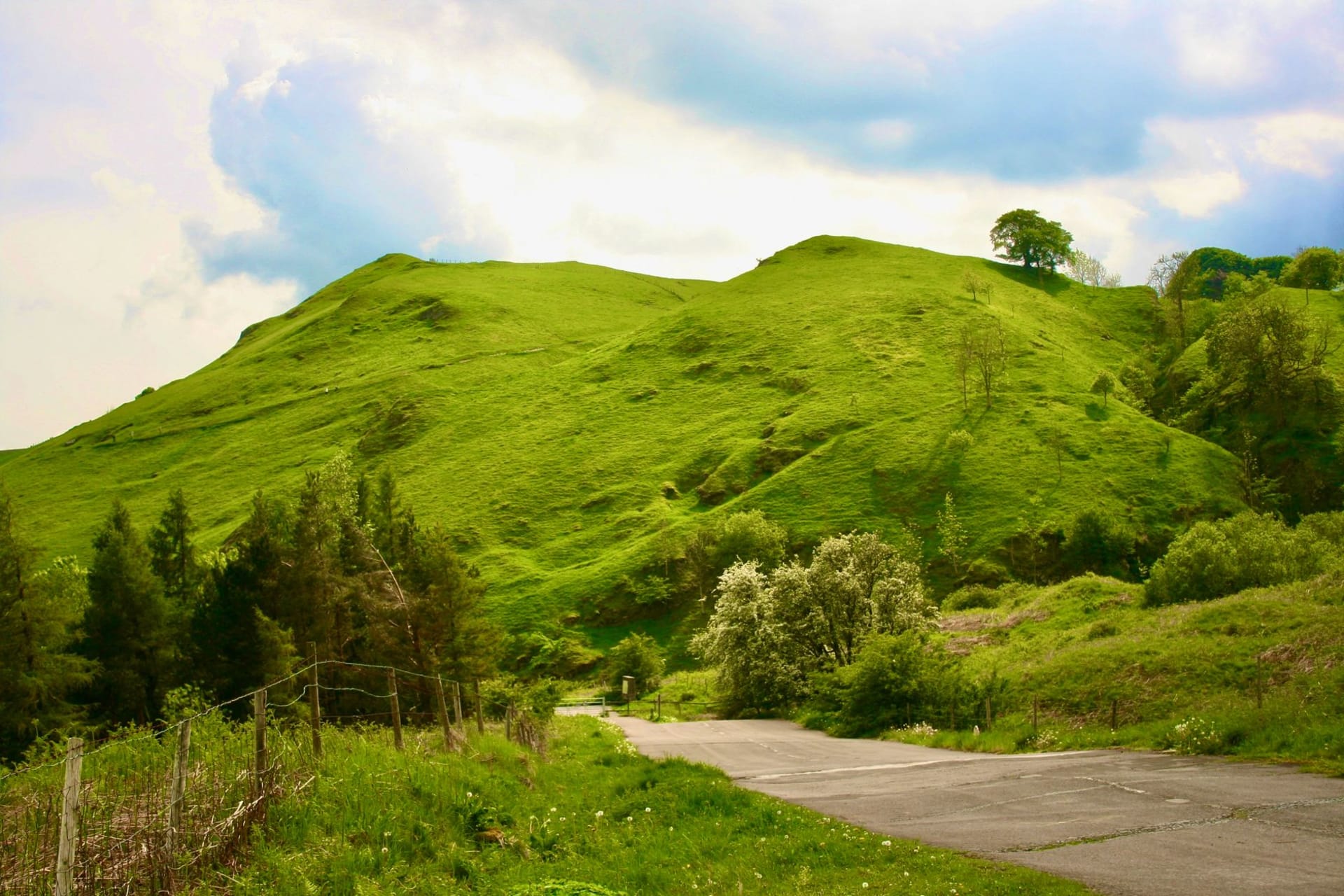
Mam Tor earned its nickname the “Shivering Mountain” honestly. The eastern face of this 517-metre peak is made of shale and gritstone alternating in layers, and the shale is unstable, which means the entire face has been slowly slumping for thousands of years — slipping in landslides that happen over human timescales, leaving a stepped and fractured hillside that looks, from Castleton below, like a mountain in the act of thinking about collapse. The road that used to run under this face was closed permanently in 1979 after decades of losing its battle with the geology. I climbed to the ridge on a cold morning in November and stood on the Iron Age hillfort that crowns the summit — earthworks that are over two thousand years old and still sharply defined in the short turf — and watched cloud shadow move across the Hope Valley below with the speed of something alive.
Castleton village sits at the foot of Mam Tor in a natural hollow between the hills, and it manages the unusual feat of being genuinely charming without being genteel. The houses are Peak District vernacular: gritstone-dark, solid, low-windowed against the weather. The main street has a cheese shop, a pub older than the idea of tourism, and a Norman castle ruin on a mound that looks directly down on everything as if reminding the village who was here first. Peveril Castle was built by William the Conqueror’s illegitimate son and now mostly exists as a shell of walls on a limestone crag, but the views from the keep — Hope Valley east, the Great Ridge west, the village rooftops below — justify the climb.

But Castleton’s underworld is its real distinction. Four show caves open to visitors within a kilometre of the village, each a different character. Peak Cavern, known until recently as the Devil’s Arse for reasons the briefest visit makes apparent, has the largest cave entrance in England — a vast natural amphitheatre where ropemakers lived and worked until the nineteenth century, their cottages still visible inside the cave mouth. Blue John Cavern and Treak Cliff Cavern are the source of Blue John stone, a semi-precious purple and yellow fluorspar found only in this hillside, which has been carved into jewellery and vases since Roman times. The gem shops in the village sell it in every form: pendants, earrings, paperweights, decorative eggs. I bought a small pendant that cost less than a sandwich and has the strange visual quality of something that shouldn’t exist — those twisting veins of colour, violet and ochre and cream, in a stone the size of a thumbnail.
Inside Treak Cliff, a guide led a small group of us through passages that dripped steadily and smelled of cold limestone — a clean mineral smell, nothing organic, like the inside of a quarry but gentler. The stalactites are lit dramatically by the tour company’s lighting and some formations have names — the Witch, the Dome of St Paul’s — that strain credulity. But the geology is genuinely astonishing. Layers of coral reef from 330 million years ago, when this hillside was a tropical seabed. The concept takes a moment to land when you are standing in Derbyshire in a dripping cave in November.

The village fills on weekends and bank holidays, when parking becomes a negotiation and the main street loses its quiet. Midweek is the right time, when the caves still run tours but the village returns to something like daily life. The Cheshire Cheese pub serves a pint and a pie that have been fuelling walkers coming off Mam Tor for generations. Stay in the village if you can — the morning light on the ridge is something you earn by being there already, not by arriving after breakfast.
When to go: May and September hit the balance of warm enough and uncrowded enough. The caves are year-round and honestly better in winter when the contrast between the cold outside and the constant cave temperature (around 7°C) becomes irrelevant. Autumn brings the best light on the ridge. Avoid August and any bank holiday unless human density doesn’t bother you.