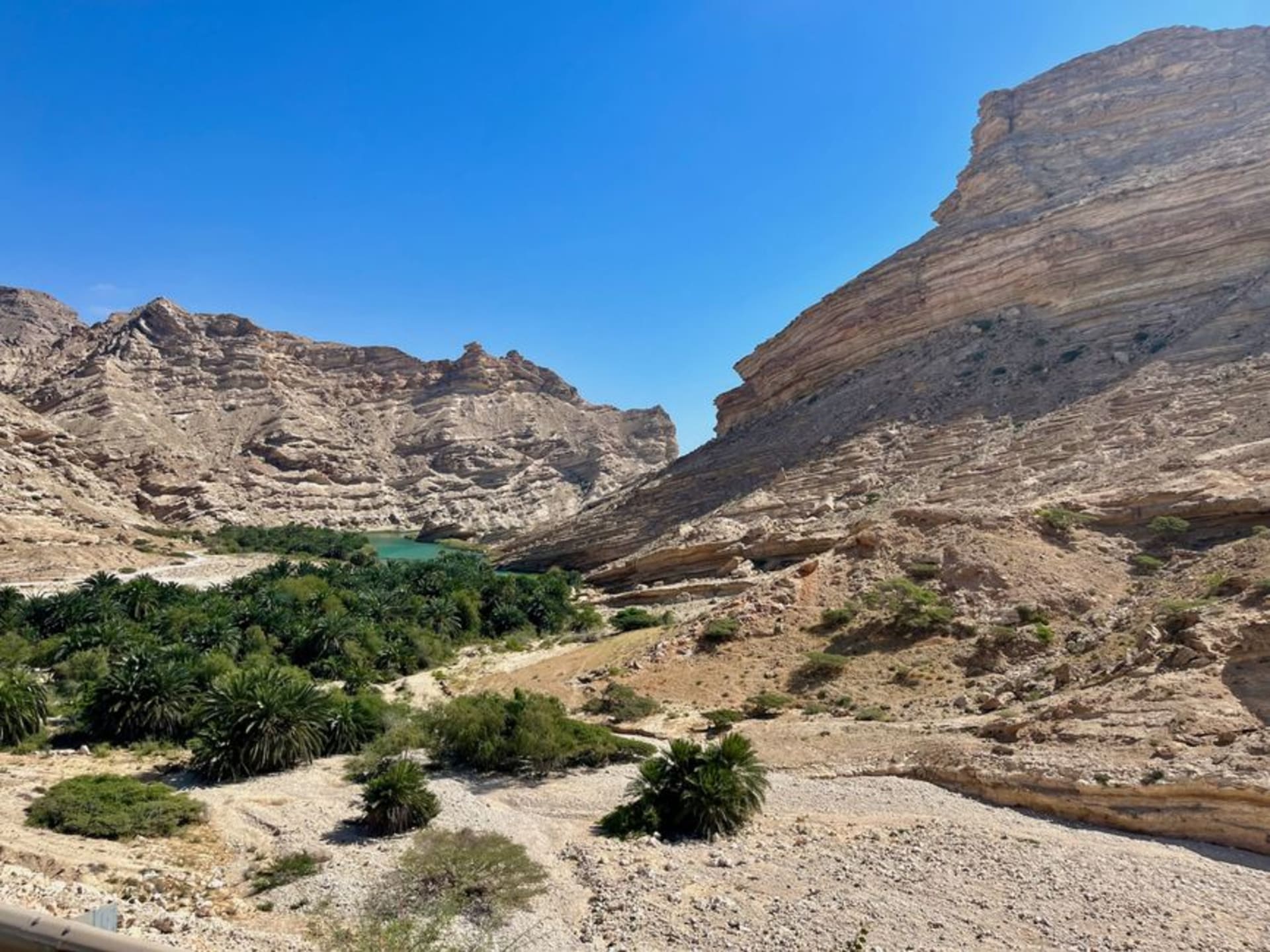
A near-secret spring-fed canyon behind Al Hamra's mudbrick houses, reached through date plantations most visitors to the region never notice.
Al Hamra gets written up for one thing: its mudbrick houses, some of them three centuries old, still standing along narrow lanes below the Hajar Mountains. Lia and I spent a morning there doing exactly what the guidebooks suggest — wandering the old quarter, admiring the wind-tower architecture, buying dates from a shop that looked older than the concept of retail. It was the guesthouse owner who mentioned, almost as an afterthought while pouring our afternoon coffee, that there was a wadi behind the plantations worth the walk.
Through the Plantations
Wadi Hoqain starts not as a canyon but as a working landscape — falaj-irrigated date and mango plantations laid out in shaded rows behind Al Hamra’s old town, the kind of green that seems impossible against the bare mountains rising just beyond. We followed a dirt path between stone walls, past a farmer redirecting water along a channel with nothing more than a flat rock and a practiced hand, until the plantations gave way to bare rock and the wadi proper began.
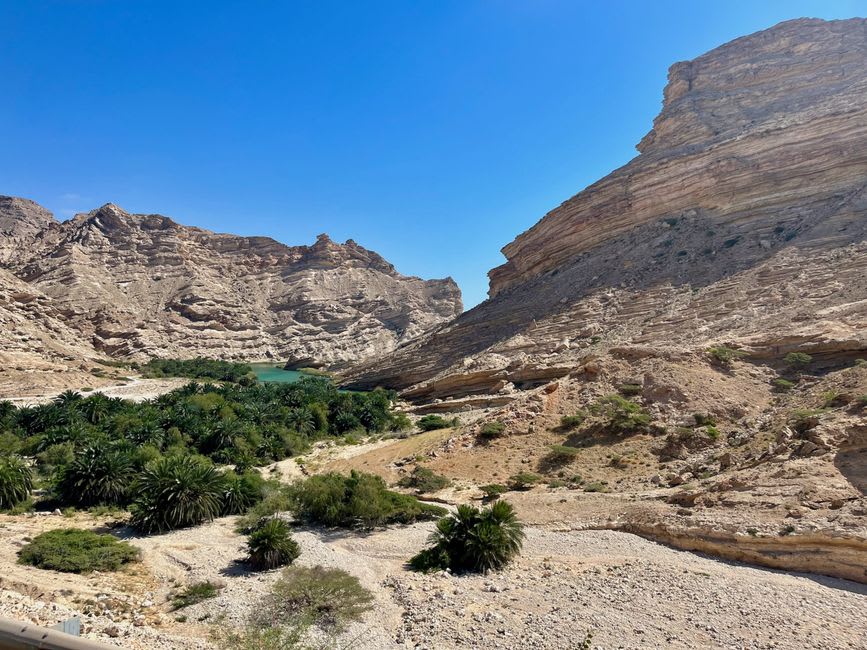
The canyon narrows quickly after that, the walls closing in until you’re walking a corridor of smooth, pale rock with a thin stream running underfoot. It never gets dramatic in the way Wadi Shab does — there’s no cave, no swim-through passage — but it has a hushed, private quality that felt entirely its own, helped enormously by the fact that we saw no one else for the better part of two hours.
The Spring Pool
About forty minutes in, the wadi opens into a small amphitheater of rock where a spring feeds a single deep pool shaded almost entirely by an overhanging cliff. Lia went in first, testing the temperature with the kind of grimace that meant it was colder than she’d hoped, and then swam a slow lap while I sat on the ledge above trying to place why the spot felt so different from the more famous wadis. I think it was the total absence of infrastructure — no rope, no sign, no rowboat crossing, just a pool that has clearly been used by shepherds and farmers for generations and happened to let us in for an afternoon.
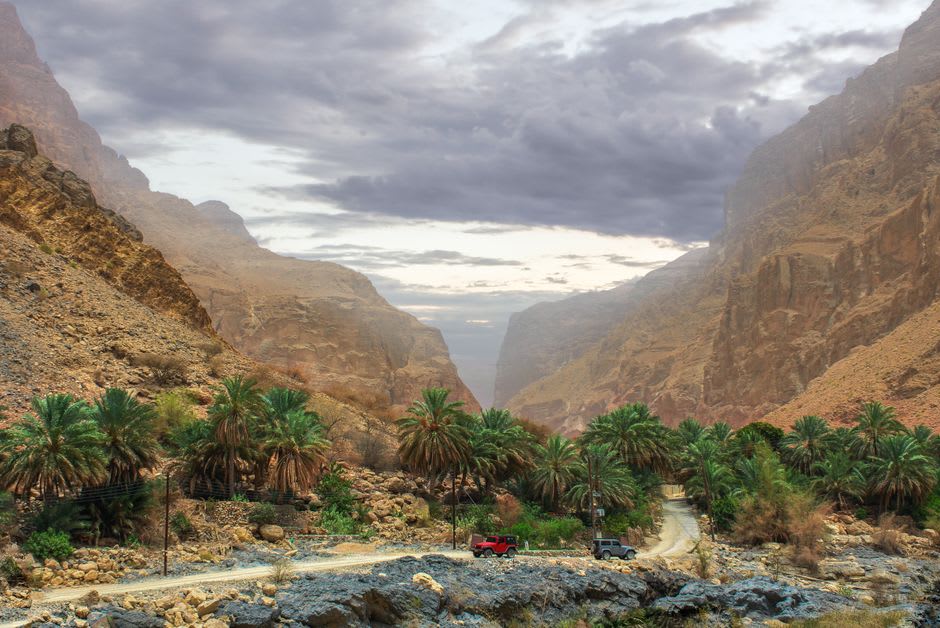
We walked back through the plantations as the light dropped, the smell of irrigation water on hot earth following us most of the way, and stopped for dates and karak tea in Al Hamra before the long drive back toward Nizwa.
When to go: October through April. The plantation walk offers little shade, so an early morning start makes the approach far more comfortable.