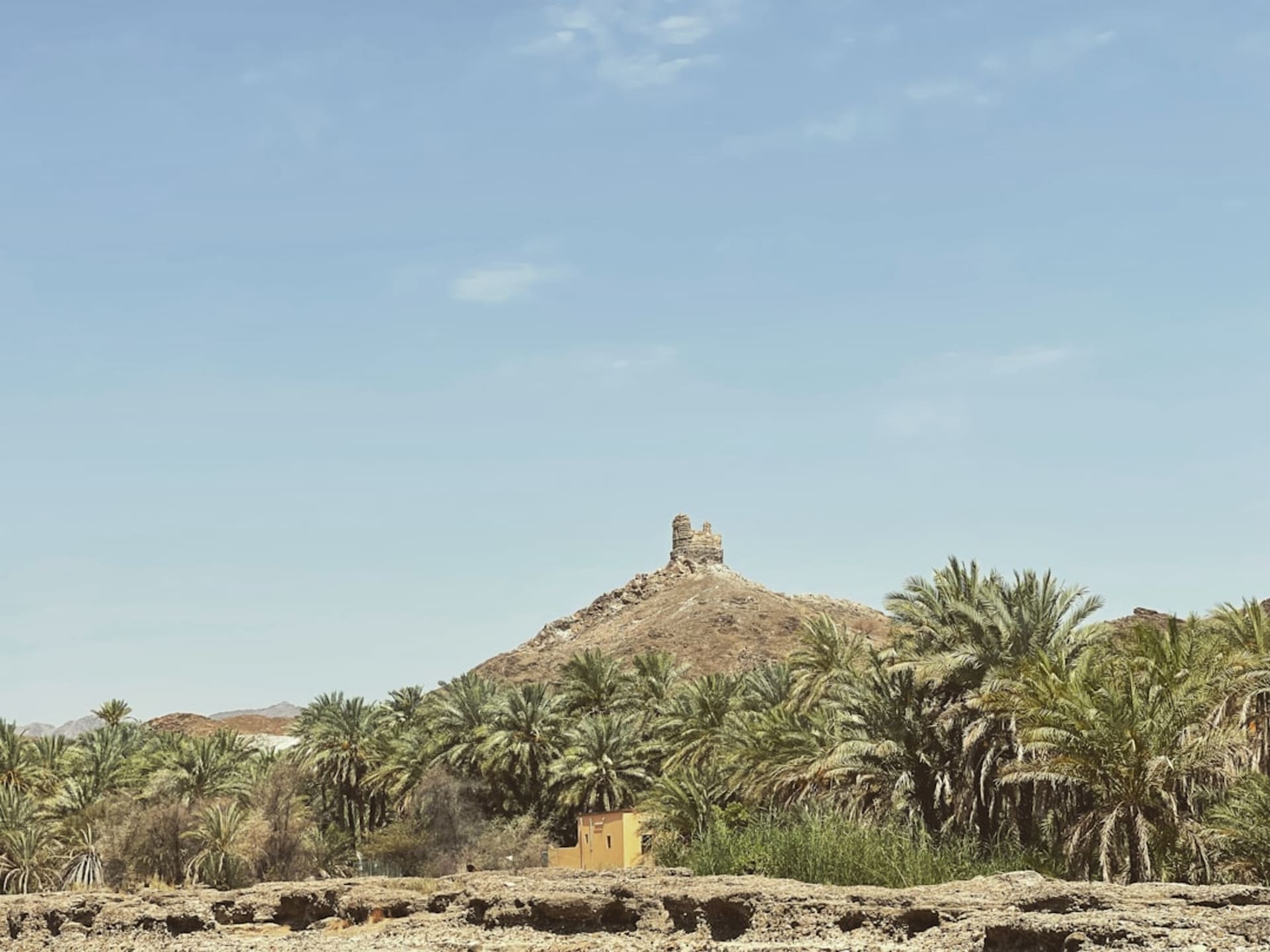
A former Ya'arubi capital's fortress with a working blacksmith inside its walls, and hot mineral springs bubbling out of the ground a short walk away.
Rustaq doesn’t get mentioned in the same breath as Nizwa or Bahla, and after a day there I still can’t fully explain why. It was once Oman’s capital, seat of the Ya’arubi dynasty in the 17th century, and the fort at its center has a scale and a strangeness that should draw more attention than it does. Maybe that’s the appeal. We had most of it to ourselves.
A Fort Built in Layers
Rustaq Fort isn’t a single cohesive structure so much as a fort built on top of an earlier fort, which was itself likely built over something older still — foundations going back, by some accounts, to pre-Islamic times, with additions and reconstructions stacked on top across centuries. Walking through it, you feel the seams. One tower is clearly older, its stone rounder and less regular; another section has the crisper geometry of a more recent restoration. The al-Hazm cannons still sit in position along parts of the wall, aimed at a valley that hasn’t needed defending in a very long time.
The tower I found most memorable was one accessed by a staircase so dark I used my phone flashlight to find the steps, emerging onto a platform with a view across the old town’s palm groves toward the Western Al Hajar mountains — hazy blue-grey ridgelines stacked one behind the other, the kind of layered depth that photographs never quite capture honestly.
The Blacksmith in the Wall
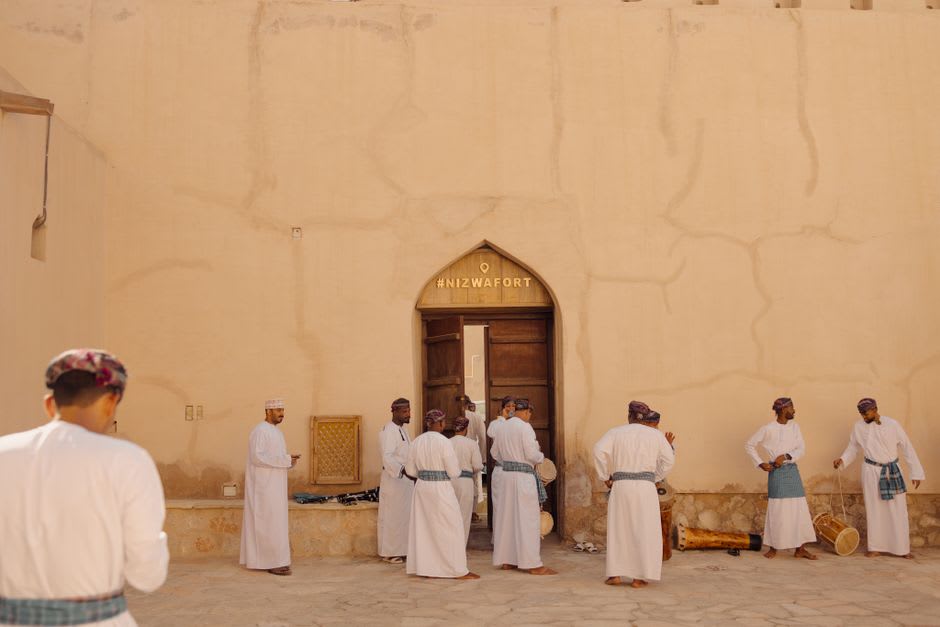
Inside one of the fort’s ground-floor rooms, a blacksmith still works — an older man hammering out khanjar blades and small tools over a coal forge built directly into a wall clearly designed for exactly that purpose centuries ago. The sound of the hammer echoed strangely off the stone, and the heat off the forge in an already warm room was considerable. He didn’t look up much as we watched, entirely absorbed, and I got the sense he’d have been there whether or not anyone had come to see it.
Ain Al Kasfah
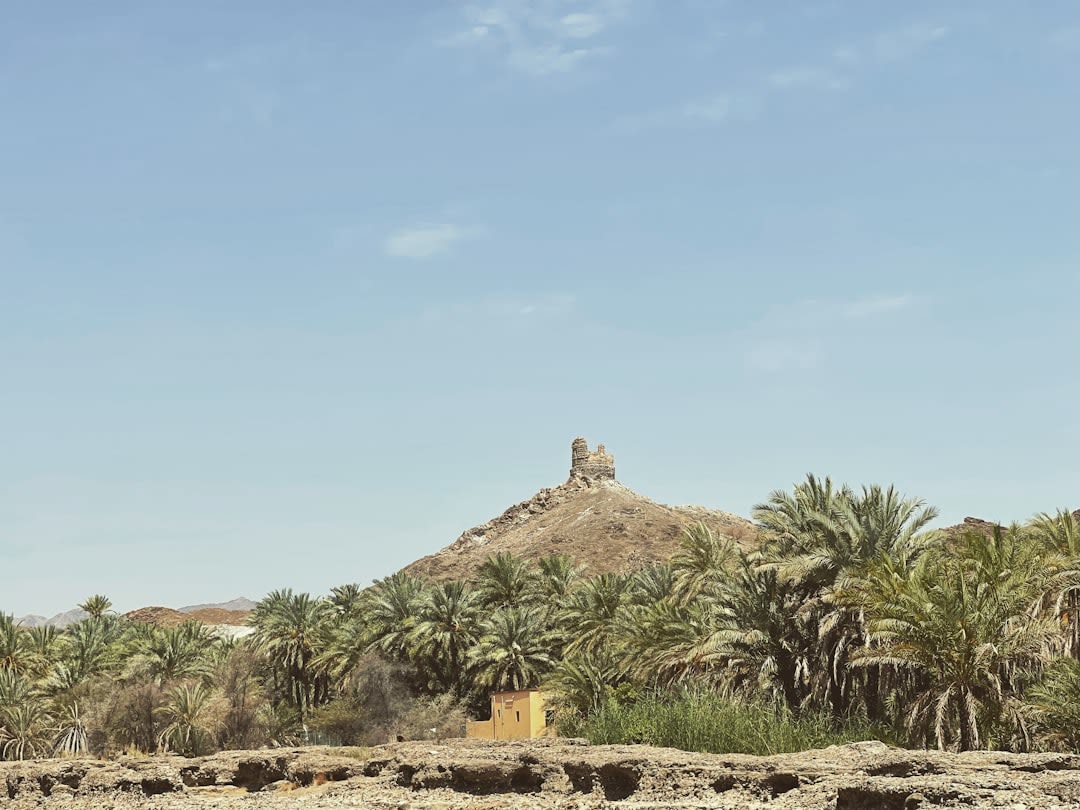
A short drive from the fort, the hot spring at Ain Al Kasfah runs warm and mineral-heavy through a narrow channel used for generations to irrigate the surrounding date plantations — locals still bathe in parts of it, and the water carries a faint sulfur smell that took me a minute to place. Lia soaked her feet in a shaded section while I watched a group of teenage boys jump into a deeper pool further downstream, shrieking at a temperature that seemed to delight rather than bother them.
When to go: October through March for comfortable fort exploration; the hot spring is pleasant year-round, though it gets busiest with local families on Friday afternoons.