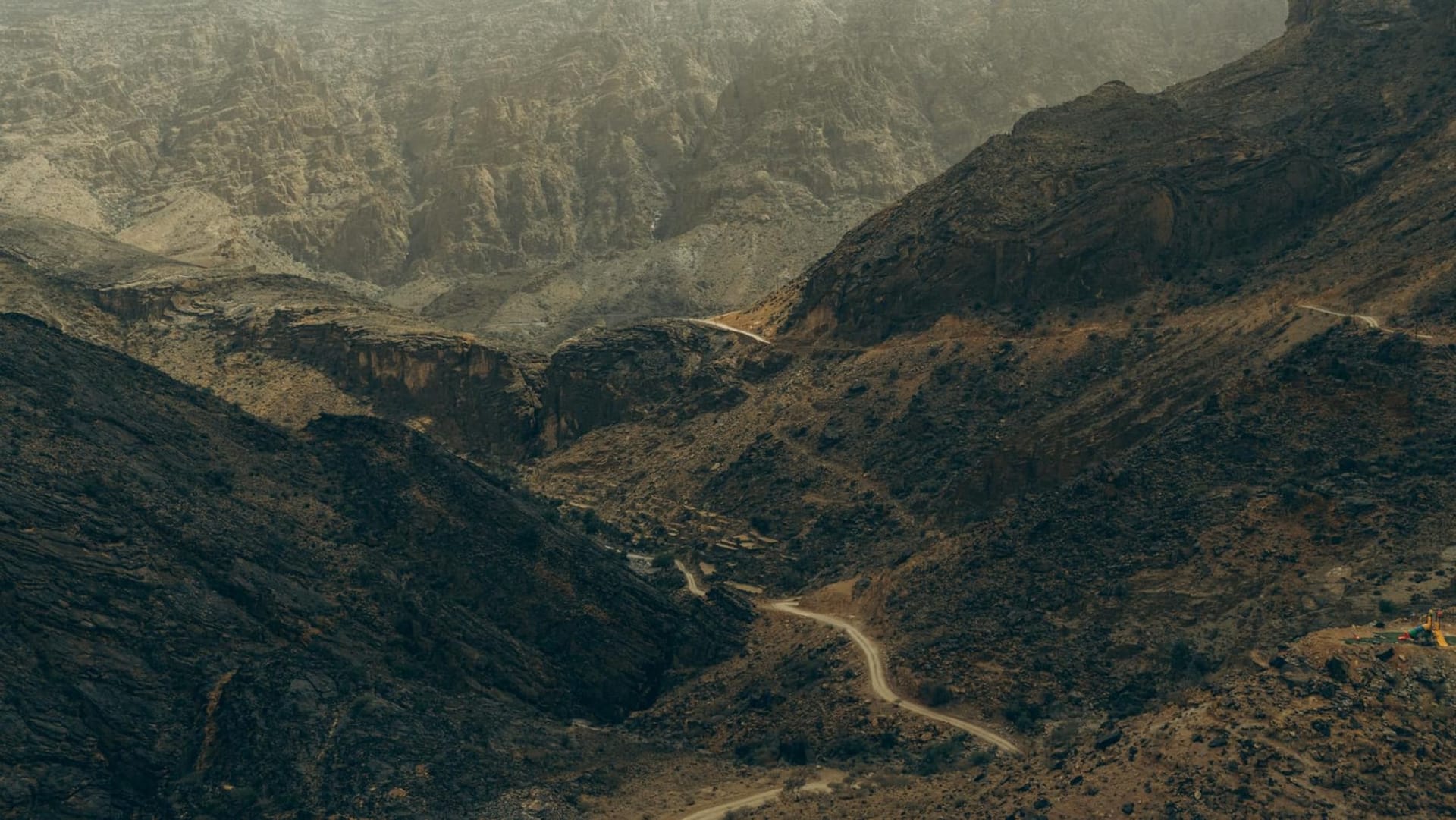
The 'Green Mountain' towering above Oman's heat — rose farms, cool air, and ancient terraced villages.
The road to Jebel Akhdar climbs without warning. One moment you are in the Al Hajar flatlands, squinting against the white glare of a Nizwa afternoon, and the next you are in second gear on a switchback that feels designed to test your resolve — and your brakes. The mountain does not reveal itself gradually. It simply arrives: two thousand meters of altitude, a drop of fifteen degrees, and air that smells of juniper and something floral that takes a moment to place. Damask rose. Hundreds of thousands of them, terraced into the cliffs in rows so precise they look architectural.
The Terraces of Wadi Bani Habib
The old village of Bani Habib sits on the rim of a canyon that drops so sharply it makes your stomach shift. I walked the goat paths between the abandoned stone houses — most families moved to the newer village below decades ago — and found the terraces still intact beneath them, falaj irrigation channels still threading through the rock, carrying snowmelt to the rose gardens as they have since the Bronze Age. Lia crouched over a pomegranate tree growing from a crack in the terrace wall, photographing it with the canyon in the background. Neither of us spoke for a while. There are places that enforce silence not through grandeur but through age, and Bani Habib is one of them.
The surprise came later, on the walk back. A woman named Fatima — working her family’s rose plot near the Al Ayn viewpoint — offered us a small bottle of rose water she had distilled herself, insisting we take it without payment and adding, through her teenage daughter’s translation, that French people are always welcome. I had not said where I was from. She had simply heard the accent and reached her conclusion. I did not correct her.
Rose Season and the Souq at Al Aqr
The Damask rose harvest runs for roughly three weeks each April, when the entire plateau smells like the inside of a perfumery. By morning the petals are picked before the heat sets in; by afternoon they are in copper stills, producing the rose water that Oman exports across the Gulf. What is not exported finds its way into everything: the halwa served with coffee at the small guesthouse where we stayed near Al Aqr village, the syrup poured over desserts at the roadside restaurant on the way up, the bottles lined up at the village souq where a kilo of dried petals costs almost nothing. I bought two bottles and a bag of dried rosebuds that I am still using in tea months later.
The souq itself is unremarkable by design — a handful of stalls, plastic chairs, a tea vendor with a thermos that never seems to empty. But the men sitting there in the late afternoon, watching the shadow of the escarpment creep across the canyon, had the particular unhurried quality I have come to associate with Oman more broadly: a generosity of time, of attention, of small hospitality that costs nothing and means everything.
Light at the Diana Point Overlook
The best light on Jebel Akhdar arrives in the hour before sunset, when the canyon walls turn from grey limestone to amber to a deep blood-orange that lasts about twelve minutes before collapsing into purple shadow. The Diana Point overlook — named after a royal visit in the 1980s — is the official viewpoint, but the ridge path running south of it offers something better: solitude and a longer angle on the terraces below. I stood there watching the color move across the stone like something poured, and felt the specific satisfaction of having climbed somewhere that required effort to reach.
When to go: April for the rose harvest — the mountain’s defining spectacle. October through February for cooler temperatures and clear skies. Avoid July and August when the lower roads are brutal even if the summit stays mild; the drive up in summer heat is punishing.