
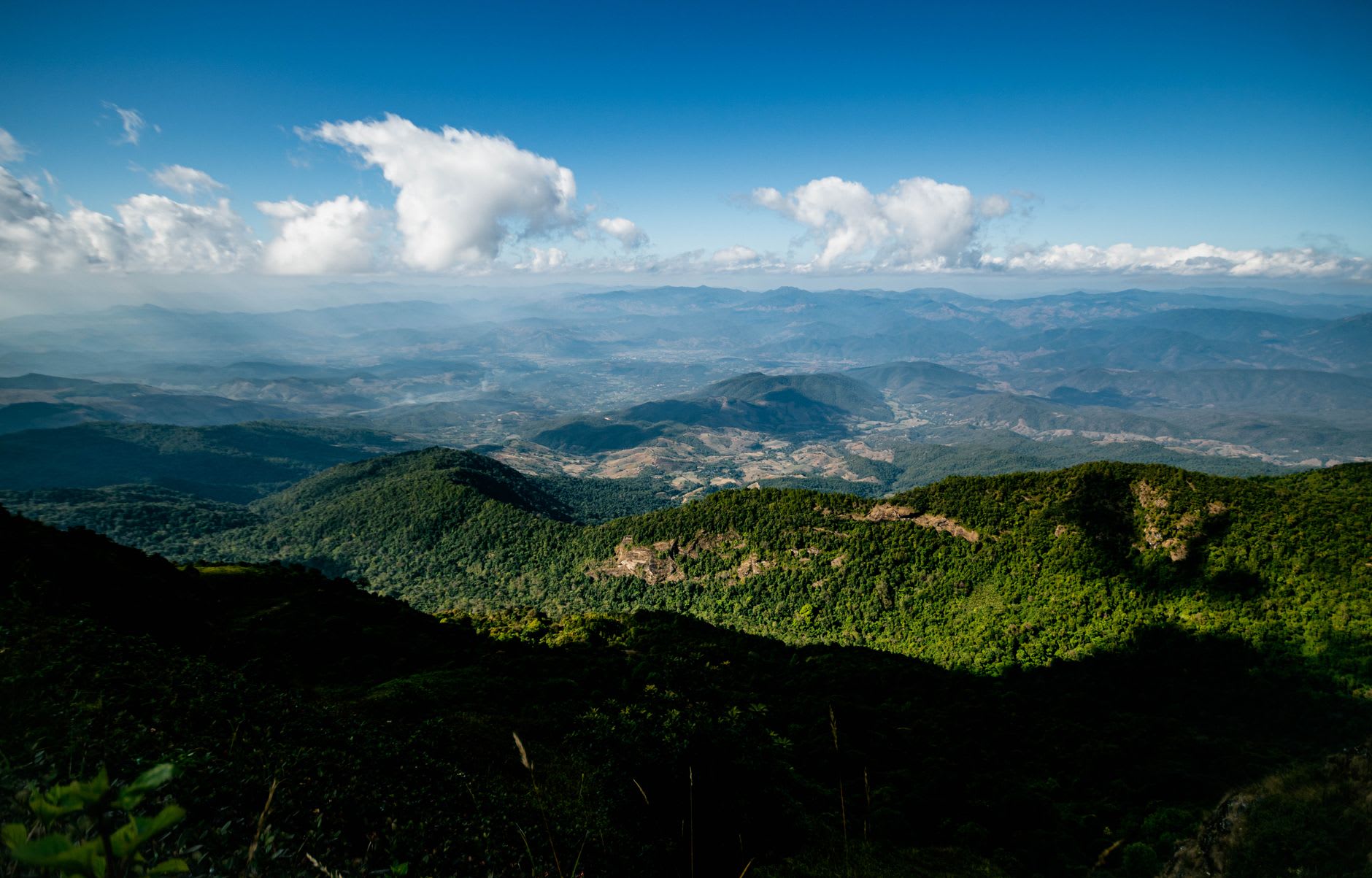
The road from Chiang Mai to Pai is 762 curves through mountain passes, and the bus driver handles all of them with one hand. I spent most of the three-hour journey pressed against the window watching valleys appear and vanish below us, the Ping River flashing silver far down in the gorge, cloud shadow moving across ridges. By the time we arrived at the flat valley floor, something had unclenched that I hadn’t noticed was clenched. Pai does that from a distance. The town announces itself slowly — a few guesthouses along the river, a market street lined with wooden shopfronts, and then the surrounding hills doing what they do, which is hold everything in.
Pai became a backpacker destination decades ago and now carries the slight self-consciousness of a place that knows it is being looked at. The walking street fills at night with travelers who came for a week and stayed for a month, selling handmade jewelry and playing acoustic guitar. But the valley around town pays no attention to any of this. I rented a motorbike on my second morning — a semi-automatic I could handle badly and still make progress with — and spent the day on empty roads between rice fields that shifted from chartreuse to emerald depending on the light. Coffin Cave, with its painted sarcophagi from the ancient Lawa people, sits past the bamboo bridge north of town and had no one there when I arrived. The hot springs at Tha Pai require getting up early before the day-trippers install themselves, but the mineral water is genuinely restorative in a way that makes me understand why people have sought out hot springs for thousands of years.
The food follows two tracks: the Thai-style restaurants where noodle soups arrive at six in the morning and cost forty baht, and the expat places doing coffee and avocado toast, serving a population of long-term residents who have made the arithmetic of Pai work for them. I ate from the morning market most days: steamed buns, grilled sai ua sausage fragrant with lemongrass and kaffir lime, pork larb from a woman’s stall that gave me chopsticks automatically until I indicated I wanted a fork, then brought both without judgment.

The evenings I spent at a bar on the river that had cushions on the floor and no menu — you pointed at bottles and settled in. The Pai River makes a sound at night that carries up to the open-air seating, and I sat there one evening watching bats navigate between the trees on the opposite bank, thinking about nothing in particular. That is the state Pai specializes in — the productive nothing, the absence of urgency. I have encountered it in very few places and am suspicious when it fails to materialize. In Pai it always does.
When to go: November to February brings cool, dry weather — misty mornings in the valley, warm afternoons, cold nights. The green season from July to October fills the rice fields with water and turns the hills alive, though some roads wash out. Avoid Songkran in April when the road fills with Bangkok holiday traffic and the valley loses its quiet entirely.