Derry
"You ask someone what to call the city and they laugh, which tells you everything about how far this place has come."
The Bogside mural of a boy in a gas mask is fourteen feet tall and looks directly at you from the moment you turn the corner at Free Derry Corner. It is called “The Petrol Bomber” and was painted in 1997 by the Bogside Artists, a collective of local men who came of age during the worst of it. I stood in front of it on a grey afternoon, the slogan FREE DERRY painted white on a gable end behind me, and tried to understand how a city holds this history and still manages to have the friendliest pub culture in Ireland. I am still working that out.
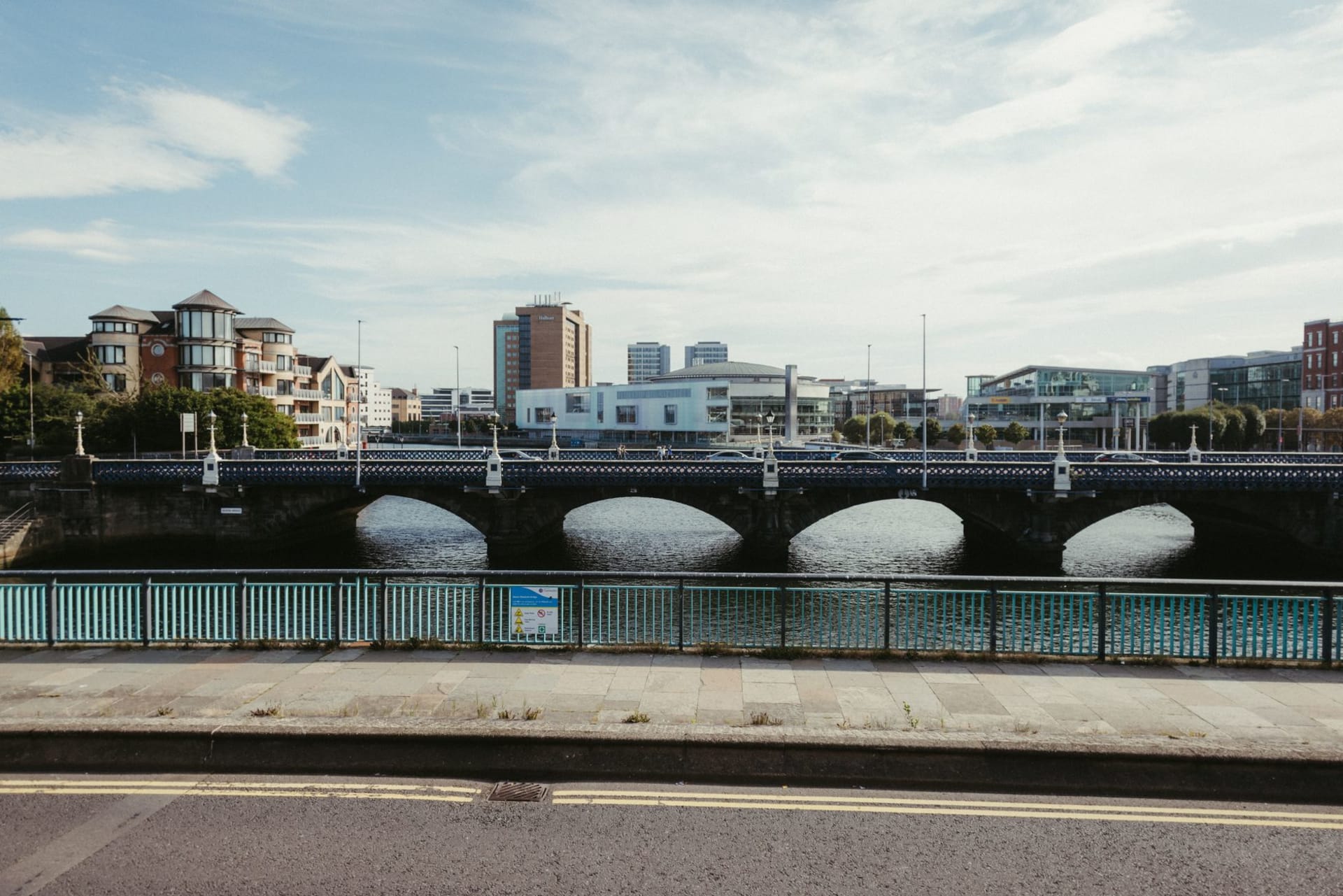
Derry’s walls are the best-preserved city walls in the British Isles, running for a mile around the old town in an unbroken circuit twenty feet high. I walked them at dusk, the river Foyle going silver below to the east, the Bogside spreading west and below me. From the walls you see the geography of the conflict laid out — the Catholic Bogside nestled against the Protestant Fountain estate, separated by a stretch of road that once had a gate. Now there is a peace bridge downstream, a curving pedestrian arch crossing the river. When I walked it on a Sunday morning, people were jogging across it from both sides, earphones in, not thinking about what it represented.

The Guildhall sits at the north corner of the walls, a Victorian Gothic confection in pale sandstone that looks like it belongs in a smaller version of London. Inside, the stained glass tells the city’s history in careful panels. Outside, the square in front of it has been pedestrianised and there are teenagers on skateboards in the shadow of a building that once housed the local power structure the Bogside community rejected. The Museum of Free Derry, a small and quietly devastating institution in the Bogside, gives the other side of that same history — testimony, photographs, documents from Bloody Sunday and what preceded and followed it.
I ate in the Walled City Brewery, a craft beer operation in a former shirt factory — Derry was the shirt-making capital of the world for a time in the nineteenth century, and the old linen buildings still anchor the city’s southern end. The food was a lamb shank that had been braising for the better part of a day, the kind of thing that tastes like someone’s grandmother’s kitchen during a cold spell. The beer was a stout with a quality that the breweries in much larger cities would envy.

What I keep returning to about Derry is the ease of it — the way people walk through this heavily storied landscape without performing the history at you. A woman I spoke to at a coffee shop near the Diamond had grown up in the Bogside in the seventies and talked about it the way people talk about a difficult childhood: with candour, without need for your reaction. The city has somewhere to be, which is the most useful thing a city can have.
When to go: The City of Derry Jazz and Big Band Festival in May fills the streets with music in a way that feels genuinely local rather than curated. Halloween — the Derry Halloween festival — is genuinely spectacular and draws huge crowds but retains an anarchic energy. Avoid the summer marching season if you want the city on its most relaxed setting. October through November has a particular melancholy beauty, the walls damp and the Foyle running full.