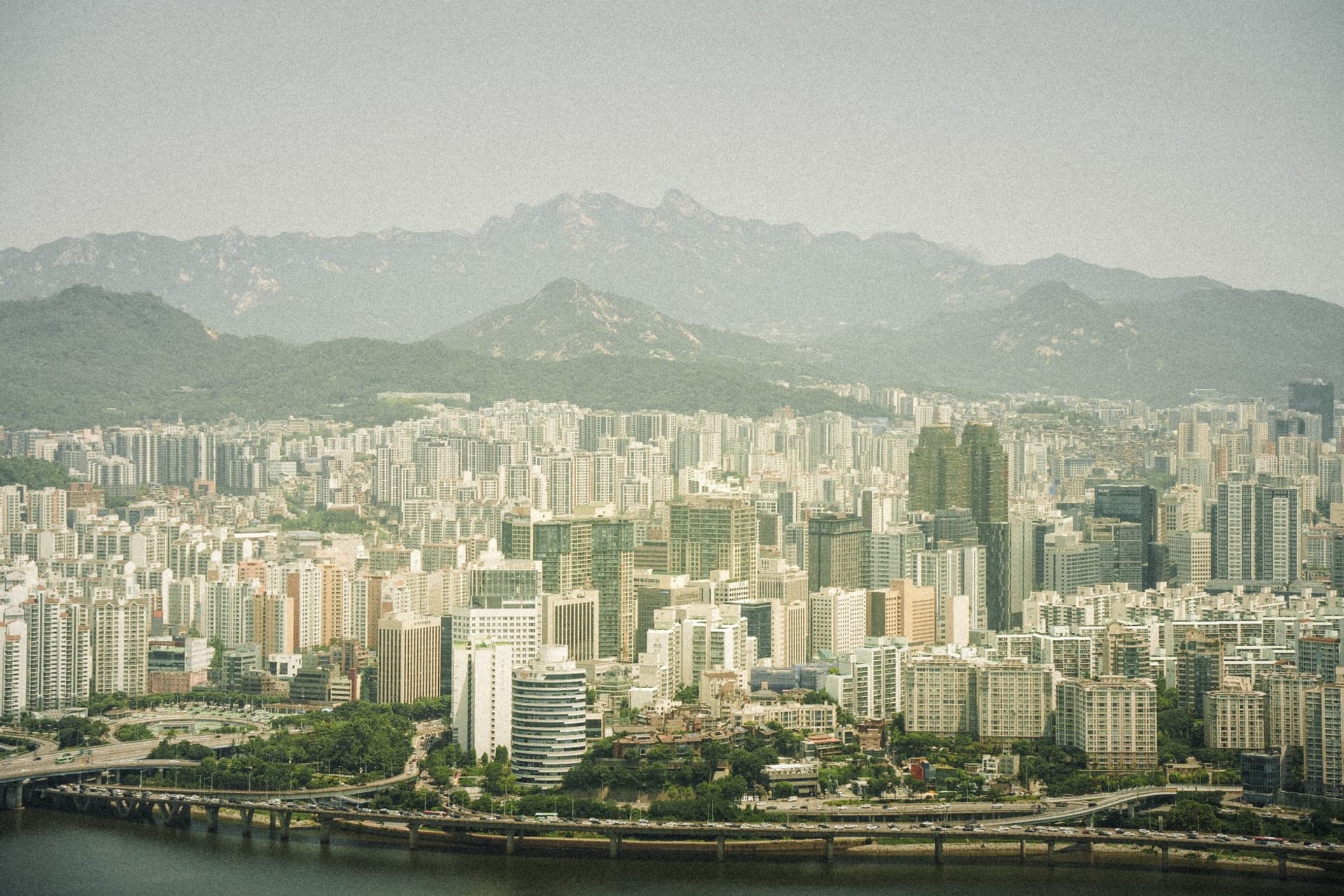
Pyongyang
"The city is so empty you start to wonder if the buildings are waiting for people, or if people have always been beside the point."
Pyongyang greets you with width. The boulevards are so broad they feel less like streets and more like the idea of streets — designed for parades, for tanks, for the collective body moving as one. On the morning I arrived, a Tuesday in October, there were almost no cars. A few bicycles. A woman in a red coat walking very quickly beside a row of identical apartment blocks. The sky above was the blue of something washed clean. I stood on Mirae Scientists Street with my two guides flanking me at a precise and comfortable distance, and I felt the particular vertigo of a place that is performing being real.
The monuments are the grammar of this city. You move between them on a schedule — the Juche Tower first, 170 meters of pinkish granite topped with a flame of red glass. You look up at it from the base and the guide explains, in excellent English, what Juche means: self-reliance, independence, the idea that the Korean people are the masters of their own destiny. I nodded. Across the Taedong River, the city spread out in orderly blocks, its skyline punctuated by the ghost of the Ryugyong Hotel — 105 stories, unfinished for decades, its glass-clad pyramid catching the afternoon light like a beautiful mistake no one has been able to decide what to do with.

What the itinerary doesn’t tell you to notice: the subway. The Pyongyang Metro is one of the deepest in the world, its escalators dropping you into tunnels where chandeliers hang above mosaic murals of harvests and victories. On the approved two stops, I watched real commuters, people with briefcases and groceries, sliding past each other in fluorescent light. A teenage boy was asleep against the window. The chandeliers swayed almost imperceptibly as the train moved. It was one of the most ordinary moments I experienced in the country, and it felt like contraband.
The food surprised me in ways I’m still turning over. In the evenings, government restaurants served naengmyeon — buckwheat noodles in cold broth with pickled radish — that was genuinely excellent. Not good for North Korea. Just good. The broth had a mineral depth I’ve chased since in Seoul and never quite found. Someone in this city takes naengmyeon seriously, tends to the recipe, cares about the buckwheat’s texture. That insistence on craft inside a system built for spectacle was the most startling thing about Pyongyang. The ordinary persists. The cook at the stove is still a cook.

Walking in Mansudae, past the bronze statues of the Kims that tourists are required to bow before — or rather, strongly encouraged — I found myself looking not at the statues but at the family beside me doing the same thing. A mother adjusted her daughter’s collar before they bowed together. The gesture was so ordinary against that extraordinary backdrop that it lodged in me like a splinter. Pyongyang refuses to be only what it wants to be.
When to go: April and May bring cherry blossoms and the Mass Games rehearsals, when tens of thousands of students practice the human mosaics that fill the May Day Stadium. October is cooler, clearer, and the city’s autumnal light turns even the concrete a warmer shade. Avoid August, when Liberation Day ceremonies make an already rigid itinerary tighter still.