
Mount Kumgang
"The mountains don't know about the resort that was closed, the apology that wasn't given, the decade that has passed since anyone came from the south."
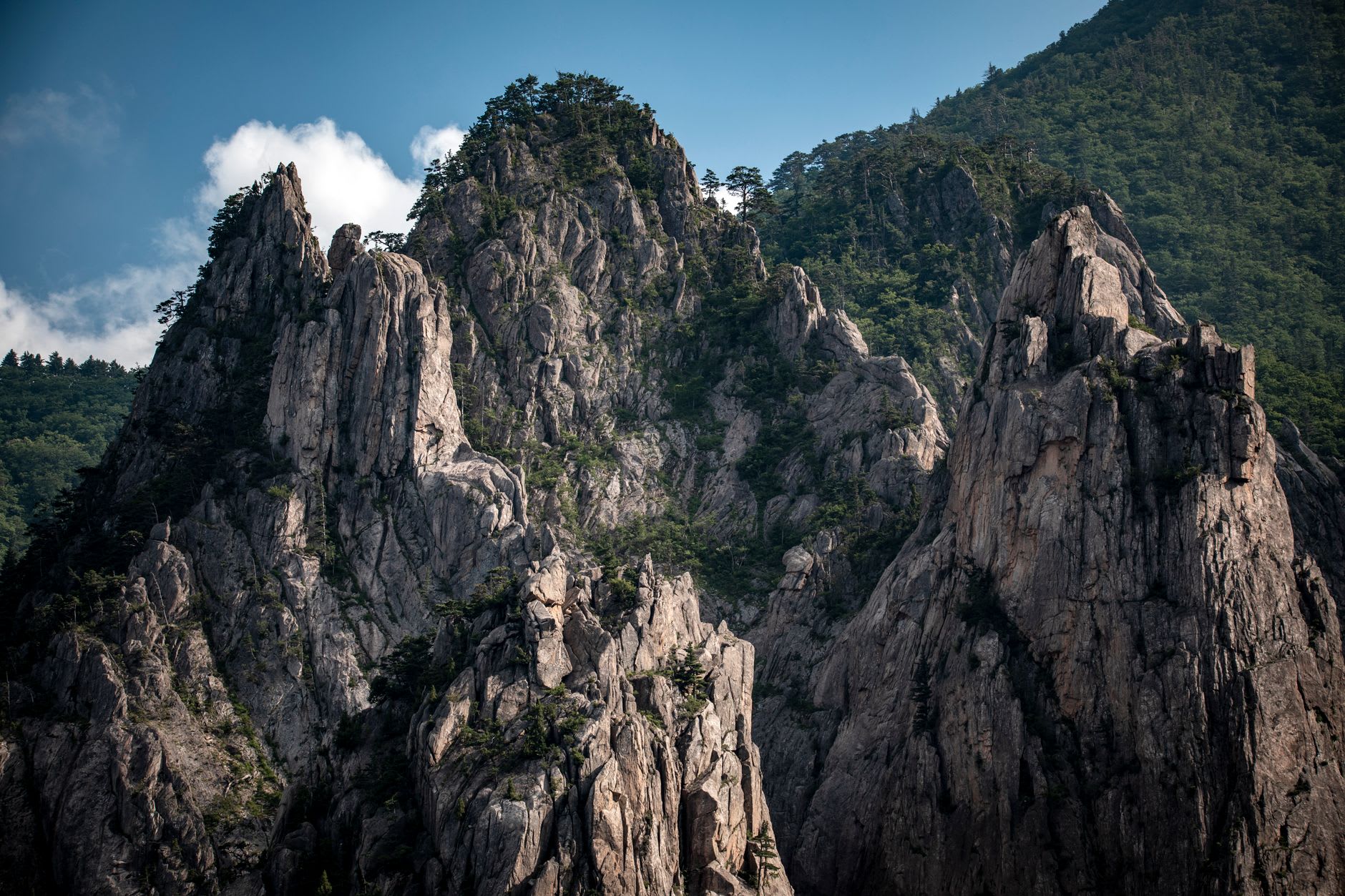
The name translates as Diamond Mountain, and the Koreans have understood for a thousand years that this was earned. The granite formations of Mount Kumgang rise along the eastern coast like the work of something that had a very specific aesthetic vision and unlimited time to execute it. The rock is almost white in certain lights, shot through with veins of quartz and feldspar, and the waterfalls drop through gorges where pine trees grow horizontally from cracks in vertical faces, reaching for light with a kind of patient desperation. I arrived in late October when the maple and ginkgo had turned, and the contrast of red and gold leaf against white granite produced a beauty so formal and resolved that it felt almost architectural.
The approach through the Kumgang range from the coast passes through a series of gorges — Manmulsang, Kuryong — where the path follows streams between rock walls that block the sky. The sound of water changes as you climb: broad and rushing at the base, then more specific, then the high tapping of a single fall coming off a ledge twenty meters above. The air in the gorges is cold and carries something mineral, the water-on-stone smell that is the same everywhere on earth and always feels like it’s telling you something.

There is a layer of recent history at Kumgang that makes the beauty more complicated to hold. In the early 2000s, this was a rare site of inter-Korean cooperation: a resort complex was built on the southern slopes, funded by Hyundai Asan, open to tourists from the South who could visit without a visa. For nearly a decade, hundreds of thousands of South Koreans came to see the mountains their grandparents had grown up knowing about, the mountains that appear in classical poetry and painting throughout the peninsula. In 2008, a South Korean tourist was shot and killed after straying into a restricted military zone. The resort closed. Diplomatic attempts to reopen it have repeatedly stalled. The buildings still stand, abandoned, on the slopes below the main peaks.
Walking past the empty resort on my way to the Samil Lake trail, I felt the weight of the absence — the restaurants with their shuttered windows, a sign in Korean script still readable after years of weather, a pleasure boat moored at the pier of the lake with no one on board and algae growing along the waterline. The mountains behind were indifferent to all of this, which seemed about right.
Samil Lake itself — three days’ lake, for the time it was said to take to walk around it — is still and very clear, the granite peaks reflected in it with the precision of a copy that thinks it might be the original. A monk’s hermitage, the Phyohun Temple, has been maintained in the forest above the lake, its wooden halls painted in the faded green and red of Korean Buddhism. Someone has placed fresh flowers at the altar. Someone keeps coming back. I stayed longer than the itinerary allowed, sitting on a stone by the lake water, watching the reflection of the mountains move slightly in the small wind, and trying to understand what it means that this has been here for a thousand years and will be here after everything else that is currently urgent has resolved itself.
When to go: October is when Kumgang is at its most spectacular — the autumn colour on the maple-covered slopes is among the finest in Northeast Asia. Spring (April to May) brings azalea bloom on the lower slopes. The mountain is accessible only through organized tours from Pyongyang with itineraries that include the coastal route via Wonsan.