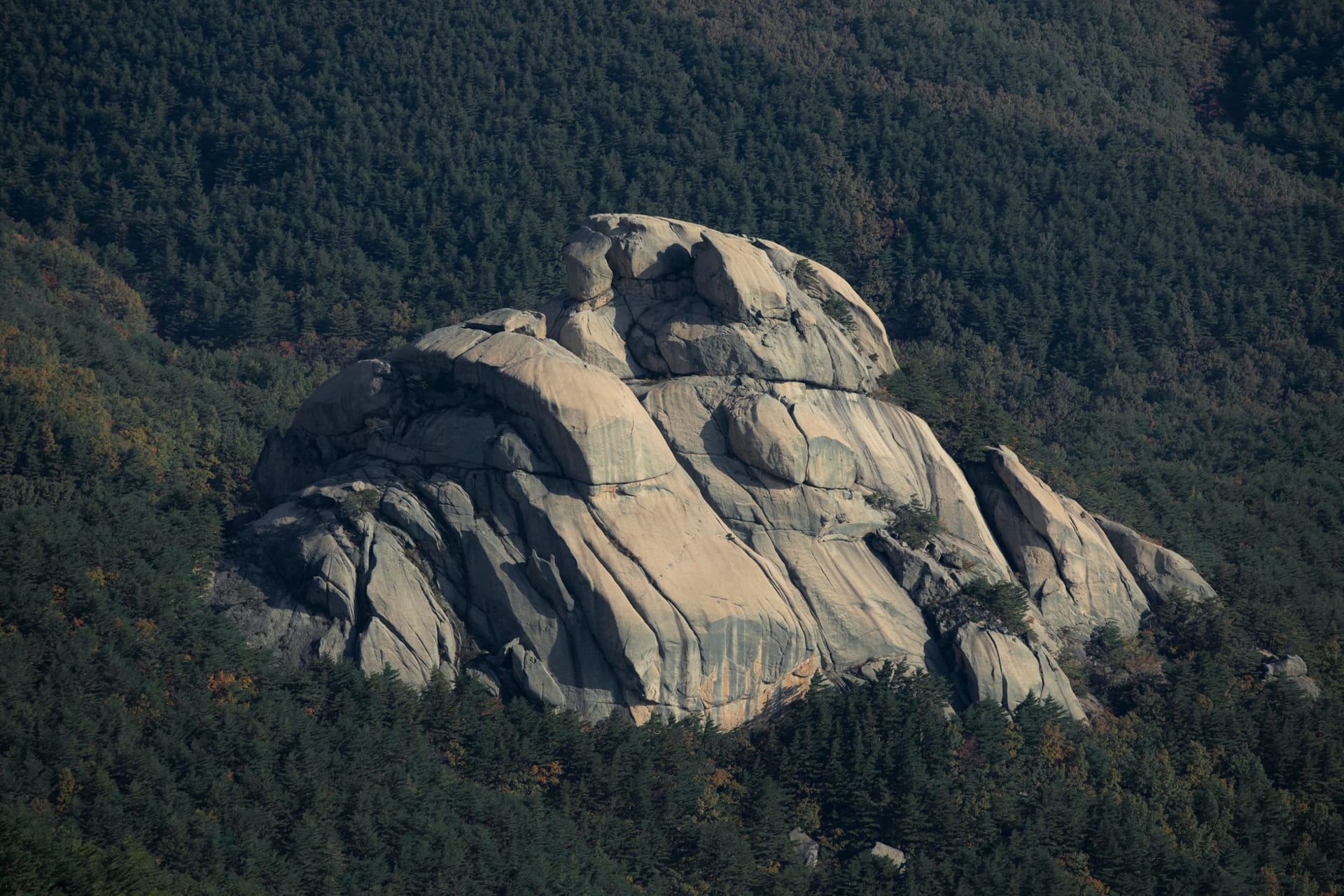
Mount Chilbo
"Our guide put her clipboard down at the homestay, and for one evening she was just a person who liked plum liquor."
Getting to Chilbosan is the whole point, in a way. It sits in North Hamgyong, in the far northeast corner of the country, a long way from Pyongyang and even further from anything a visitor is normally shown. We flew up to Orang and then drove, and by the time the bus crested the last ridge and the rock formations of Outer Chilbo came into view, I had been awake long enough to be slightly delirious, which is maybe the correct state for the place. The name means Seven Treasures Mountain, after the seven valuable things that legend says are hidden in it, and the local interpretation of what those treasures are changes depending on who you ask.

The mountain divides into three parts and they could be three different countries. Inner Chilbo is forested and gentle, all maples and walking paths. Outer Chilbo is the dramatic one, a chaos of weathered granite pillars and crags that the guides have named — there is a Camel Rock, an Old Man Rock, the usual catalogue of pareidolia that mountains everywhere seem to collect. And then there is Sea Chilbo, where the eroded coast meets the water in a way that genuinely stopped me. Lia and I stood on a headland watching the swell break against columns of rock, and for a few minutes nobody narrated anything to us, which on this particular trip felt like a small miracle.
The homestay
The reason people who study this country talk about Chilbo is the homestay village at the foot of the sea section. It is, like everything here, organised and supervised — let us not pretend otherwise. But it is also the closest a tourist gets to a North Korean home: a row of single-storey houses with heated ondol floors, where families cook for you and you sit on cushions and eat seafood that was in the water that morning. We had clams, a grilled fish I couldn’t identify, kimchi sharper than anything I’d had further south, and a clear plum liquor that arrived in a plastic bottle and did a lot of work.

There was a moment that night I keep returning to. Our guide, who had spent four days being precise and watchful, set her clipboard on the floor and laughed at something her colleague said, properly laughed, and for an evening she was just a woman who liked plum liquor and teasing her friend. I’m not naive about where I was or what I was allowed to see. But people are people, and the homestay is the rare crack in the itinerary where that becomes undeniable.
Going in clear-eyed
Chilbo is the prettiest place I was taken in the country and also the one that made me most uneasy, because the beauty is real and the constraints around experiencing it are total. You go where you are taken, you photograph what you are permitted to photograph, and the village exists for visitors as much as it does for the people living in it. I won’t tell you that’s fine. I’ll only tell you that the coast is extraordinary, the air smells of pine and salt, and I was glad, complicatedly, to have stood on that headland.
When to go: Late September into October, without question — the maples in Inner Chilbo turn and the whole massif goes red and gold, and the autumn light on the sea cliffs is the reason photographs of this place exist. Summer is humid and hazy. Winter shuts much of the access down.