Hakupu sits at the southern end of Niue’s main road, which is really the only road, and the first time I drove through it I thought I’d missed it. A church. A community hall with a hand-painted sign. A few houses set back from the road behind coconut palms. A dog sleeping on the verge who raised his head as I passed and then decided I wasn’t worth the effort. I turned around and went back and parked under a breadfruit tree and sat for a while, and slowly the village assembled itself around me — sounds coming from the houses, a woman hanging laundry, a truck moving slowly past toward the eastern track.
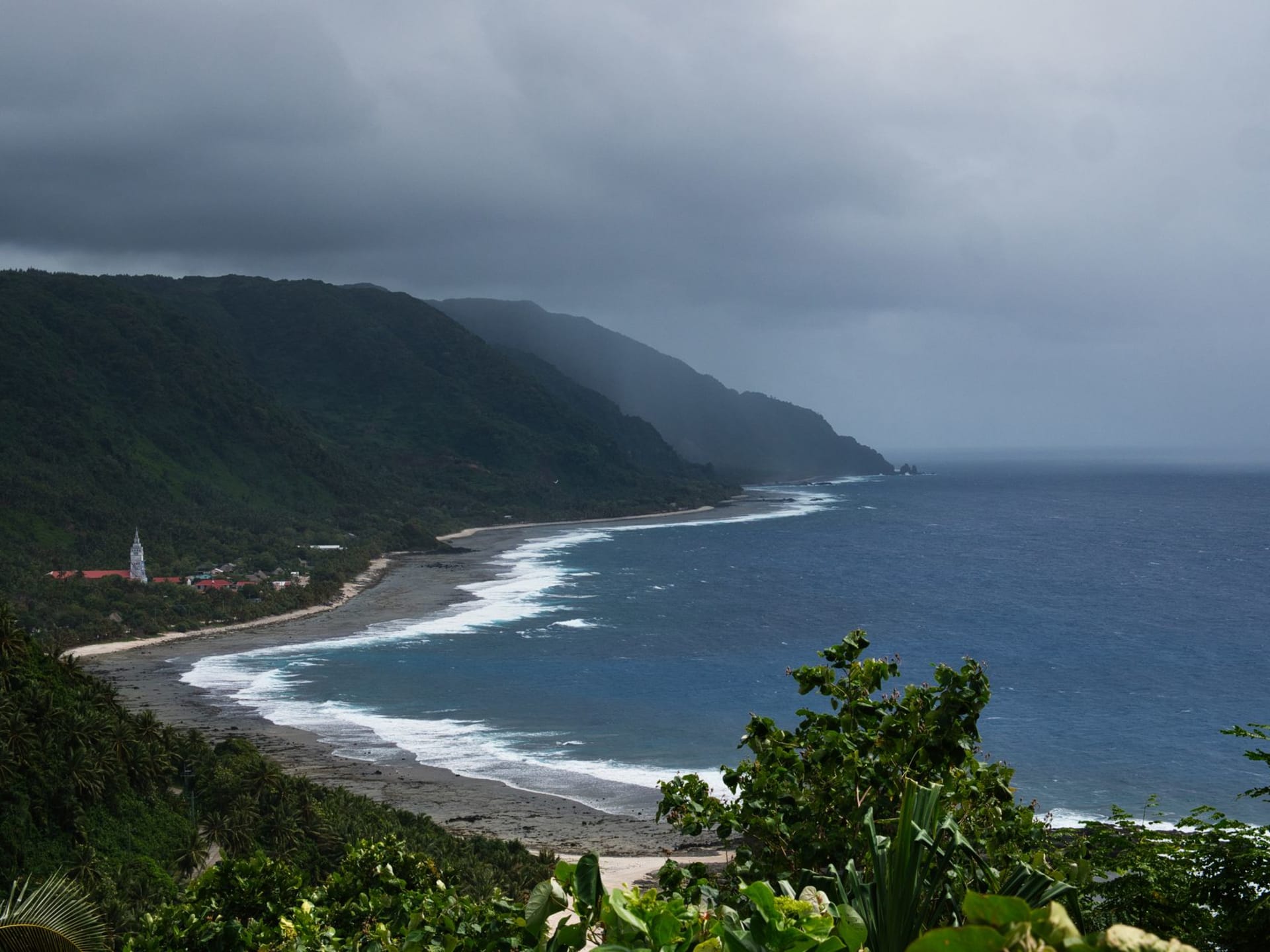
The church is the oldest on the island, a white coral limestone building with a red roof that catches the morning sun and holds it. Sunday service here is, I was told, the main social event of the week — all of Niue operates on a similar calendar, where Sunday belongs entirely to church and family, the road closes to through traffic in some villages, and the island turns quiet in a way that’s qualitatively different from its usual quietness. I attended a service my second Sunday. The singing was extraordinary — four-part harmonies without instruments, voices filling the small space with something that felt architectural.

From Hakupu, the track leads east into the Huvalu Forest Conservation Area, but the village itself has its own coastal access via a path that winds through the southern scrub to the clifftops. The coast here is wilder than the west — the swell hits it more directly, and the rock formations are more tortured, more obviously the product of geological violence. I walked the coastal path one afternoon and found a series of unnamed blowholes working in the swell, shooting spray ten metres up through cracks in the limestone with a sound like a percussive exhale.
What I remember most clearly about Hakupu is an afternoon spent at the community hall where three women were plaiting pandanus leaves into baskets. They were making them to sell at the Saturday market in Alofi, and they talked while they worked without breaking the rhythm of their hands. One of them had spent three years in Auckland working in a hospital and had come back because, as she said, “Auckland has everything except what you need.” That’s the negotiation so many people on Niue seem to be having with themselves — the pull of the resources and opportunities available in New Zealand against the pull of being somewhere that knows your name.

The population of the village, like the island overall, has been declining for decades as younger Niueans move to Auckland. The 2011 census counted fewer than 200 people in Hakupu. What remains is a community that functions as communities do when they’re small enough that everyone’s contribution is visible and necessary — something you feel in the neatness of the yards, the fresh paint on the hall, the handwritten notices about the village meeting posted on the gate.
When to go: Hakupu is worth visiting any time, but Sunday morning for church — if you attend respectfully — is a genuinely moving experience. The coastal path is best in dry season (May to October) when the footing is more reliable. The track east into Huvalu Forest from Hakupu is signposted and takes about ninety minutes one way.