Hemi brought coconut bread wrapped in a cloth. That’s the detail that keeps coming back to me — not the cave itself, extraordinary as it was, but that my guide had thought to bring food, and that we ate it on a limestone ledge above the water, looking down into a pool the colour of a flame when it burns at its hottest, that deep blue-white at the core. He’d been coming to Avaiki since he was a child. His grandfather had brought him. He knew the cave the way you know a room you grew up in — not just where things are, but how the light moves through it at different times of day.
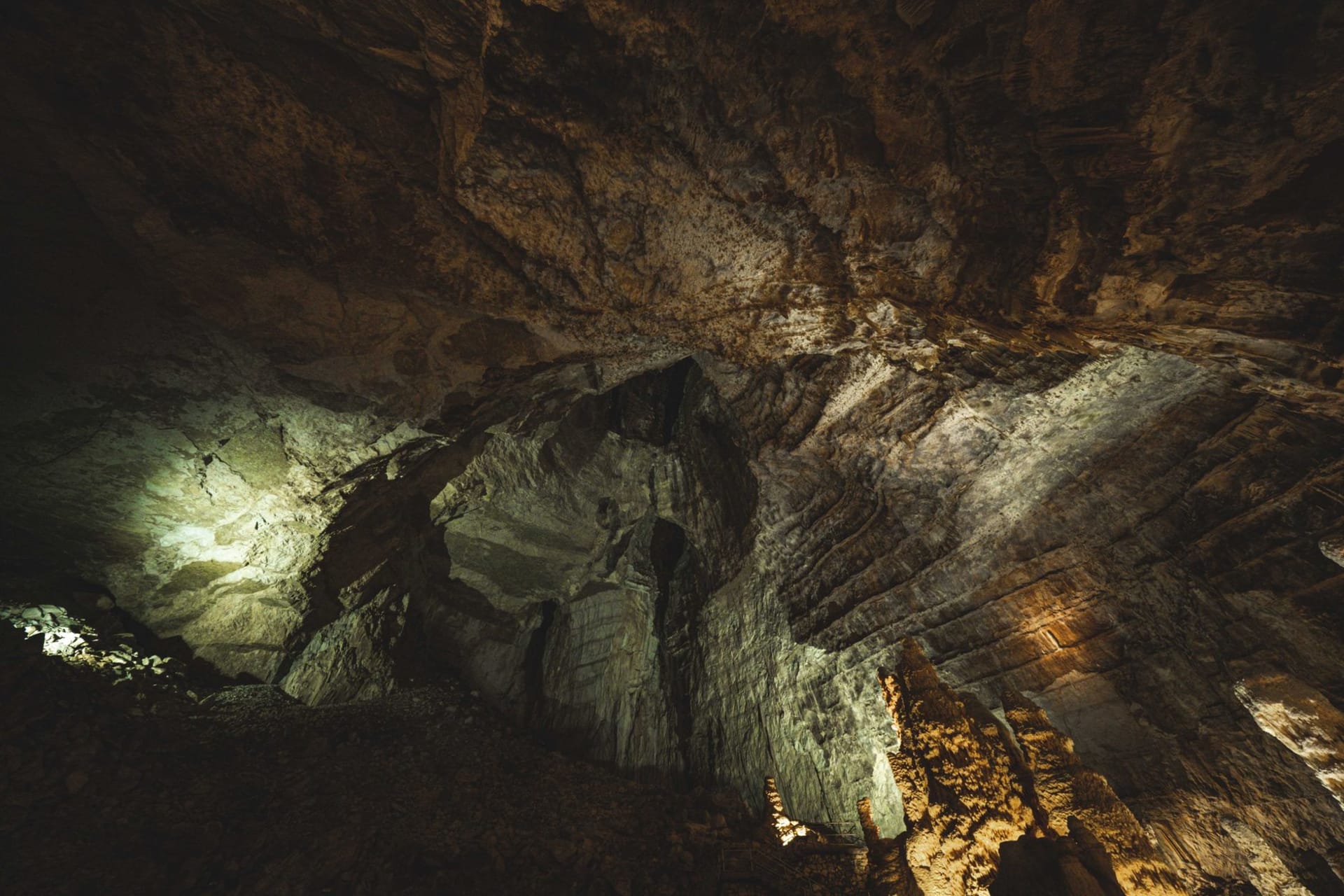
Avaiki is reached by descending through a crack in the raised coral plateau on Niue’s northwest coast. The descent is steep but short, and then you’re in a vaulted chamber, the ceiling riddled with stalactites and the floor opening into a pool of cold, brilliantly clear water that connects underground to the open sea. The colour of the water shifts as you move around the chamber — from deep blue in the centre to pale jade near the edges where the rock shelf drops away — because the light doesn’t enter directly but filters through fissures in the coral above, arriving attenuated and strange.

In Niuean mythology, Avaiki is the underworld — the place from which the islands were fished up from the ocean, the spirit world that underlies the physical one. Standing inside it, that cosmology doesn’t feel metaphorical. The cave has a genuinely otherworldly quality: the silence is profound except for the occasional drip of water from the ceiling, the cold air is noticeably cooler than the outside heat, and the light behaves as if it’s operating by different rules. I swam in the pool. The water was cold enough to make me gasp on entry and then clear enough that I could see the bottom ten metres down without distortion.
Hemi talked about Niuean relationships with the ocean while we ate. Not in an anthropological way — he wasn’t explaining his culture to me — but in the way people talk about something they love and take for granted. He mentioned that his mother had made the coconut bread that morning. He pointed out a ledge near the cave entrance where his grandfather had sat and fished with a handline as a young man. The cave was layered with his family’s presence in a way that made my own visit feel both privileged and temporary.

The cave is accessible independently — there’s a track from the road with basic signage — but going with someone who knows it is worth whatever it takes to arrange. Not because navigation is difficult, but because the cave means something here, and understanding what it means changes what you see when you’re standing inside it. Without that context it’s just a beautiful swimming hole. With it, it becomes a place with genuine weight.
When to go: Avaiki is best visited at low tide when the pool is more accessible and the water clearer. Morning gives the best light through the ceiling fissures — by mid-afternoon the angle shifts and the interior darkens considerably. The descent is slippery after rain. Bring water shoes and a waterproof torch; the inner recesses of the cave are worth exploring but poorly lit.