Kom Ombo
"It is the only temple I know where one half worships what the other half fears."
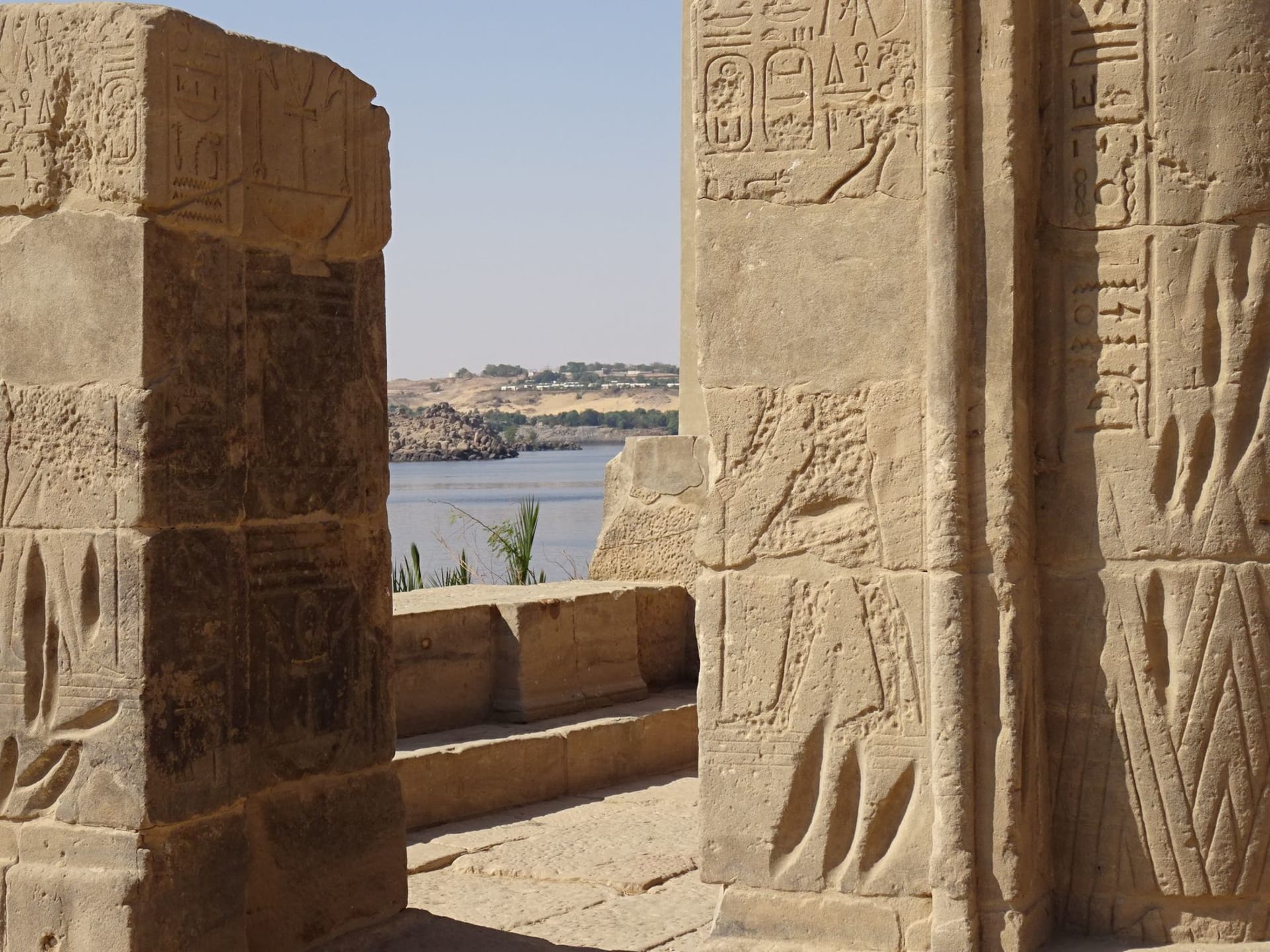
Kom Ombo appears suddenly on a bend in the Nile, and that location — the point where a long straight reach of river curves and the current slackens — is not accidental. The ancients understood the bend as a place of power, a point where the river showed its intention, and they built accordingly. I came upriver by felucca and saw the temple before I saw the town: two identical pylons, almost symmetrical, lit orange by the late sun and reflecting cleanly in the still water. The captain adjusted the sail so we approached slowly, which was the correct thing to do.

The temple is dedicated to two gods who had no obvious relationship — Sobek, the crocodile god of fertility and the Nile’s dangerous power, and Haroeris, a form of Horus the Elder associated with medicine and the sky. Each half of the temple is a mirror of the other: two hypostyle halls, two sanctuaries, two sets of priests, two sets of rituals performed simultaneously on either side of a shared central axis. The theological logic is not immediately clear, but the architectural solution is elegant — a building that contains a duality rather than resolving it. I walked the axis several times trying to locate the exact point where the building changes allegiance. I never found it.
The crocodile museum at the edge of the site holds mummified crocodiles found in the vicinity — dozens of them, wrapped in linen, their snouts still showing. In the Sobek cult the crocodiles were sacred animals, bred in the temple pool and buried with ceremony. Seeing them now in their glass cases, still perfectly intact, I had the odd feeling of looking at something that should have decayed centuries ago and simply did not, preserved by the same desert logic that saves everything here.

The town behind the temple is a sugar town — the surrounding countryside is cane fields, and the air sometimes carries a faint sweetness that mixes with river damp. In the evening the Corniche fills with local families walking and children eating ice cream and nothing is oriented toward tourism. I sat at a plastic chair facing the river and ordered a Fanta and felt entirely invisible in the best possible way.
When to go: Most visitors stop here in transit between Aswan and Edfu — on cruise ships or feluccas — and that is entirely reasonable. The temple is at its most photogenic at sunset when the stone turns gold against the river. Allow two hours minimum if you stop independently.