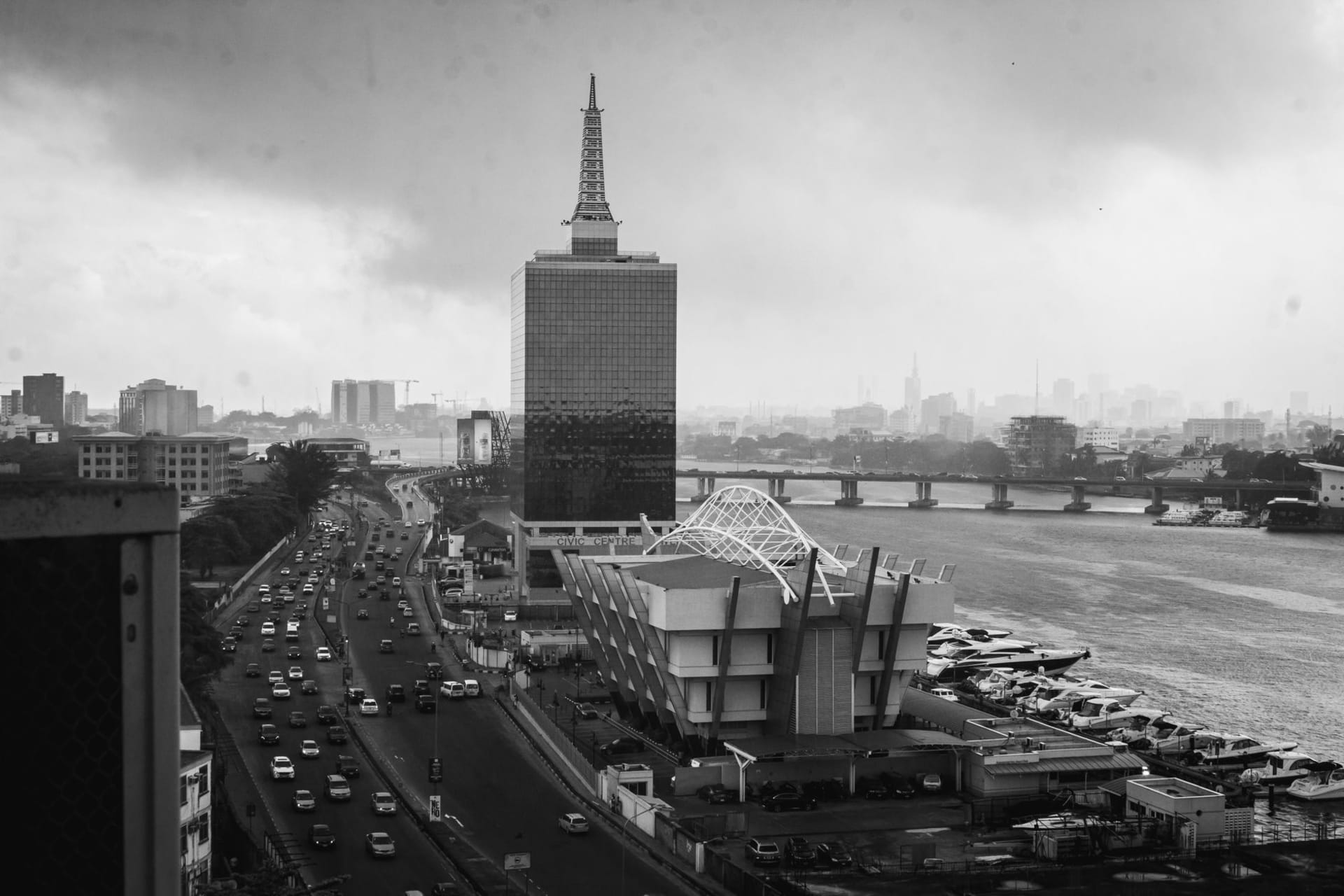
I arrived into Lagos on a Tuesday afternoon and the city started before the plane had finished taxiing. Through the oval window I could see a landscape of rooftops stretching in every direction to the horizon, interrupted only by the silver flash of the lagoon and the dense tangle of the expressway where traffic had already been stationary for what looked like hours. Nothing about Lagos begins gradually. It begins all at once, at full volume, and it expects you to keep up.
The airport at Murtala Muhammed is chaos in the most instructive sense. I watched strangers negotiate, joke, argue, and dissolve into laughter in the span of thirty seconds, and I understood immediately that the social bandwidth here operates on a register most places simply don’t have. The taxi driver who picked me up — a man named Emeka who had four phone calls going simultaneously while navigating the go-slow on the Lagos-Abeokuta expressway — told me he’d lived in London for seven years and come back because, as he put it, London was too quiet for him. That line stayed with me.

The creative energy in Lagos is the thing no description quite prepares you for. I spent an afternoon in Yaba, the neighbourhood everyone calls Lagos’s Brooklyn, though that comparison only goes so far. Yaba has its own logic, its own specific smell of open drains and frying plantain and someone’s printer working overtime on the ground floor of a building where a fashion label occupies the top two. I met a painter there who was finishing work destined for a gallery show in London, and in the same breath showed me a mural she’d done on the wall of a mechanic’s shop around the corner. The scale-switching is dizzying. The output is relentless. Afrobeats, Nollywood, contemporary art, fashion — all of it being made with an urgency and confidence that is, frankly, infectious. The rest of the world is catching up to what Lagos has already been doing for years.
In the evenings, Lekki Phase 1 becomes something else entirely. The suya vendors set up along the side roads around nine or ten, the charcoal smoke rising through the streetlights, the beef cut thin and pressed with yaji spice — ground groundnut, ginger, paprika, cloves — before being laid over hardwood coals. The char builds up the outside while the inside stays juicy, and you eat it standing at the roadside wrapped in newspaper, talking to whoever shows up next. The social life of this city happens outdoors and at speed and at night, once the heat has lost some of its weight.

Victoria Island and Ikoyi carry the glossier register — restaurants with proper wine lists, art galleries in converted townhouses, beach clubs facing the Atlantic. Tarkwa Bay, reached by motorboat from Five Cowrie Creek, is the city’s escape hatch: a beach that is quiet by Lagos standards, which still means someone has a speaker going at the water’s edge, but where you can actually see the horizon and breathe something other than traffic exhaust. The Atlantic here is rough and brown with silt, not the postcard turquoise of the brochures. There is something right about that — the ocean as Lagos makes it.
When to go: November through March is the dry season, when humidity drops to manageable levels and the harmattan haze gives everything a warm, gold-filtered light. Avoid peak rainy season (June to August) if you can — the flooding on the mainland makes navigation genuinely difficult, and the outdoor culture that makes Lagos vivid is largely muted. December brings a festive intensity that is worth experiencing if you can handle the crowds.