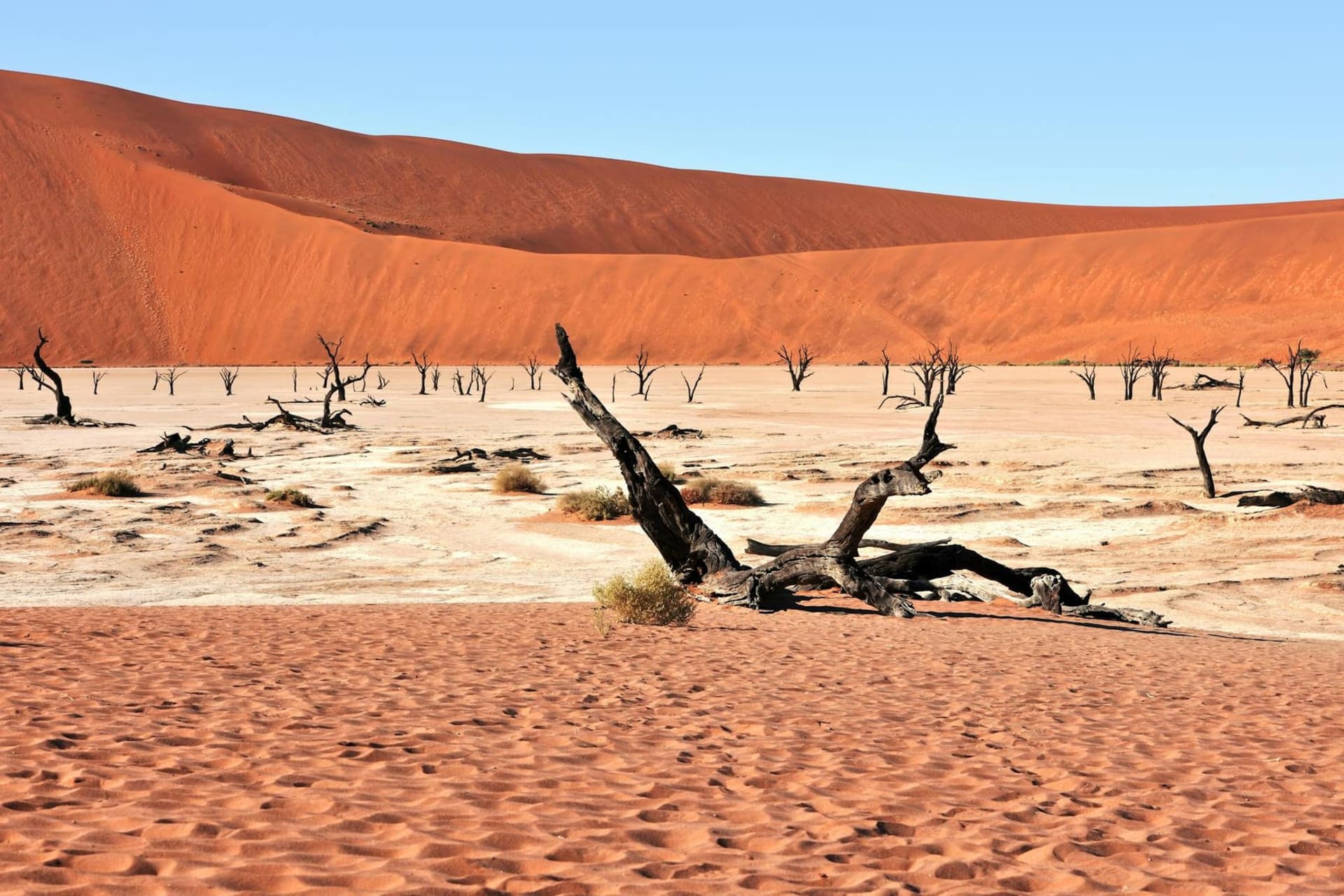
Deadvlei's bleached white clay pan with ancient dead camel thorn trees — the most photographed place in Africa.
The ranger at the Sesriem gate had warned us: go before first light, or the dunes will eat your ambitions. We set the alarm for 4:30, climbed into the 4x4 half-asleep, and drove the forty kilometres to Dune 45 in absolute darkness while the Southern Cross hung so low it felt like a ceiling.
The Walk Across the Pan
Nothing in any photograph prepares you for the spatial logic of Deadvlei. You park at the end of the two-wheel track, wade up a face of rust-red sand — the quartz grains here are iron-coated, five million years of oxidation, and they squeak faintly underfoot — and then you crest the ridge and the ground simply disappears into white. The clay pan stretches maybe five hundred metres across, perfectly flat, a colour somewhere between chalk and bone. Standing at the edge, Lia grabbed my arm without saying anything.
The camel thorn trees — Vachellia erioloba — died around 1350 CE when the Tsauchab River shifted course and left this bowl without water. The air here is so dry, so relentlessly antiseptic, that even bacteria can’t finish the job of decomposition. The trees just stand there, carbonised by centuries of sun, their branches describing black calligraphy against the dune wall. I stood next to one and felt obscurely ashamed of my camera.
What No One Tells You About the Light
Every travel image of Deadvlei is shot in the same two-hour window: the first light, when the eastern dune catches fire and the western face stays in purple shadow. What surprised me — genuinely stopped me mid-stride — was the silence. Not absence of sound but a physical silence, something with weight and texture. The sand absorbs it. At half past six in the morning, with maybe thirty other visitors scattered across the pan, I could hear the creak of my own boot leather. It felt like trespassing inside a painting.
The heat arrives fast. By eight the clay has warmed to the touch and the light bleaches flat. We retreated to the car, made instant coffee on the tailgate, watched the tour buses arrive in convoy.
Getting There and Moving Through
Sossusvlei sits inside the Namib-Naukluft National Park, accessed through Sesriem. The graded road from Sesriem Camp to the 2x4 parking area is manageable in most vehicles; the final stretch to the pan itself requires 4x4 or the park’s shuttle. We stayed two nights at Sesriem to catch both the sunset on the dunes and the pre-dawn walk — one night is never enough.
When to go: May through September offers cooler temperatures and clearer skies; the austral summer brings brutal midday heat above 45°C and occasional flash floods that can close the access road entirely.