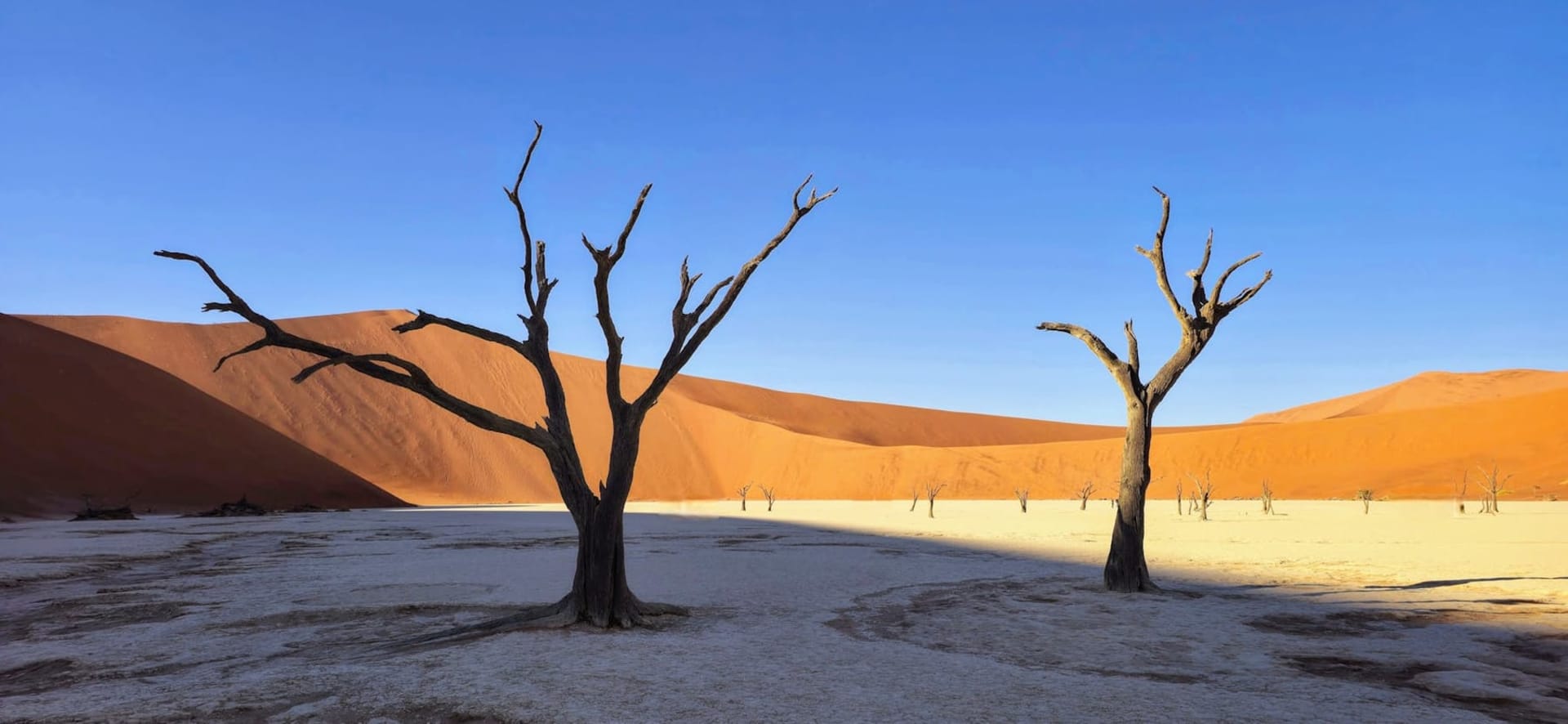
A remote highland massif in central Namibia with multi-day canyon hikes, natural pools and no cell signal for a week.
I paid the rescue fee at the Naukluft park gate with a kind of ceremonial focus. It is not a large sum, but the act of handing it over — in cash, at a wooden counter, to a ranger who then wrote your name into a physical ledger — makes the stakes legible in a way that a digital waiver never could. You are about to walk into a massif where no signal reaches, where water sources are mapped but not guaranteed, and where help, if it were needed, would take hours to arrive. Lia folded the receipt into her hip pocket and we drove to the trailhead without saying much.
Into the Gorge
The Naukluft Eight-Day Trail begins near the Tsams River crossing, a shallow, sandy thread that barely qualifies as a river in June. Within the first hour the path drops into a limestone gorge and the Namibian plateau disappears above you, replaced by walls of pale dolomite that glow amber by nine in the morning. The light here is not the flat, diffuse brightness of the coast. It arrives with direction, with weight, casting shadows sharp enough to read by.
I had read about the natural pools — Tufa Pool on day two, Arbeit Adelt on day four — but I had not expected their colour. Fed by springs filtering through limestone, the water holds a milky aquamarine, the kind of tint you associate with glacial melt, not the Namib. Lia sat at the edge of Tufa Pool for a long time before getting in, just looking. I understood. You want to record it before you disturb it.
The Surprise of Silence
What I had not anticipated was the quality of the silence. Not absence of sound — there are birds, wind, the knock of my boots on rock — but the complete removal of background frequency. No aircraft overhead. No road hum. By day three my body had stopped listening for those things, and I noticed the shift the way you notice a headache only once it has left.
The trail’s most disorienting stretch is the plateau section between Bergpos and the Quartz Valley, where the terrain flattens and the horizon becomes perfectly horizontal and vast. On a grey afternoon it felt briefly unreal, like walking through a painting of a landscape rather than through one.
Practical Notes
The park is administered from Sesriem, and permits must be arranged weeks in advance — the trail has a strict daily limit of three groups. Carry every litre of water between mapped sources; the rangers’ notes on reliability are current but not infallible.
When to go: May through September, when temperatures in the canyon stay manageable and the risk of flash flooding in the gorges is low. Avoid the summer months — the heat becomes a genuine emergency risk above 1,800 metres.