Khonoma
"The hornbill appeared in the oak tree above the trail and I stood so still my legs fell asleep."
The road to Khonoma climbs for twenty kilometres out of Kohima before depositing you at a ridge where the whole Dzükou valley system opens on one side and a staircase of rice terraces drops away on the other. I had hired a shared jeep with two Nagamese-speaking men who were returning to their village for a wedding, and they explained the terraces to me without being asked — that some of them are five hundred years old, that the Angami Naga who built them developed a water management system so sophisticated that engineers studied it in the twentieth century. The fields looked precisely like what water and rock can achieve given sufficient centuries of human patience.
Khonoma has been green by decree since 1998, when the village banned hunting and declared its surrounding forests a community conservation area. The forests above the village now hold what may be the densest population of Blyth’s tragopan — a spectacularly colored pheasant — in India, and the hornbills that gave Nagaland its festival emblem appear reliably in the canopy if you walk the upper trail before nine in the morning. I spent an hour on that path in complete silence, which is a more demanding discipline than it sounds when your natural instinct is to check your phone every ten minutes.

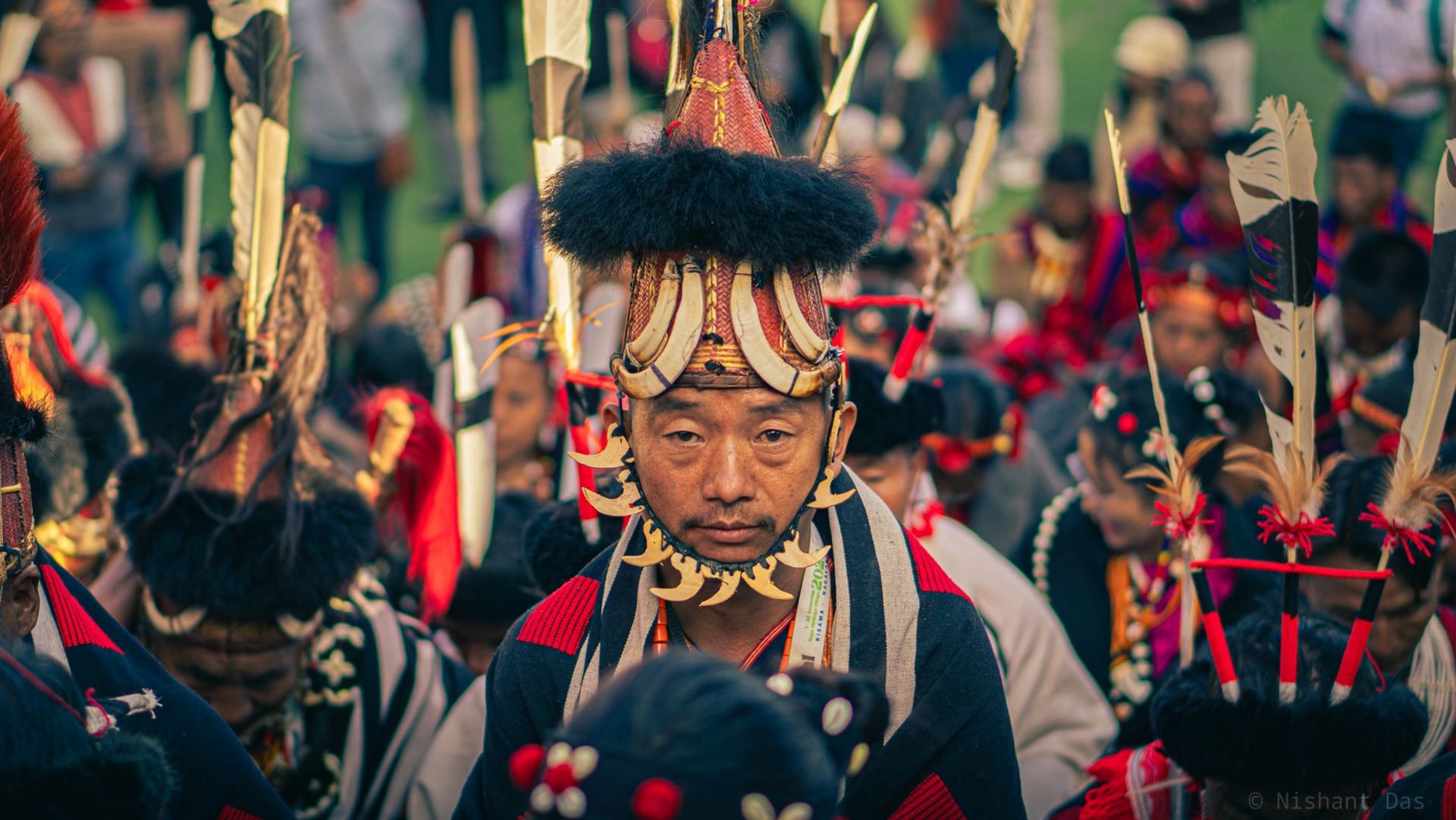
The village itself is a specific kind of beautiful — stone paths between traditional Angami houses whose outer walls are decorated with crossed dao blades and ceremonial horns from past mithun sacrifices. The Angami fought British colonial forces here with such ferocity that the village withstood three separate sieges; that history sits in the stonework, in the way the older men carry themselves, in the pride with which the village has refused to become a conventional tourist attraction. There are homestays, a small cultural museum, and a few food options — smoked pork appears at every meal, occasionally with rice wine that has a vinegary funkiness I grew fond of — but no souvenir stalls, no entrance fees, no organized performance. You are simply a guest in someone’s working village.
The terraces are planted twice a year with different varieties, and in September the standing water in the upper fields reflects the cloud-patterns in a way that is genuinely photographic in the old-fashioned sense — something your eye does before the camera does. Walking down through them in the afternoon light, the paths slippery with mountain clay, a group of women returning from the lower fields with baskets of mustard greens, felt like an older version of the world had been kept running in this one corner while the rest of it rushed ahead.

What stays with me is the texture of the village water — it runs cold and clear through a series of stone-lined channels that cross every path, fed by springs from the forest above. Everywhere in Khonoma, you hear it. After the heat and diesel of Kohima and the festival noise of Kisama, that sound of cold clean water running through stone was the most restorative thing I encountered in Nagaland.
When to go: October and November for trekking and clear skies, when the harvest is in and the terraces are golden. March through May brings wildflowers on the upper trails. December is crowded with festival visitors staying close to Kohima.