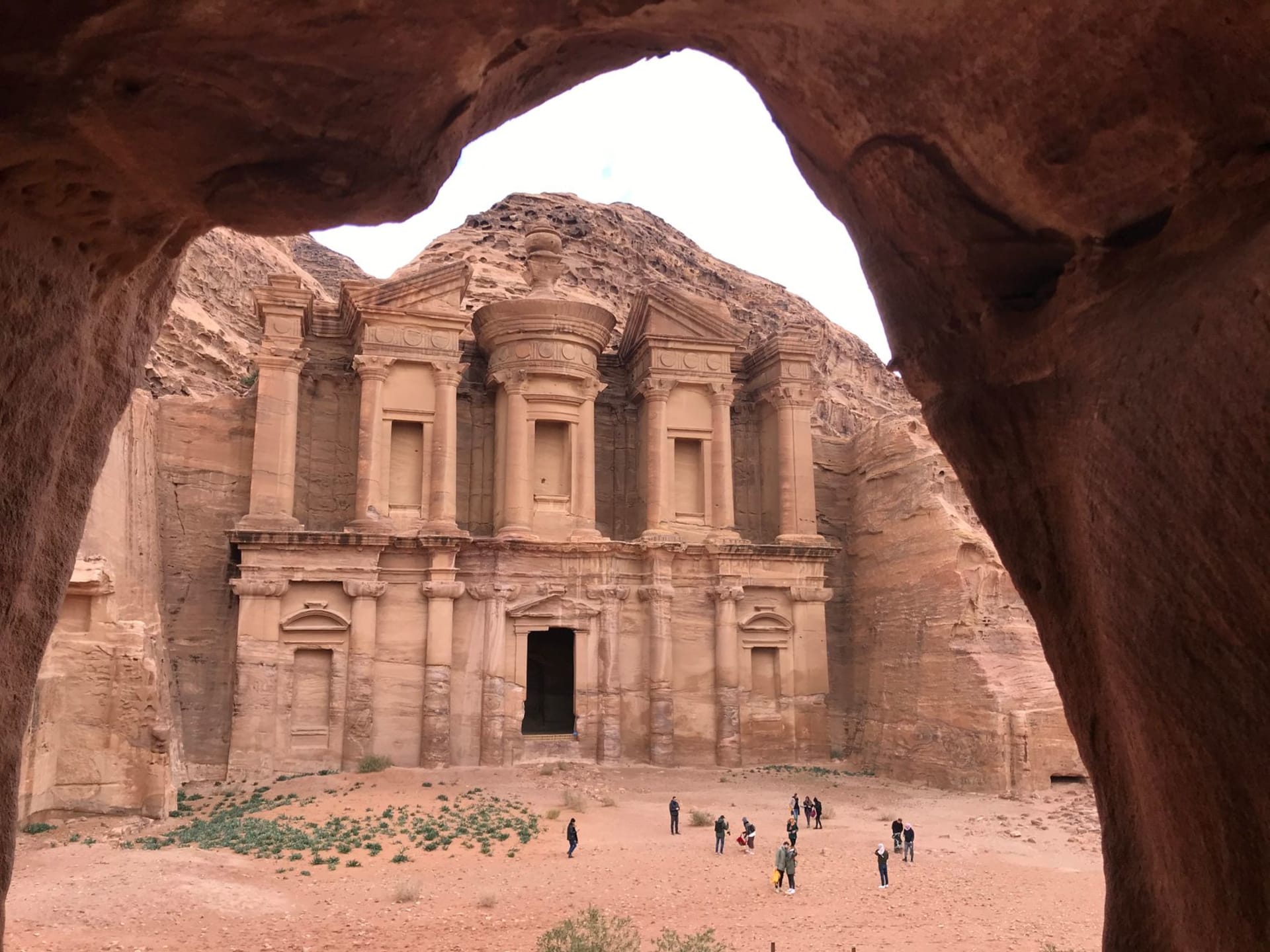
The High Place of Sacrifice
"Up here, Petra becomes a map and the mountains start to make more sense than the valley below."
The steps up to the High Place are cut into the living rock, which is a Nabataean thing — they did not build staircases so much as reveal them, cutting down through the sandstone surface to expose the path that was already inside the mountain. I climbed on a morning when the wind was coming from the west, carrying desert dust, and the light on the colored stone walls on either side of the path was doing something I kept stopping to look at — the way the layers in the sandstone, red and cream and violet, caught the morning at different angles, each band a different intensity. By the time I reached the ritual site at the top I had been climbing for forty minutes and had taken more photographs of rock than I usually consider acceptable.

The High Place of Sacrifice — Zibb Atuf in Arabic, a phrase that more or less translates to the sacred peak — is the best-preserved Nabataean open-air sanctuary ever found. Two obelisks carved from the mountain itself stand at the entrance, their purpose still debated: boundary markers? Symbolic representations of the gods Dushara and Al-Uzza? A message to approaching worshippers? Beyond them, the ritual platform opens: a courtyard, a triclinium for ritual meals, and the altar itself — a square block of stone with a drain cut into its surface for blood, a basin beside it for ablutions. The Nabataeans sacrificed animals here. Probably incense too, given that frankincense was both their trade commodity and their primary religious offering. Standing on the altar platform, the smoke of two thousand years of offerings impossible to smell but easy to imagine.
But the reason most people climb here — the reason I stayed two hours past when I had planned to — is the view. The whole of Petra spreads below you from up here in a way that is impossible from the valley floor. The colonnaded street runs straight through the center. The Royal Tombs face you on the eastern cliff. The Qasr al-Bint temple anchors the far end of the main plaza. You can see the geometry of the city — the way the Nabataeans organized their public space with Roman-period orderliness while simultaneously cramming tombs into every available canyon wall. And around all of it, the mountains, layer after layer of sandstone in colors that have no accurate English names, running out to the horizon.
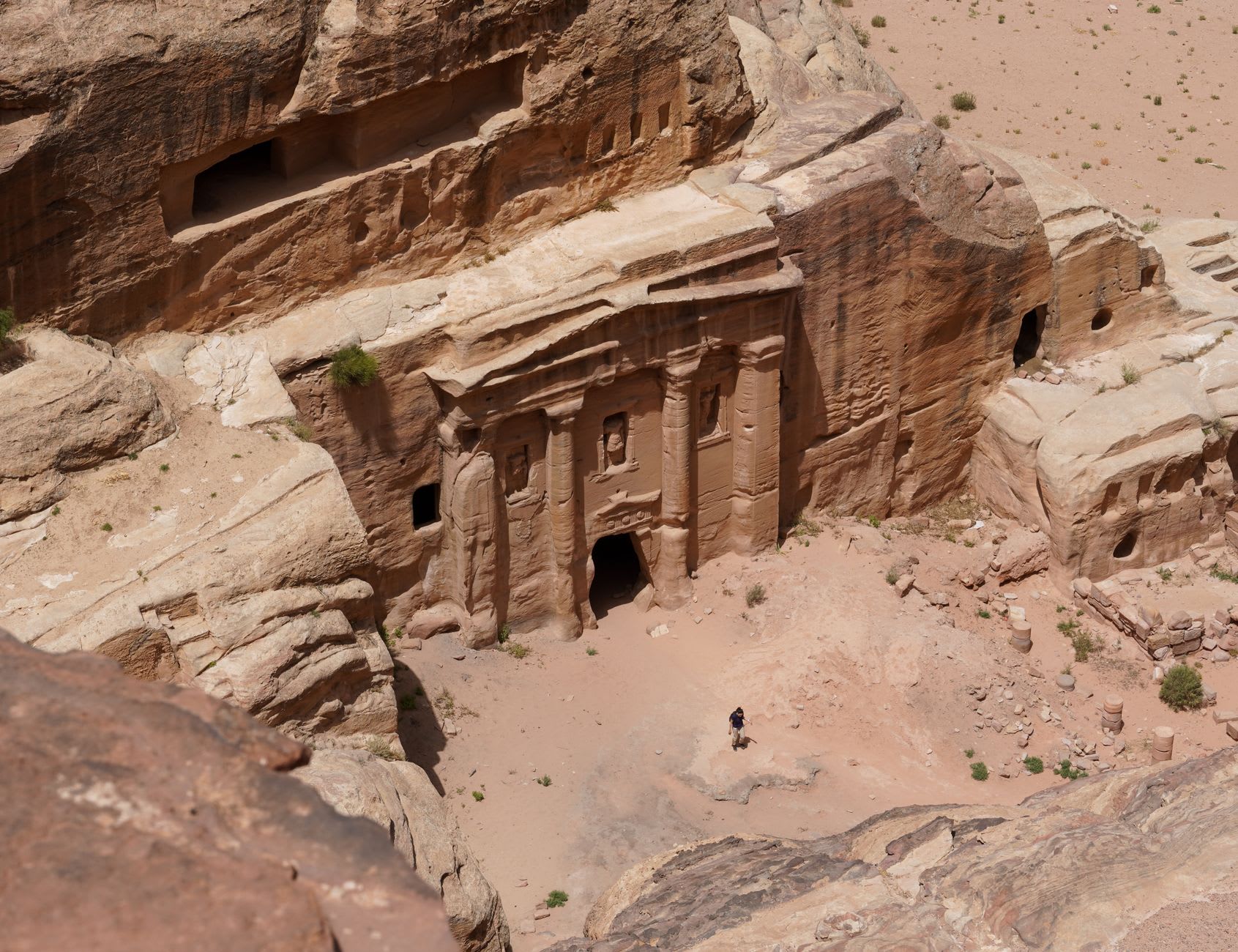
The descent on the western side passes two carved monuments usually called the Lion and the Obelisk Tomb, and a garden triclinium that still has its ceiling painting visible in fragments. Most visitors go back the way they came. The western descent is more interesting — longer, quieter, and it drops you out near the Colonnaded Street rather than back near the Siq, which makes it a natural second half of a circular morning. I descended with a Dutch couple I had met on the altar platform, none of us talking much, all of us a little stunned by what we had just seen.
When to go: The climb is most pleasant in the morning when temperatures are manageable and the light comes from the east, raking across the view below. Allow two to three hours for the round trip from the valley floor, more if you take the western descent. Spring and autumn are ideal; summer mornings are still feasible if you start before 7am and carry water.