Bagan
"From a balloon above Bagan, the thousand temples below make religion look like the most productive impulse humans ever had."
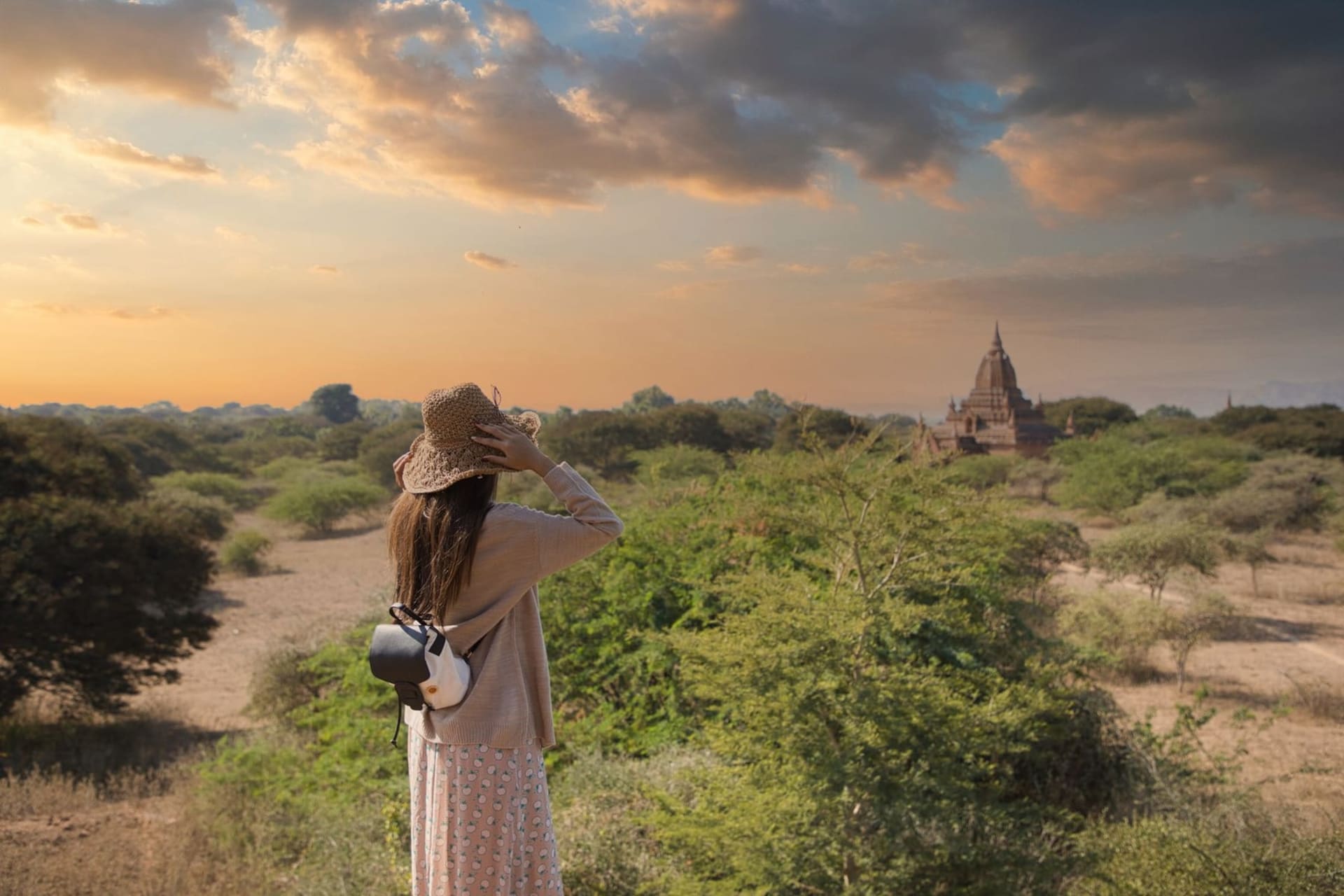
Thousands of red-brick temples punctuate the plains of the Irrawaddy, best seen from a hot-air balloon at dawn.
There is a particular quality of light in Bagan at five in the morning — not quite dark, not yet gold, a kind of bruised violet that turns the laterite stupas into silhouettes. I had stepped outside our guesthouse on Thiripyitsaya Road before Lia was even awake, and the air smelled of wood smoke and something floral I never managed to identify. A monk in saffron passed me on a bicycle without looking up.
The Plain at Ground Level
Most people come for the balloon, and I understand why. But Bagan’s real texture lives at ground level, in the hours when the tour groups haven’t arrived yet. I rented a creaking e-bike from a shop near the Nyaung-U market and spent an entire morning getting deliberately lost among the lesser temples — the unnamed ones, crumbling and unlabeled, where farmers have stacked hay against the outer walls and roosters patrol the gaps in the brickwork. Inside Sulamani Temple, I found faded murals the color of old blood: processions of figures carrying offerings toward a Buddha whose face had been worn smooth by centuries of incense smoke and devotion. The walls were warm to the touch even before the sun had fully risen.
At the Nyaung-U market, I ate a bowl of mohinga — the catfish-and-lemongrass noodle soup that functions as breakfast across Myanmar — standing at a wooden stall while a woman ladled broth with the practiced calm of someone who has done exactly this ten thousand times. The soup was sharper than I expected, bright with fish sauce and lime, nothing like the gentle versions I’d had in Yangon.
Above Everything
The balloon lifted just after dawn, and what surprised me — genuinely surprised me, because I had seen the photographs — was the silence. I had expected spectacle. What I got was something closer to bewilderment. The Irrawaddy glinted to the west. Below us, the two thousand-plus temples and pagodas of the Bagan plain spread in every direction without apparent order, as if the earth itself had been trying to express something it couldn’t quite finish. Lia gripped my arm and said nothing. There was nothing to say.
What I hadn’t anticipated was how small the human structures looked against the plain. All that devotion, all those kings and laborers and craftsmen across three centuries of the Pagan Kingdom — and the land simply absorbs it, patient and enormous.
Practical Notes
The afternoon light on the temples turns them from red to near-orange around four o’clock; Shwesandaw Pagoda fills with people chasing the sunset, but Buledi, a few minutes’ ride south, offers the same view without the crowd.
When to go: November through February brings dry weather and bearable heat — the cool mornings make early temple visits genuinely pleasant. Avoid the monsoon months of June through September when the laterite paths turn to mud and the mist never fully lifts.