Alyosha Monument
"He's sixty-five metres tall and staring into the distance. I kept looking to see what he was watching."
The climb up to Alyosha takes about twenty minutes from the city centre, which means twenty minutes of ice underfoot and wind coming in from the north, and no railing for the last section. I made this mistake in thin-soled city shoes, because I hadn’t yet understood that in Murmansk in December, every outdoor surface is a potential trap. By the time I reached the hilltop I was half-crawling and my hands were past feeling. Then I looked up and the monument was directly above me — a concrete soldier fifty-six metres tall on a nine-metre plinth, facing north over the bay, his coat sculpted in a way that made it look like it was still moving in the wind — and I forgot about my hands entirely.
Officially called the Monument to the Defenders of the Soviet Arctic, Alyosha has watched over Murmansk since 1974. He commemorates the soldiers, sailors, and partisans who repelled the Nazi advance on the Kola Peninsula during the Second World War — one of the few frontiers on the Eastern Front that the Germans never crossed. That fact is not incidental to the city’s identity. Murmansk is one of the few Soviet cities in the Arctic that was never occupied, and Alyosha is part of how that survival gets physically expressed.
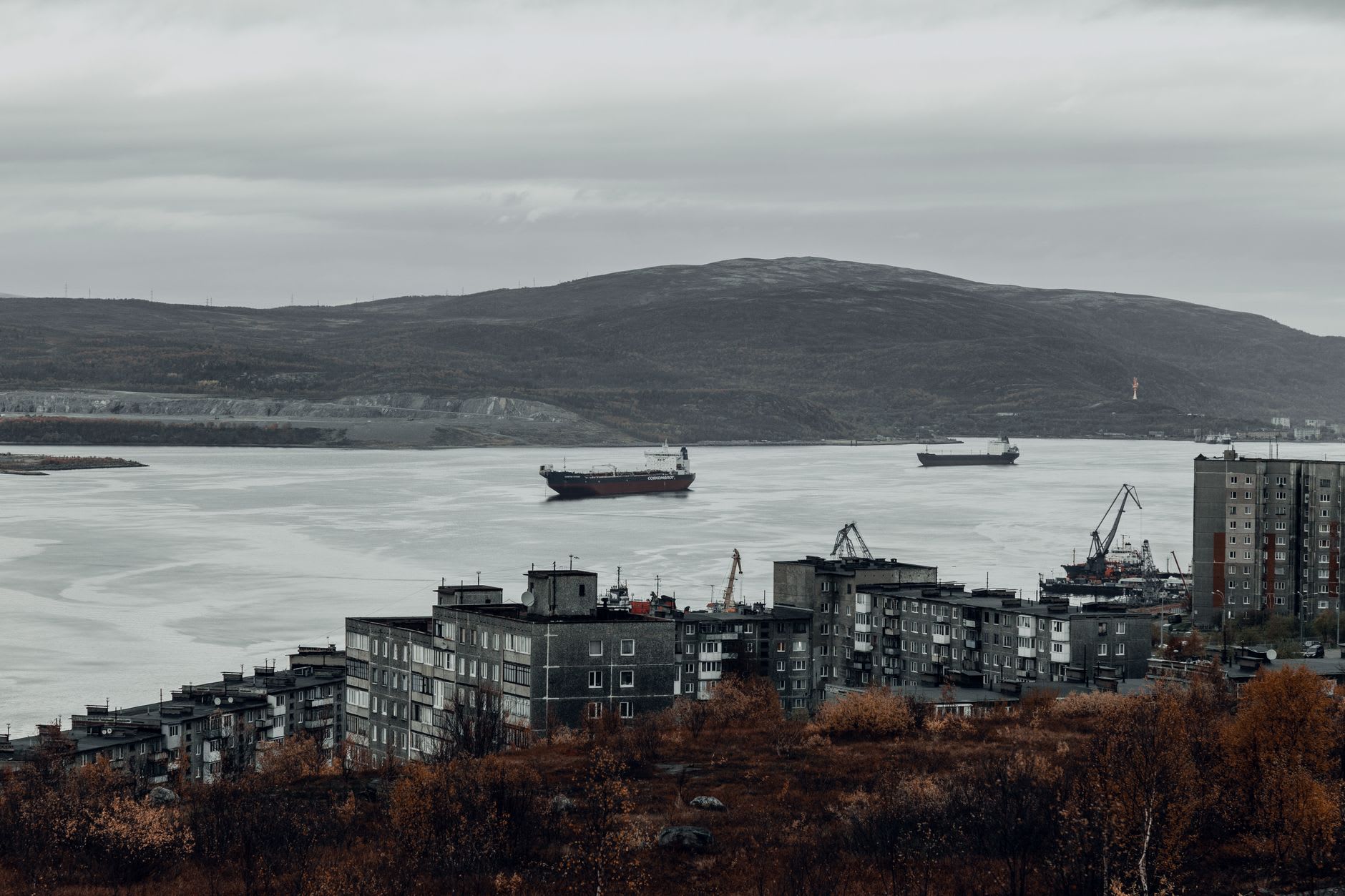
Standing on the observation platform at the monument’s base, Kola Bay opens up below you in a way that is almost indecent in its scale. The city crawls across the hillsides in its brutalist Soviet colour palette — faded ochre, grey, pale yellow — and the bay sits dark and vast beyond it. On the night I went, there were no other tourists. An older couple came up the path, spent about two minutes at the railing, and went back down without speaking. A stray dog of the specifically Russian urban variety — medium-sized, purposeful, utterly self-sufficient — appeared from somewhere behind the monument and watched me with what I interpreted as mild contempt.
I went back up to Alyosha on my fourth evening to see if the aurora would appear from the hilltop. It didn’t, but what happened instead was that the city lights below created a kind of low glow against the undersides of the clouds, and the monument above me caught that reflected light from below while the sky stayed dark above. For a strange twenty minutes, the soldier seemed to be lit from the inside — not dramatically, just barely, like something that generates its own heat. I took photographs that looked nothing like what I was seeing. This seems to be true of most things in the Arctic.

At the foot of the hill, before the main climb, there is an eternal flame burning in a small memorial plaza. Fresh flowers appear near it even in deep winter — not many, but consistently there. This is the thing about Soviet war memorials in Russian cities that keeps stopping me: they are not nostalgic in the way that monuments to distance can become. People actually use them. They are still, forty-five years after this one was built, places where the city brings its grief and its pride simultaneously. Alyosha is absolutely a Soviet construction, with everything that implies — the scale designed to dwarf the individual, the aesthetics of socialist realism — and he is also, genuinely, a point of orientation for a city that needs one.
When to go: The monument is striking in any season but the polar night gives it an intensity that’s hard to replicate. Go once during the brief twilight hour to see the panoramic view in that bruised purple light, and once after dark to see the city glow below. Aurora appearances directly above the monument are possible on clear nights between October and March.