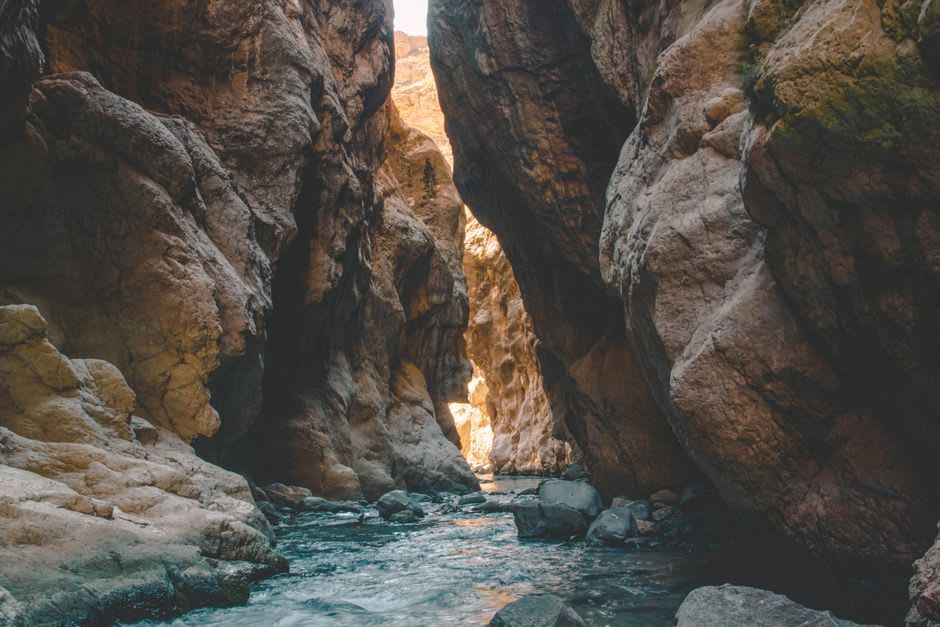
Towering limestone walls 300 metres high squeeze a cool stream through the heart of the High Atlas.
We arrived at Tinghir in the late afternoon, when the palmery was already pooling in shadow and the kasbah walls had gone the colour of dried blood. The taxi driver dropped us at the mouth of the road that threads east into the gorge, said something I didn’t catch over the engine noise, and was gone. Lia and I stood there with our bags and looked at each other. Neither of us had quite anticipated the scale.
Inside the Rock
Nothing prepares you for the moment the walls close in. You walk the paved road along the Oued Todra — a stream so shallow you can cross it in sandals without wetting your ankles — and then the canyon narrows to perhaps ten metres across and the cliffs shoot upward until the sky is a crooked blue seam five hundred feet above your head. The light at midday falls straight in like a spotlight; by three in the afternoon one wall is already deep in shade while the other still blazes amber. Swallows cut across that thin strip of sky, impossibly fast.
The rock itself is extraordinary up close. Banded in layers of rose and grey limestone, streaked with iron-red where mineral water has seeped for centuries, cold to the touch even in summer. I pressed my palm flat against it and felt the chill move up my arm.
The Unexpected Quiet
What surprised me was the silence. I had expected crowds — Todra Gorge appears on every Morocco itinerary — and there are tourist cafés right at the narrow section, tables arranged with a certain theatrical confidence on the boulders above the stream. But we arrived on a Tuesday in late October and by six in the evening the day-trippers had dissolved back toward Ouarzazate, and the gorge became something else entirely. Just the water noise, the occasional clatter of a stone dislodged somewhere high above, and the smell of cold rock and river mint crushed underfoot.
We ate a tagine of lamb and preserved lemon at one of the simple restaurants near the entrance, sitting on a low bench with our feet almost in the stream. The cook brought out a plate of msemen we hadn’t ordered, just set it down without explanation. We ate every piece.
Getting the Timing Right
The narrow section of the gorge — roughly the first 600 metres from the main café cluster — is accessible on foot in under an hour, though the road continues deeper into the mountains toward Tamtatouche for those with a vehicle or the appetite for more.
When to go: Spring (March to May) and autumn (September to November) offer the best balance of cool temperatures and clear light. The gorge is spectacular in all seasons, but summer midday heat in the canyon can be surprisingly fierce despite the altitude.