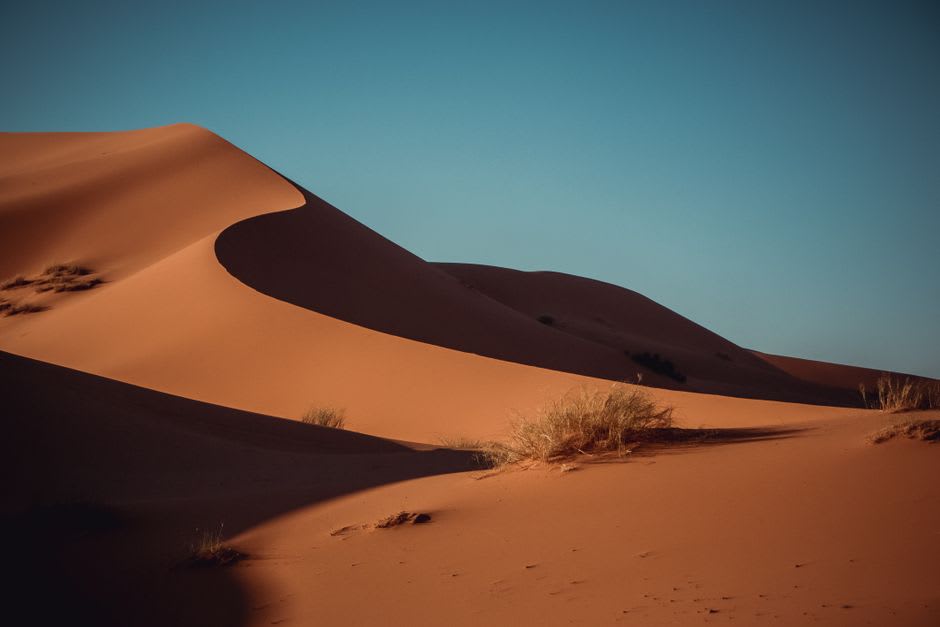
Gateway to the giant dunes of Erg Chebbi — the most photogenic corner of the Sahara in Morocco.
We arrived at Merzouga on the back half of a long day from Erfoud, the road narrowing to a single thread of tarmac through hammada — that flat, stony desert that looks like someone dragged a comb across the earth and left nothing behind. Then the dunes appeared. Not gradually. All at once, like a wall of fire rising from the horizon, the Erg Chebbi in full late-afternoon light, orange shading into rust shading into something closer to blood. I told Lia to look and she was already looking.
The Village at the Dune’s Edge
Merzouga itself is a loose scattering of guesthouses and auberges along the Avenue Principale, a sandy main drag where motorbikes idle and carpet sellers sit in open doorways pretending not to watch you pass. The real action is at the dune’s foot, where Café du Sud and a handful of similar places serve mint tea so sweet it leaves a furred coating on your teeth. We sat there the first evening until the last light drained out of the sky and the dunes went from orange to grey to almost nothing. The silence, once the generators cut out, was the most complete I have encountered anywhere. Not peaceful exactly. More like erasure.
Into the Erg
Going up the dunes on foot is harder than it looks from a photograph — two steps forward, one sliding back, the sand impossibly fine and dry. We went at five in the morning, before the camel tours started, the cold still sharp enough to need a jacket. At the crest of the first ridge the whole Erg opened up: dune after dune rolling south toward Algeria, scored with wind-carved ridges, no footprints on any of it. That was the unexpected thing — how private it felt. I had imagined Erg Chebbi to be crowded, Instagram-colonised, performed. Instead, in that hour before sunrise, it was genuinely empty. Just the two of us and the sound of the wind reshaping things.
For dinner we found ourselves at a small unnamed place near the village mosque, following a man who flagged us down from a plastic chair. Inside: a single room, three tables, a blackboard listing harira, tagine kefta, and merguez. The harira arrived first — thick lentil soup with a squeeze of lemon, cumin-dark, served with dates on the side. That combination, the warmth of the soup against the residual cold of the desert morning, was the meal of the trip.
When to go: October through March offers the most bearable temperatures — spring and autumn mornings are cool and clear, ideal for dune walking. Avoid July and August entirely; midday heat in the Erg exceeds 45°C and the sand itself becomes dangerous to touch.