Gobi Desert
"The Gobi is not empty. It is full of things you hadn't planned on noticing."
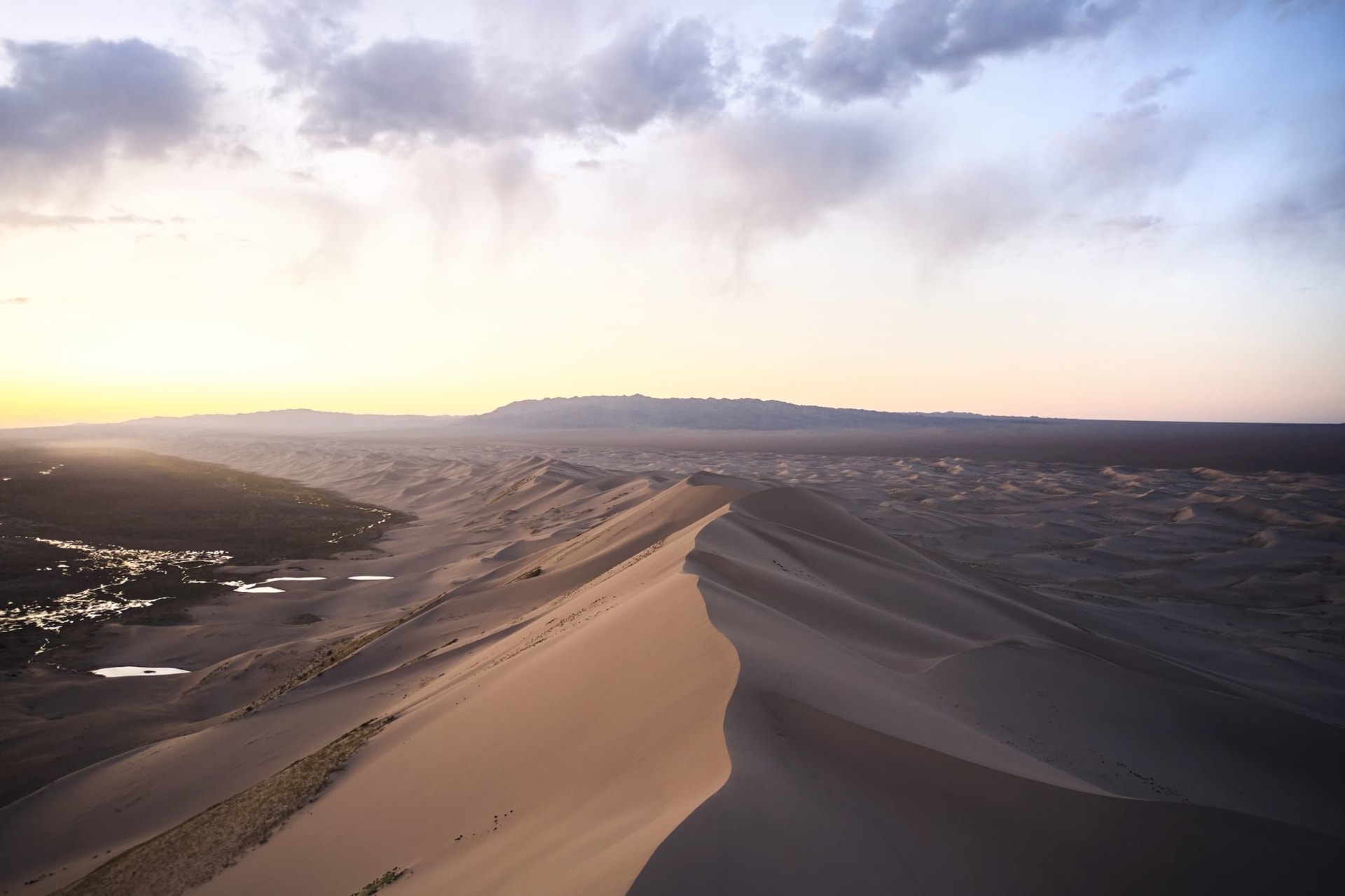
The first thing the Gobi corrects is the image you brought of it. I had been building it in my mind for months before I arrived — towering dunes, seas of sand, the aesthetic of Lawrence crossed with Dune. What I found stepping out of the Russian van twelve kilometres south of Dalanzadgad was grey-brown gravel stretching to three different horizons, a saxaul forest so low and twisted it looked like furniture left out in the rain, and a herd of Bactrian camels regarding me with the particular indifference camels have perfected over millennia. There were dunes — I would find them the next day at Khongoryn Els, enormous singing dunes that turn gold at every light change and produce a low hum audible from a kilometre away. But the Gobi is not primarily a dune field. It is something stranger, drier, and considerably more varied than that.

The Yol Valley cuts into the Gogobi Gurvan Saikhan mountain range like a wound — narrow, sheer-walled, shadowed even at midday — and in winter it fills with ice that persists into June in a canyon only a few metres wide. I walked into it in late August and the temperature dropped fifteen degrees within fifty metres. The valley is home to Lammergeiers — bearded vultures with wingspans that fill the gap between the walls — and the silence inside it is the concentrated kind, the kind that has geography and mass. A ger camp sits at the valley entrance, and the cook there made a mutton soup so dark and savoury it tasted like the valley itself had been strained into a bowl.
Nights in the Gobi hit differently than days. The temperature drops fast — sometimes thirty degrees from afternoon to midnight — and the sky that reveals itself after dark is not the sky you see anywhere with interference. The Milky Way does not streak across it; it occupies it, edge to edge, a river of light so dense it has texture. I lay on my back in the gravel for an hour the second night and felt the planet rotating, which sounds like a thing people say and in this case was simply a physical sensation I had not expected.

Travelling the Gobi means committing to a driver, a ger-to-ger route, and a loose schedule that the terrain will revise. Roads in the conventional sense do not exist — you follow GPS coordinates and wheel tracks across the gravel, occasionally arriving at an unmarked ger camp where someone will have tea ready and you will eat together before continuing. The family I spent a night with near the Flaming Cliffs had a twelve-year-old son who spoke workable English learned from a solar-powered tablet and wanted to discuss Arsenal FC at length. We talked football for forty minutes after dinner while his grandfather played a morin khuur in the corner of the ger. Nobody thought this was unusual. The Gobi accommodates everything.
When to go: May through June and September through October for manageable temperatures. July and August are hot but survivable with shade and water. The Gobi in winter is genuinely extreme and requires proper outfitting and an experienced local guide — not impossible, but not casual either.