Uxmal
"Built by a sorcerer, according to legend, in a single night. The stonework suggests otherwise — but only barely."
The difference between Uxmal and Chichén Itzá is the difference between a specialist’s obsession and a general attraction. Chichén Itzá draws two million visitors a year and has the infrastructure — the vendors, the crowds, the guided groups in matching T-shirts — that two million visitors require. Uxmal draws a fraction of that and has been left, largely, in the condition it deserves: a site of extraordinary beauty that you can walk through in something approaching contemplative silence.
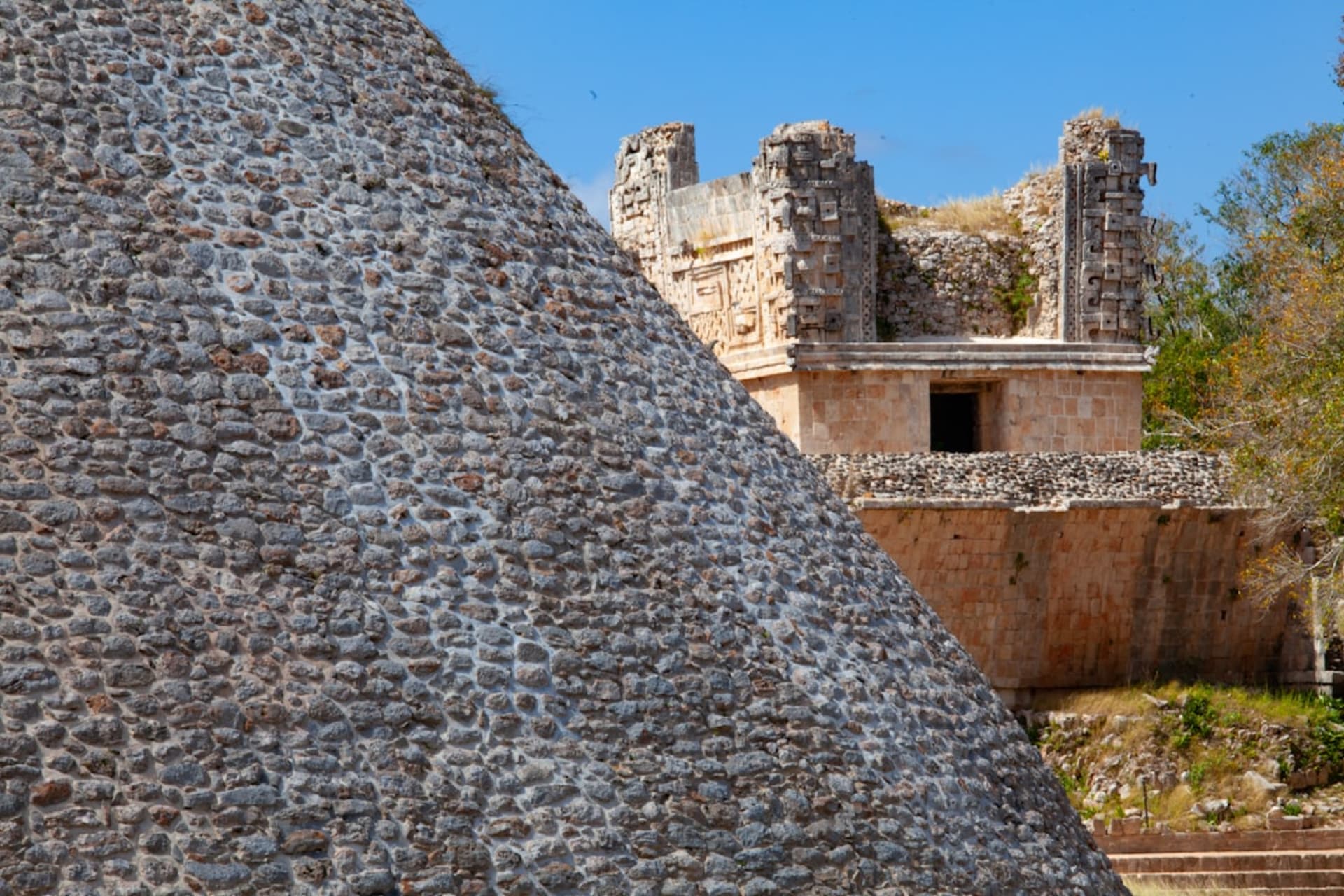
The architecture here is Puuc style — named for the low hills of the Yucatán where this regional tradition flourished between 700 and 1000 CE. Where Chichén Itzá favors mass and vertical drama, Uxmal favors surface: the facades of its buildings are covered in an extraordinarily dense geometric mosaic carved in limestone, the individual pieces cut and fitted with a precision that is still astonishing when you get close enough to examine them. Rain-god masks, serpent bodies, lattice patterns, astronomical symbols — the entire vocabulary of Late Classic Maya cosmology rendered in stone with the patience of a civilization that measured time in centuries.
The Pyramid of the Magician
The pyramid at the entrance to the site is one of the most immediately striking structures in all of Mesoamerica, for a reason that takes a moment to identify: its base is oval, not square. Every other major Mesoamerican pyramid is built on a rectangular plan. The Pyramid of the Magician — built over five construction phases spanning several centuries, each encasing the previous — has a rounded profile that gives it an almost organic silhouette against the sky, rising to 35 meters above the jungle floor.
The name comes from a Maya legend: a dwarf sorcerer built the pyramid in a single night to fulfill a prophetic challenge from the ruling lord. The construction archaeology suggests a rather more extended timeline, but the legend captures something true about the building’s uncanny appearance — it looks like something that should not be possible.
The Nunnery Quadrangle
The name is a colonial-era misnomer — the Spanish called it a nunnery because of its cloistered plan, but it was probably an administrative and ceremonial complex. What matters is the stonework: four long buildings arranged around a central courtyard, each facade covered in a different geometric pattern in the Puuc mosaic style.
The north building’s facade is the most elaborate — rain god masks stacked in vertical columns at the corners, a central doorway framed by serpent bodies, the entire upper register a mosaic of lattice and geometric forms. Looking at it for twenty minutes and then standing back and looking again: the scale of the project is what becomes clear slowly. Every stone cut by hand. Every piece fitted without mortar. The entire facade is essentially a giant stone puzzle, assembled with a tolerance for error that was apparently zero.
The Governor’s Palace
The Governor’s Palace — a long, low building on a raised platform at the southern end of the site — is considered by many archaeologists to be the finest single building in pre-Columbian Mesoamerica. The facade runs 98 meters and is covered in over 20,000 individually carved stone elements, assembled into a mosaic that includes the image of the ruling lord twice in the central doorway and astronomical references embedded in the geometric patterning.
The building is oriented to align with the rising of Venus at its southernmost point on the horizon — a deliberate astronomical targeting that required the architects to rotate the entire building slightly off the site’s main axis. Venus was the morning star of the Maya war cult. The alignment was the point.
The Sound and Light Show
Uxmal runs a nightly sound and light show that illuminates the major structures in sequence while narrating the site’s history. Unlike the similar shows at some archaeological sites, this one is worth attending: the light design on the Nunnery Quadrangle in particular reveals the mosaic detail in ways that daylight doesn’t, and the absence of crowds at night makes the site feel genuinely mysterious.
The show runs nightly, starts at dusk, and lasts about forty-five minutes. Check times at the entrance.
Practical Notes
The Puuc Route: Uxmal is the centerpiece of a circuit of five Puuc-style sites within an hour’s drive: Kabah (with its remarkable Codz Poop facade of 250 rain-god masks), Sayil, Xlapak, and Labná. A car or taxi for the day allows all five. The Ruta Puuc bus from Mérida runs this circuit once daily on Sundays only.
Getting there: 80 kilometers south of Mérida by highway. Buses from Mérida’s second-class terminal (Noreste) run several times daily (1.5h). Most visitors take a taxi or rental car. No buses back after 3pm — confirm return options before leaving Mérida.
When to go: November through March for bearable heat. Arrive at 8am opening for an hour before the day-tripper buses arrive from Mérida. The site has almost no shade; bring significant water and a hat.