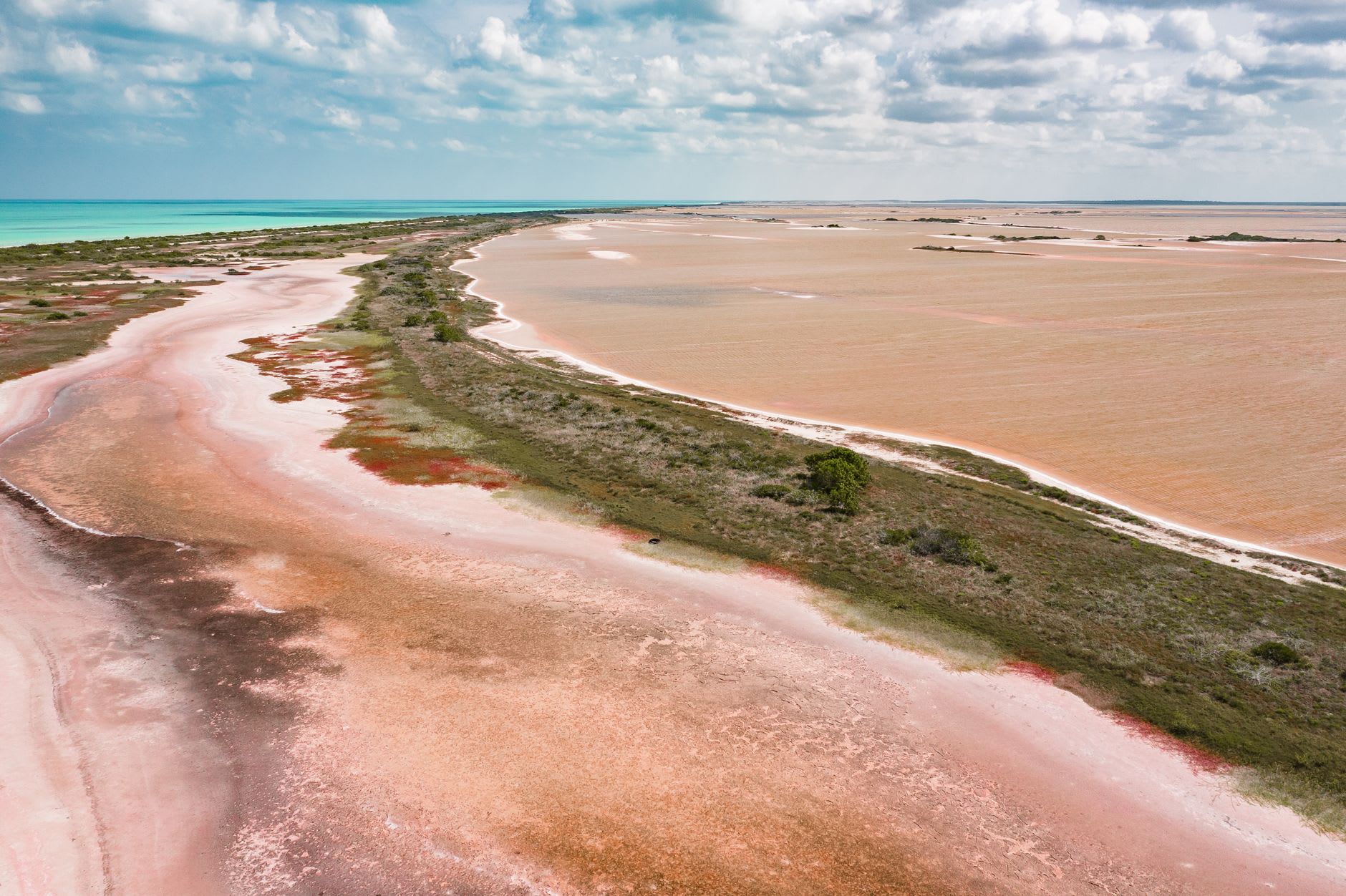
Río Lagartos
"There were perhaps a thousand flamingos and when they moved they moved as one thing, a coral pink wave that had no reason to be that color and was anyway."
Lia found Río Lagartos. I want to give credit where it belongs — I was focused on Chichén Itzá and the cenotes and the Ruta Puuc, and she was the one who said we needed to go north to the coast first, that the flamingos were worth the detour. She was correct, as she frequently is when I am being too structured in my itinerary thinking.
Río Lagartos is a fishing village on the north coast of the Yucatán Peninsula, the coast that faces the Gulf of Mexico rather than the Caribbean. This distinction matters: the north coast is flat, hot, less developed, less photographed, and almost entirely overlooked by the tourist circuit that concentrates on Cancún and the Riviera Maya to the east. The village itself is small — a few streets, a waterfront malecón, fishing boats, a population that fishes and guides tourists with roughly equal energy. It sits at the edge of the Reserva de la Biosfera Ría Lagartos, a 60,000-hectare estuary and mangrove system that is one of the most important flamingo nesting sites in the Americas.
The Dawn Boat Tour
Every guide I found online, every person in the village who mentioned the flamingos, every piece of advice I received in advance said the same thing: go at dawn. We went at dawn. We hired a guide named Fredy, who was a fisherman first and a birder second but who was effectively ornithological in his knowledge of everything inside the reserve. He ran a small lanchasupported by a cooperative of local guides that has been running these tours for over a decade.
We left the village dock at 5:15am in a flat-bottomed boat, the sky still dark at the edges. The ría — the estuary — opens wide from the village, and we moved through channels flanked by mangroves in the half-dark, Fredy running the engine at low throttle and using a flashlight to check the water ahead. The mangroves closed over us in places, the roots visible at water level, and then opened into wider sections where the stars were still clear above.
The flamingos arrive in their main nesting area about forty minutes from the village. Fredy cut the engine 200 meters out, let the boat drift. The sky was beginning to pale.
They were already moving when I first saw them — not individual birds but the collective, a coral-pink mass at the edge of the flat water, wading and feeding in the shallow brackish zone. A thousand birds, possibly more; Fredy said the colony numbered roughly 25,000 in the reserve and the section we were watching was one node of it. The color is the first thing, and it’s a problem for language: flamingo pink is not the pink of anything I have useful reference for. It’s coral, but brighter. It’s something between living tissue and a specific wavelength of light that you associate with sunrise rather than biology. I took thirty photographs and none of them were adequate.
The movement is the second thing. When the colony shifted — and it shifted constantly, each bird adjusting position in response to the birds around it, the whole group feeding in slow coordinated sweeps across the shallows — it moved as a single unit. A thousand birds making the same turn, the same extension of neck, the same step into the water. It looked edited. It looked like something that required choreography. What it actually required was evolutionary pressure over millions of years to produce a social feeding behavior that is more efficient in groups, and Fredy explained this while pointing at a sub-group doing something slightly different near the mangrove edge. He knew the behavior patterns — not just species identification but what specific movements indicated, whether the birds were feeding well or disturbed, which individuals were paired for the season.
We stayed for perhaps an hour at the flamingo site. Fredy then moved us through the mangrove channels to see the rest of the reserve: spoonbills (again — Tabasco had not been enough), magnificent frigatebirds riding thermals above the estuary, a pair of ospreys on a dead mangrove branch, a crocodile in the channel that Fredy pointed out by its eyes, two small points of amber reflection in the beam of his flashlight at the water surface.
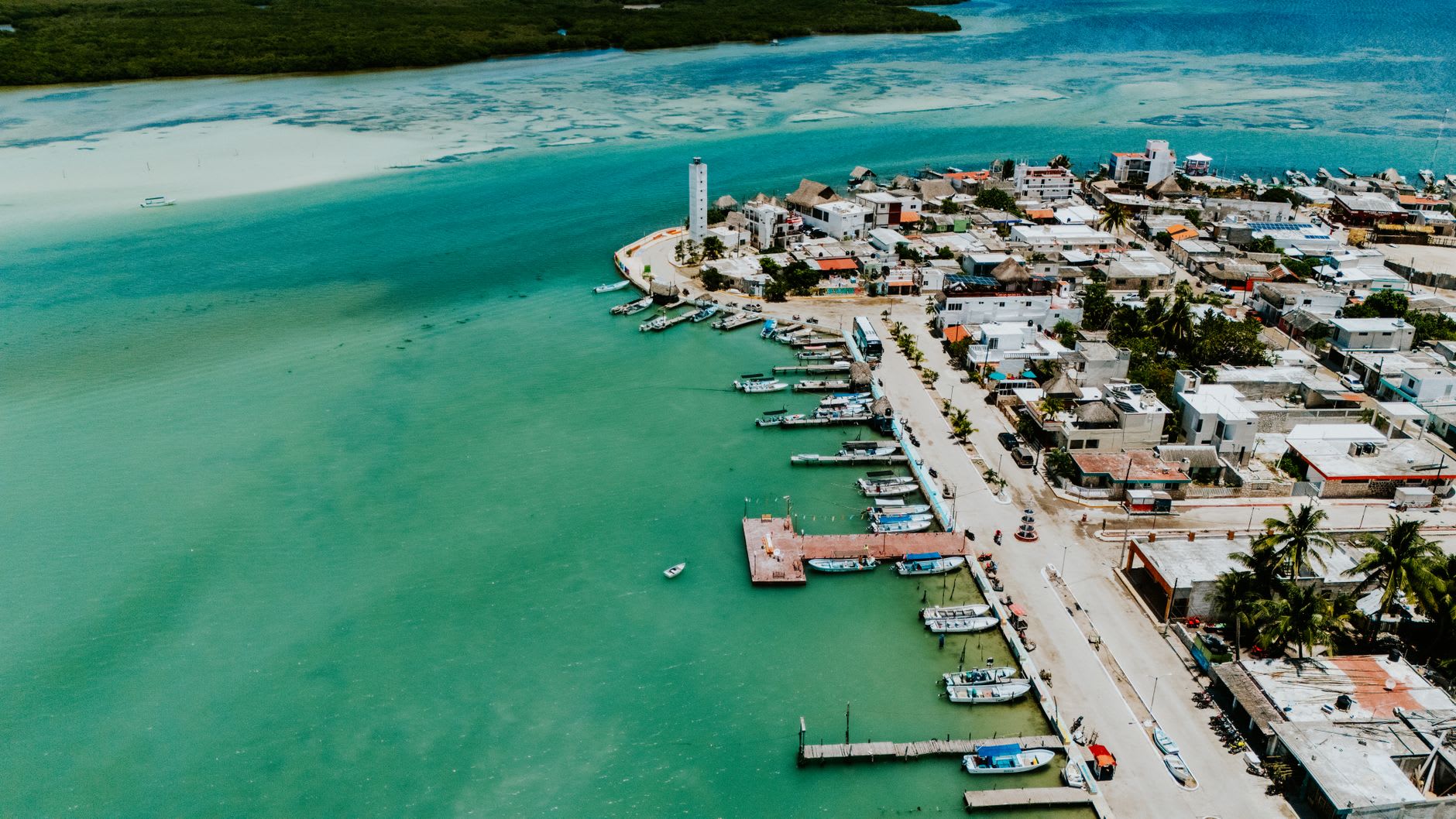
The Saltflats and Lia’s Better Judgment
Las Coloradas are the pink saltflats 15 kilometers east of Río Lagartos along the coastal road, and they are the reason the village has recently started appearing on social media with some frequency. The color is produced by halophilic microorganisms — salt-loving algae and bacteria — in the concentrated brine pools of a working salt operation. It is not a natural wonder in the pristine sense; it’s an industrial facility whose byproduct happens to be a shocking Barbie-coral-pink that photographs extraordinarily well.
Fredy’s tour included a stop there after the flamingo site. The color at 8am with the sun already building was extraordinary — a large shallow pool of water so pink it looked photoshopped, surrounded by salt piles and the processing infrastructure of a salt company that has presumably become somewhat accustomed to tourists appearing to document their facilities.
Lia noticed, as we were standing at the edge of the pink water, that there were people applying the pink mud to their faces and arms. She looked at me. I looked at the mud. The mud in the saltflat zone has a high mineral content and is said to be good for skin — this is either true or it is the kind of thing that becomes true when enough people say it in enough influencer captions, and in this case I am not equipped to distinguish between them.
“Apparently you’re supposed to put it on,” Lia said.
I said I would not.
“I’ll go first,” she said.
She crouched at the edge and applied a quantity of the pink mud to her forearms, and then, for reasons I still don’t fully understand, also to her face. I stood at the edge of the pink pool in the 8am Yucatán heat watching my partner apply salt-flat mud to herself and thought: this is the specific absurdity of being a person who travels. Fredy watched us from the boat with the expression of a man who has seen this many times.
I did eventually apply a small amount to one forearm, under peer pressure. My skin felt soft afterward. I am not conceding anything by reporting this factually.
Getting There and Practical Notes
Río Lagartos is approximately 100 kilometers north of Valladolid by car — about 90 minutes. From Mérida it’s around 200 kilometers, roughly two and a half hours. There’s no direct ADO service to the village itself; buses run to nearby El Cuyo and Tizimín, from which you can take a colectivo. The road is flat and straightforward.
For overnight options: the village has a small number of hotels and guesthouses, mostly family-run. They are simple and usually include access to guide contacts. I’d recommend staying at least one night — the dawn boat tour requires an early departure and staying in the village eliminates the logistical problem of arriving from elsewhere at 5am.
For tours: the local guides cooperative operates from the waterfront. Guides should be licensed by SEMARNAT (the Mexican environmental agency) to enter the biosphere. Fredy runs tours through this system. The price for a 3-4 hour dawn tour including the flamingo site and Las Coloradas is negotiated locally and is very reasonable relative to what the experience delivers.
The reserve is open year-round. The flamingo breeding season runs from April through July — this is when the colony is at its largest and the nesting behavior most visible. Outside breeding season the flamingos are present but more dispersed. December through March is excellent for bird diversity generally, as migratory species from North America are passing through.
Do not confuse Las Coloradas with a natural wilderness area — it’s an industrial site with a striking aesthetic. Go, photograph it, apply the mud if that’s your instinct. Just be clear about what it is.