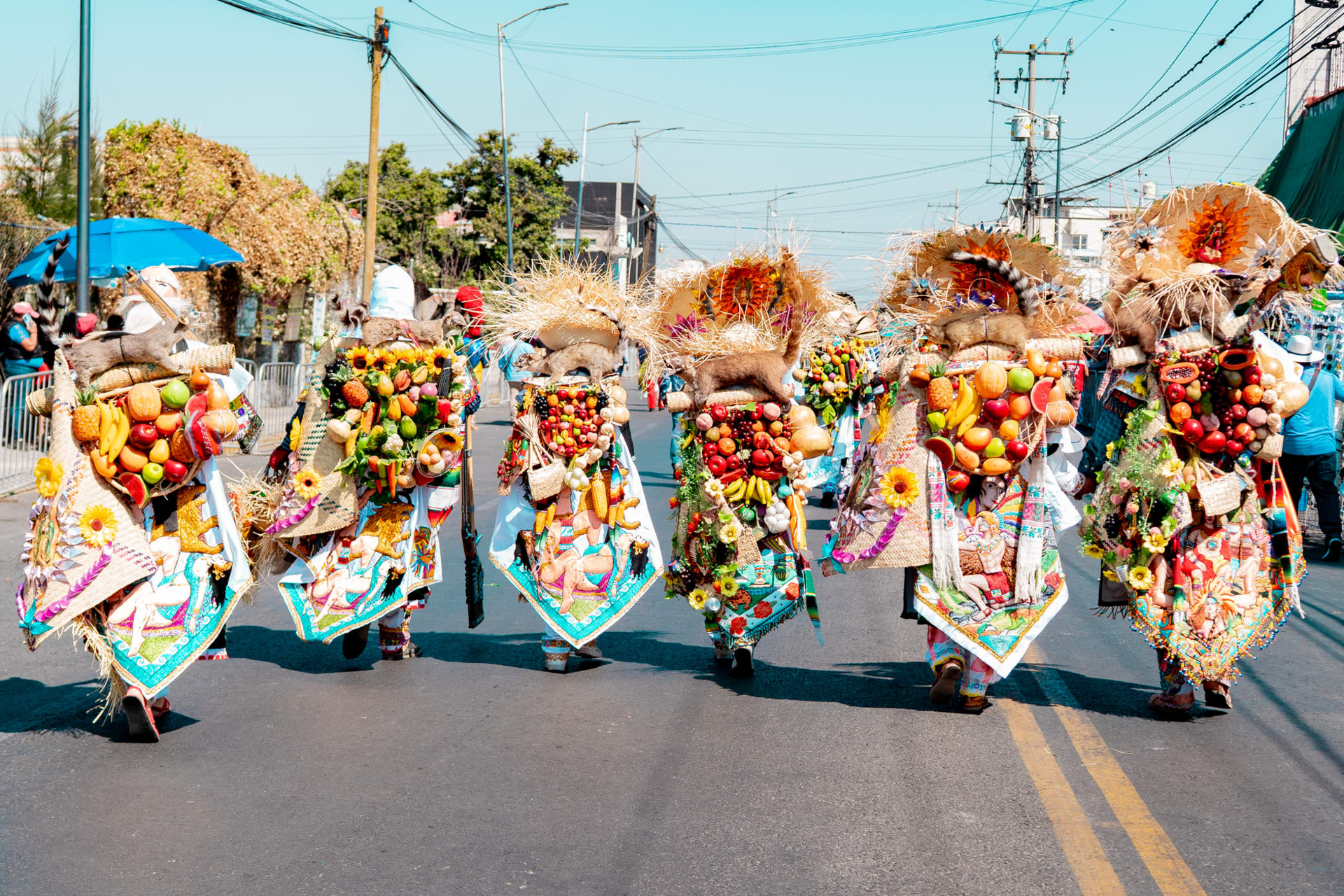
Huamantla
"They were building something extraordinary across the entire city, knowing it would be gone by morning. I kept having to remind myself this was normal to them."
I arrived in Huamantla two days before the Noche que Nadie Duerme, the Night Nobody Sleeps, which is either too early or exactly right depending on what you want from it. If you come the day before, you see the preparation. If you come two days before, you see the preparation of the preparation — the sorting of sawdust by color, the drying of flower petals, the groups of families and neighborhood associations sitting on the sidewalk making scale drawings of their designs before committing to the street.
Huamantla is a quiet town of about 50,000 people in the foothills of the Sierra Malinche in eastern Tlaxcala — a pleasant colonial center, a good regional market, the kind of place you might spend a pleasant half-day without urgency. Then August arrives and the entire city tilts toward the festival, and quiet becomes wrong as a description.
The Alfombras
The alfombras — the carpets — are the central event, and the word carpet undersells them. They are created from dyed sawdust, flower petals, sand, seeds, and other organic materials, laid across the streets of the city center in continuous geometric and figurative designs that in some cases extend for several city blocks. Individual neighborhoods and families claim their sections of street weeks in advance. The designs range from elaborate pre-Columbian geometric patterns to devotional Catholic imagery to portraits to purely abstract compositions — whatever the makers decide. Some of them are technically astonishing.
The carpets are made the night before the procession. The Night Nobody Sleeps refers literally to the fact that people work through the night — families, neighbors, groups of all ages, children included — to complete the design before dawn, when the procession of the Virgin of Charity passes over it and the carpets are destroyed. By mid-morning they are gone. The street sweepers come through and the season’s work is over.
I walked through the city at eleven at night and then again at two in the morning and again at five. Each time the carpets were more complete and the atmosphere was more charged — not a party atmosphere, exactly, but focused, purposeful, the hum of a city doing something it has been doing for a long time and considers important. Fathers holding flashlights while their daughters laid out flower petals by color. Groups of young men applying sawdust through stencils with the focused economy of people who have done this before. An old woman directing the final positioning of the centerpiece of her block’s design with the authority of someone who has been making this particular carpet for forty years.
France has elaborate civic festivals — the Carnival of Nice, the rose festivals of Provence — but I am trying to think of an equivalent to this: an entire city staying up all night to make something beautiful knowing it will be destroyed in hours. The Bayeux Tapestry is eleven hundred years old. These carpets are eleven hours old when they end.
The Puppet Museum
The Museo Nacional del Títere occupies a section of the former convent of San Luis Obispo, a colonial building on the edge of the historic center. It is a serious collection — not a cabinet of curiosities but a properly curated institution tracing the history of puppet theater in Mexico from pre-Columbian figurines through the golden age of traveling puppet shows in the nineteenth and twentieth centuries to contemporary puppetry as performance art.
The Mexican puppet tradition is richer than I had understood. The theater-in-miniature that itinerant puppeteers took through towns and villages across the country for two hundred years was the main access many communities had to narrative performance — to comedy, tragedy, political satire, ghost stories, love stories. The puppets in the collection carry this history in their faces. Some of them are carved wood with paint worn to the grain; some are articulated wire figures with papier-mâché heads; some are soft-bodied cloth puppets with glass eyes. A few are simply disturbing in the way that well-made old dolls are disturbing, which is to say in a way that suggests interior life.
I spent an hour in there and could have spent more. The restoration work on the older puppets is excellent. The museum also runs workshops during the festival season, if you’re staying long enough.
The Feria and Getting There
The Feria de Huamantla runs through most of August — bullfighting, traditional music, regional food vendors, fairground rides, the full machinery of a Mexican state fair. The Noche que Nadie Duerme occurs in mid-August, the exact date tied to the feast of the Assumption. Book accommodation several weeks in advance if you want to be in the city for the Night; Huamantla is small and its guesthouses fill.

Huamantla is about 45 kilometers east of Tlaxcala city and about 40 kilometers west of Puebla on the road through the Sierra Malinche. Buses from both Tlaxcala and Puebla run regularly. Outside of August the town is worth a visit for the puppet museum and the colonial center, but if the Noche que Nadie Duerme is even remotely possible for your schedule, arrange your schedule around it. I have not seen anything else in Mexico quite like it.