Balancán
"At four in the morning, the howler monkeys started. The sound is not a howl. It is a roar, and it belongs to the darkness entirely."
I arrived in Balancán by second-class bus from Villahermosa, a five-hour journey on a road that crosses the flat floodplain of eastern Tabasco — an ancient seafloor now given over to cattle, sugarcane, and water. The Tabasco floodplain is one of the wettest places in Mexico, and in the bus window the landscape is a sequence of lagoons, wetlands, and river oxbows that the road navigates without urgency. I ate a bag of churros from a vendor at the Emiliano Zapata stop and watched a great blue heron stand entirely still in a roadside lagoon as if it had been assigned to that specific spot.
Balancán itself is a small municipal seat on the western bank of the Usumacinta — the great river that forms the boundary between Mexico and Guatemala further south, and which here is wide and brown and moving with the authority of a river that has been doing this for a very long time. The economy is cattle ranching and river fishing. The town has a market, a few basic hotels, a zócalo with plastic chairs in the shade. This is not a tourist town. There is no tourist infrastructure in Balancán in the way that phrase is usually meant. There is one hotel where I stayed that was clean and had a working fan and a woman who made breakfast.
Four in the Morning
I had been told about the howler monkeys before I went. The howler monkey (Alouatta palliata in these forests) is the loudest land animal in the Americas and produces a sound that is difficult to prepare for through description. “Howl” is inadequate. What comes out of the forest at four in the morning is something between a roar and a bellow, a low-frequency sound that seems to vibrate the air rather than simply pass through it, and which carries for two or three kilometers in the pre-dawn silence.
I woke up to it at four a.m., lying in my hotel room with the fan turning slowly overhead, and lay completely still for about five minutes trying to decide if what I was hearing was what I thought it was. It was. There were several animals — a troop, I later learned, tends to have one or two adult males who lead the dawn chorus — and they were answering each other from different positions in the trees along the river bank, the calls overlapping into something that sounded genuinely primeval.
I got up and walked to the river. This was perhaps not the most prudent decision at four in the morning in a town I didn’t know, but the calls were pulling me in a direction and the streets were empty and safe and the night was warm. At the river bank I stood under a large ceiba tree and listened for forty minutes while the monkeys finished their morning business and the sky began to lighten over the far bank, which is Guatemala.
The River at Dawn
The Usumacinta at dawn is one of those landscapes that earns its reputation without effort. Wide, flat, moving. The far bank is dense tropical forest, unbroken. The near bank has the town’s fishermen already on it by five-thirty — men in small boats with outboard motors, heading downriver to their nets.
The herons are the main event. Great blue herons, little blue herons, tricolored herons, and — if you’re patient, which the morning suggests you be — the occasional roseate spoonbill, pink as a flamingo, working the shallows with the side-to-side sweep of its spatulate bill. I had my coffee from a thermos and stood on the bank for an hour while the light went from grey to gold and the fishermen’s boats became visible as silhouettes moving against the far bank.

Pomoná and the Honey
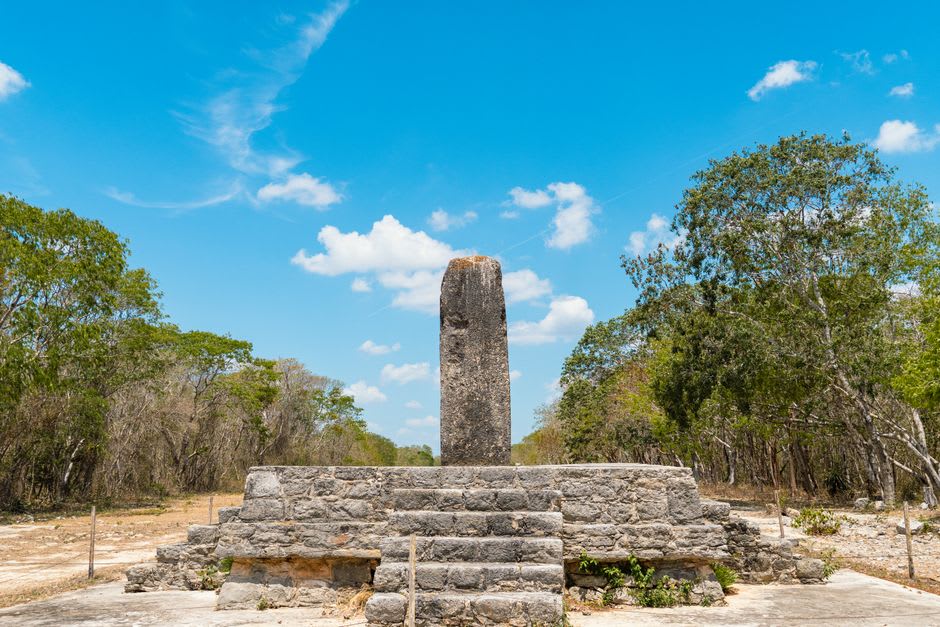
Two things to do from Balancán: visit the Pomoná archaeological zone, a Chontal Maya site about thirty kilometers east, where you’ll find carved stelae and platform structures in a cleared jungle setting with very few other visitors; and buy honey at the market.
The honey is from stingless native bees — Melipona beecheii, a small bee that the Maya have kept for centuries — and it is fundamentally different from European honeybee honey: thinner, more acidic, with a complexity that ranges from floral to almost fermented depending on what the bees have been working. A small glass jar of it cost me forty pesos at the market from a man who extracted it from a wooden box log and filled the jar while I watched.
In France, I grew up with the idea that honey is honey — clover honey, lavender honey, chestnut honey — and the variation within that category is real but legible. Melipona honey is outside that category. It tastes like a decision made in a different taxonomic universe.
Getting to Balancán requires either a second-class bus from Villahermosa or a car, and the car is genuinely better for exploring the surrounding floodplain. But the bus journey itself — five hours through the Tabasco wetlands, stopping at villages you’d never find on your own — is one of the best ways to arrive somewhere slowly enough to understand where you are.