Monte Albán
"At eight in the morning I had the Grand Plaza almost to myself. By ten the tour groups arrived. The difference between these two versions of Monte Albán is not small."
I went twice. The first time was mid-morning, arriving around ten, when the site was already filling with tour groups from Oaxaca City and the light was high and flat and the groups were moving through the plaza in ordered formations with guides speaking into handheld amplifiers. I walked the full site and thought it was impressive and returned to Oaxaca City and ate my lunch and thought about it.
The second time I arrived when the gates opened at eight. I have since recommended this to everyone I know who is going to Oaxaca, and I recommend it here: arrive at Monte Albán when it opens, in the long morning shadows, before the tour buses.
The Grand Plaza
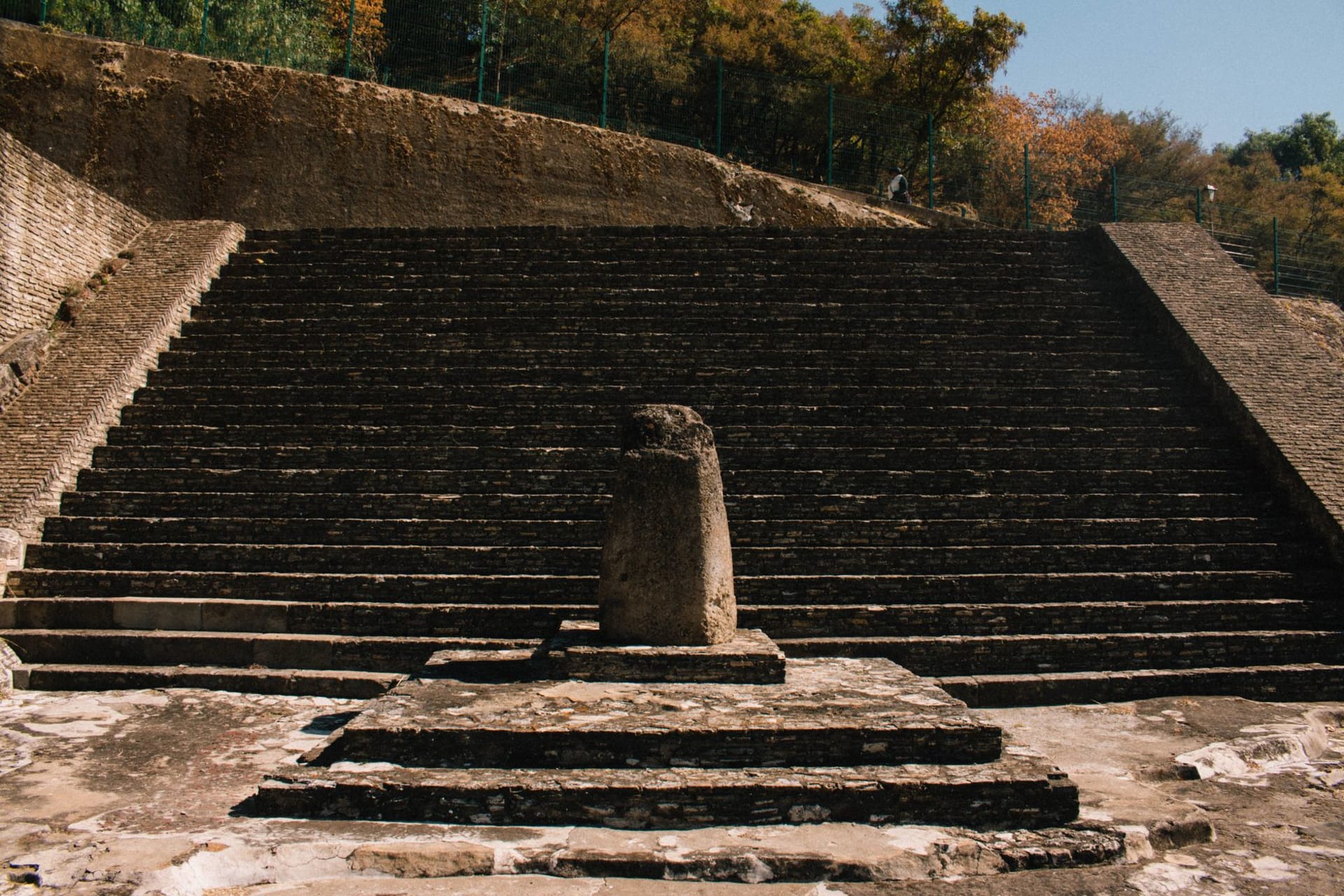
Monte Albán was built on a mountaintop that the Zapotecs flattened over centuries, a construction project of such ambition that it remains difficult to fully comprehend even when you are standing on the result. The mountain had to be leveled. The Grand Plaza that occupies the top is approximately 300 meters long and 200 meters wide, oriented on a rough north-south axis, surrounded by temple platforms, pyramidal structures, and ceremonial buildings.
Standing at the southern platform at eight in the morning with the valleys below still half in mist, I counted three other visitors on the entire complex. The light came in from the east at a low angle and made the stepped platforms cast shadows that moved visibly as the sun climbed. The silence was not absolute — birds, wind, the distant sound of a car on the road far below — but it was the closest thing to silence I’ve found at a major archaeological site in Mexico.
The Zapotecs built here from around 500 BCE and occupied the site until roughly 700 CE, at which point the city was gradually abandoned. At its height the population of Monte Albán and its surrounding valley settlements may have reached 25,000 people. Walking the plaza at eight in the morning with three other visitors, trying to imagine 25,000 people concentrated on this mountain, is one of those exercises in historical imagination that the site makes almost irresistible.

The Danzantes and Building J
On the western flank of the Grand Plaza, the building called the Gallery of the Danzantes contains carved stone slabs that were among the first things I looked for and the last I left. The Danzantes — literally “dancers,” a name that has nothing to do with their actual subject matter — are among the oldest stone monuments in Mesoamerica, dating to around 500 BCE. They depict captured rulers and prisoners of war in contorted positions: figures with closed eyes, open mouths, splayed limbs, some with glyphs identifying their names or origins.
The postures are not dancing. They are the postures of captives, probably of sacrifice. The carving is direct and confident in a way that makes some of the later Mesoamerican monumental sculpture seem overworked. These are images made without hesitation, with full knowledge of what was being depicted.
Building J, in the center of the plaza, is astronomically oriented — its arrow-shaped form points toward a specific star rising at a specific time of year, and the opening carved through one of its walls functions as an astronomical sighting device. I stood at it and tried to understand the geometry and partially succeeded. The Zapotecs were tracking celestial cycles here with precision sufficient to align a major stone structure. The building was constructed centuries before most of what I learned to call ancient history in school.
Tomb 7 and the Mixtec Period
After the Zapotec decline, Monte Albán was used by the Mixtec elite as a burial site — which is how Tomb 7 came to contain the greatest pre-Columbian gold and jade collection ever found in Mexico. The tomb itself is below the northern platform; you can enter a reconstruction of it in the on-site museum. The original contents — gold jewelry, jade masks, crystal vessels, carved bones — are in the Museo de las Culturas de Oaxaca in Oaxaca City, and the Oaxaca museum is essential both before and after the site.
France has a deep relationship with archaeological sites. The caves of the Dordogne, the Roman ruins of Provence, the menhirs of Brittany. I grew up understanding that history left physical traces in the landscape. But Monte Albán operates on a different scale of continuity — Oaxaca City is nine kilometers away, the Zapotec and Mixtec traditions are not dead, and the people whose ancestors built this city are still present in the valley below. The site is not a preserved ruin of something finished. It is a part of a continuing story.
By ten o’clock when I left the second time, the parking lot was filling with tour buses. I was glad I had come early.
