Mitla
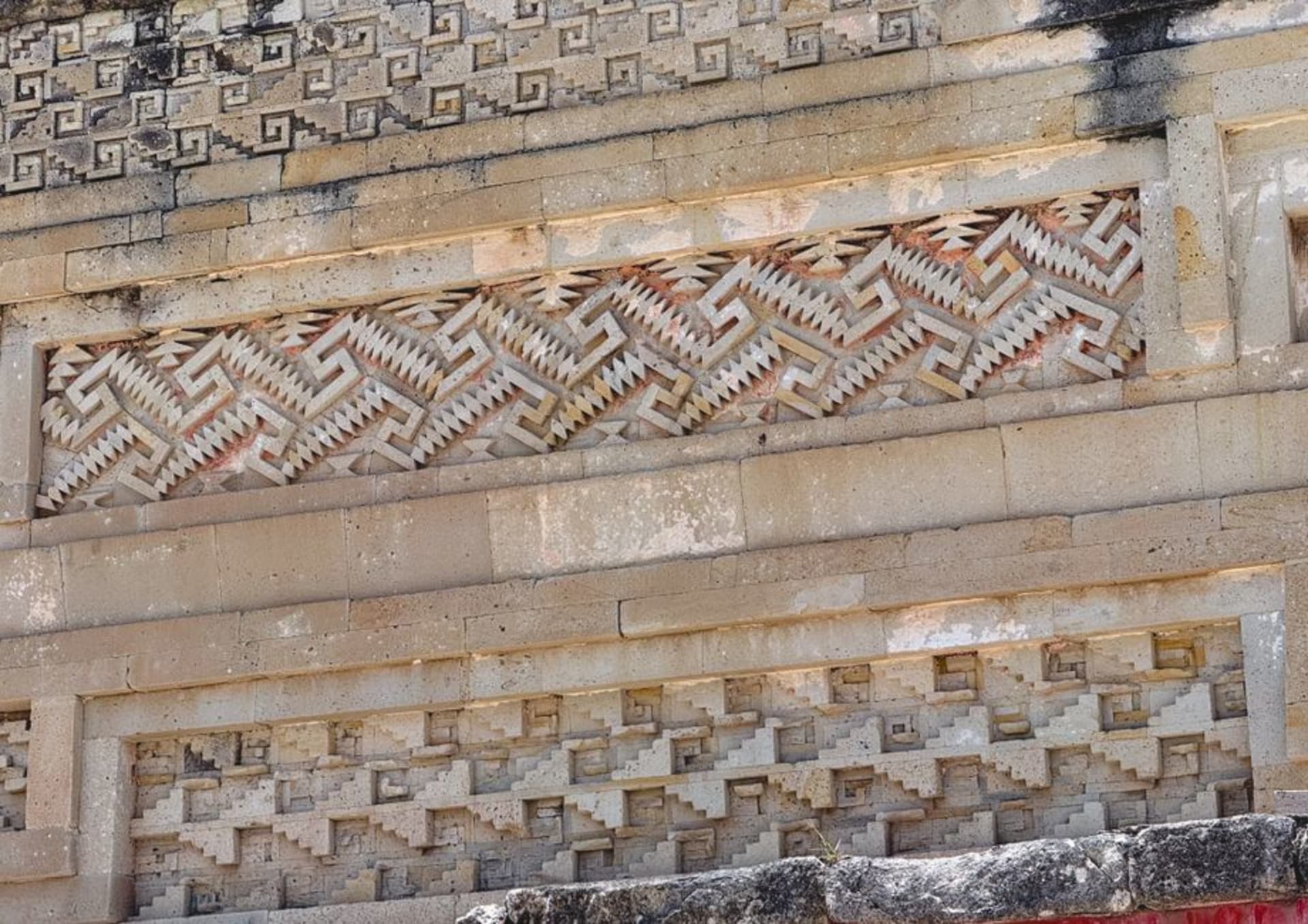
"The stonework at Mitla has no mortar. Ten thousand pieces of carved limestone fitted together dry. The patterns have not shifted in a thousand years."
Mitla sits 46 kilometers east of Oaxaca city in the Tlacolula valley, and if you’re doing the valley circuit — the Sunday market at Tlacolula, the archaeological site at Yagul, the mezcal villages between them — it’s the last stop before turning back. It is also the stop that most justifies the drive.
The Zapotec name for Mitla was Lyobaa — “place of rest” or “place of the dead” — and the site functioned as the Zapotec civilization’s principal mortuary and priestly center for the last several centuries of its pre-Columbian existence. Where Monte Albán (the other major Zapotec site, outside Oaxaca city) was the political and military capital, Mitla was the religious one: the place where the high priests lived, where the ruling classes were buried, and where, according to Spanish colonial accounts, a corridor led underground to a world without end.
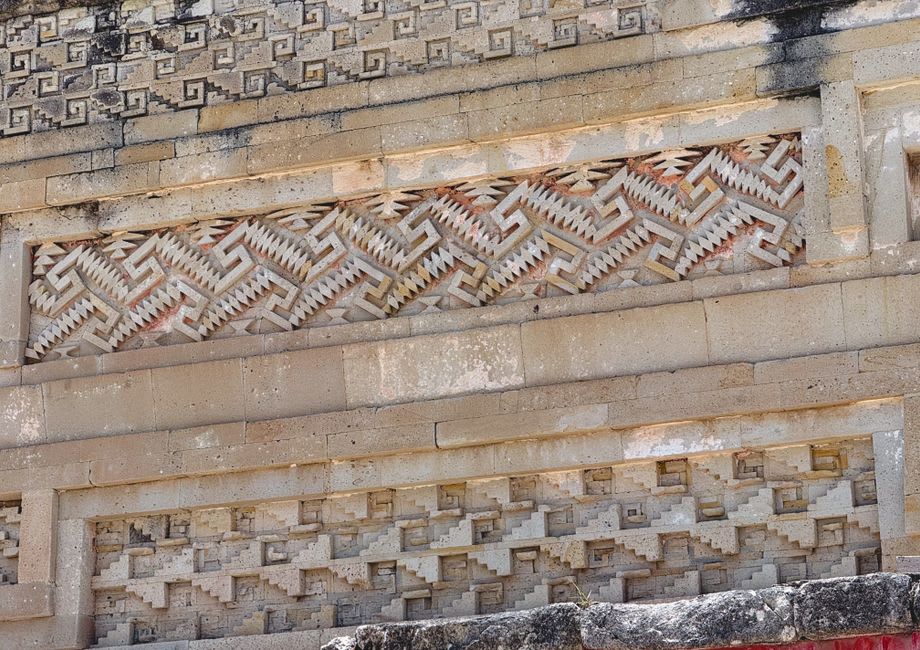
What distinguishes Mitla architecturally from every other pre-Columbian site in Mexico is the interior decoration: the walls of the main ceremonial buildings are covered, top to bottom, in a geometric stone mosaic of interlocking stepped frets, meanders, and diamond patterns, assembled from individually cut limestone pieces without mortar. The pattern vocabulary is called the greca — a word the Spanish applied to what they recognized as a Greek key motif — and it appears in at least fourteen distinct variations across the four main building groups at Mitla, no two rooms using exactly the same configuration.
The Architecture
The five groups of buildings at Mitla were constructed between approximately 900 and 1200 CE. The accessible section contains three of the five.
The Group of the Columns — the main ceremonial complex — consists of two long halls flanking a central patio. The Hall of the Columns takes its name from the six monolithic columns of stone that once supported the roof; the mosaic panels covering the interior walls are the finest at the site, the geometric patterns perfectly preserved because the carved limestone pieces are each individually seated in the stone backing without any material that would degrade.
Walking the length of the hall slowly, examining the patterns at close range: what becomes clear is the precision of the geometry. Each piece of the mosaic is cut to exactly the angle required by its position in the pattern, without any piece being made a little larger to cover a gap. The craftsmen working in the 10th century were operating to tolerances that would challenge a modern stonemason.
The underground cruciform tomb beneath the Hall of Columns is accessible and worth the small additional fee. The tomb is a narrow cruciform chamber cut into the bedrock, its walls also carrying geometric decoration. The Spanish accounts of a corridor leading to a world without end were probably describing a tomb system that extended further than the current excavation has revealed; the sense of depth and enclosure in the existing space is sufficient to understand why the description took the form it did.
A colonial church built directly on one of the Mitla building groups — using stones from the Zapotec buildings as construction material — stands at the edge of the site as a visible record of the colonial decision to superimpose rather than merely replace.
The Village and the Mezcal
The village of Mitla surrounds the archaeological site and has a Sunday market that predates the Spanish conquest — the Tlacolula valley Sunday market circuit, of which Mitla is the eastern anchor, has been a regional trade network for at least a millennium.
The market sections: artisan weavings from the valley villages (the reds and blacks of the Mitla style are distinctive), produce, live animals, and the mezcal row where palenque (small-scale distillery) owners bring their batches from the surrounding hills.
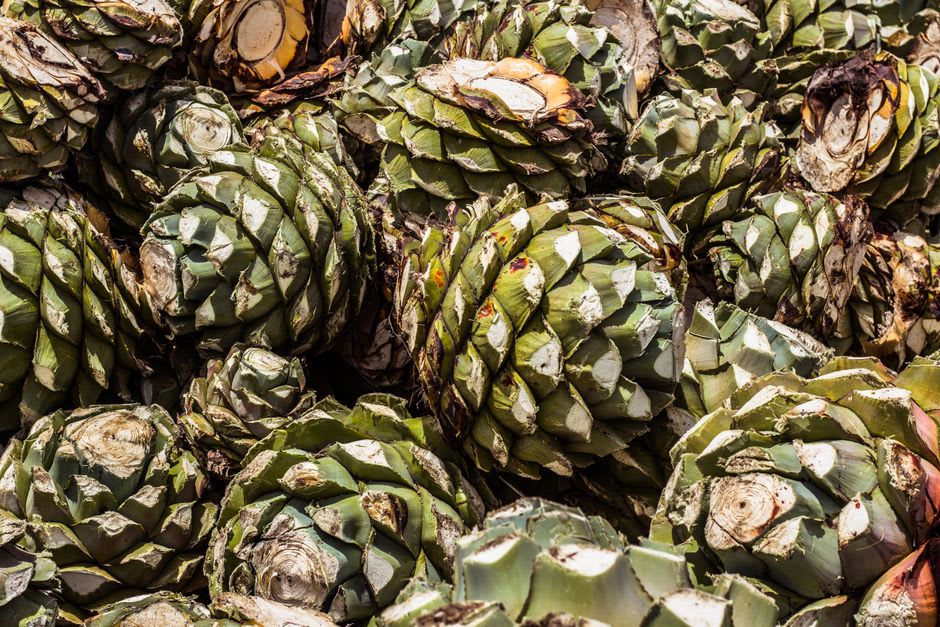
Mezcal from the Tlacolula valley tends toward the earthy and mineral expressions of the Espadín agave grown at altitude on rocky slopes — different in character from the coastal and highland varieties. The vendors at the Sunday market pour tastings from bottles without labels; asking about the agave type, the roasting method, and the village of origin produces more information than the label would anyway.
Getting there: Colectivos (shared taxis) from Oaxaca’s second-class bus station run the full Tlacolula valley circuit and stop at Mitla. Fare is minimal. The 45-minute drive passes Yagul and Tlacolula — the full circuit is a comfortable day from Oaxaca city.
When to go: The site is open year-round. Sundays for the market (arrive 8-10am for the fullest spread). October-May for most comfortable weather. The site has no shade; bring a hat and water even in winter.