Tlatelolco
"Three civilizations in one square, and a massacre in the middle of it. I arrived at nine in the morning and there were four other people. A place this heavy shouldn't be this empty."
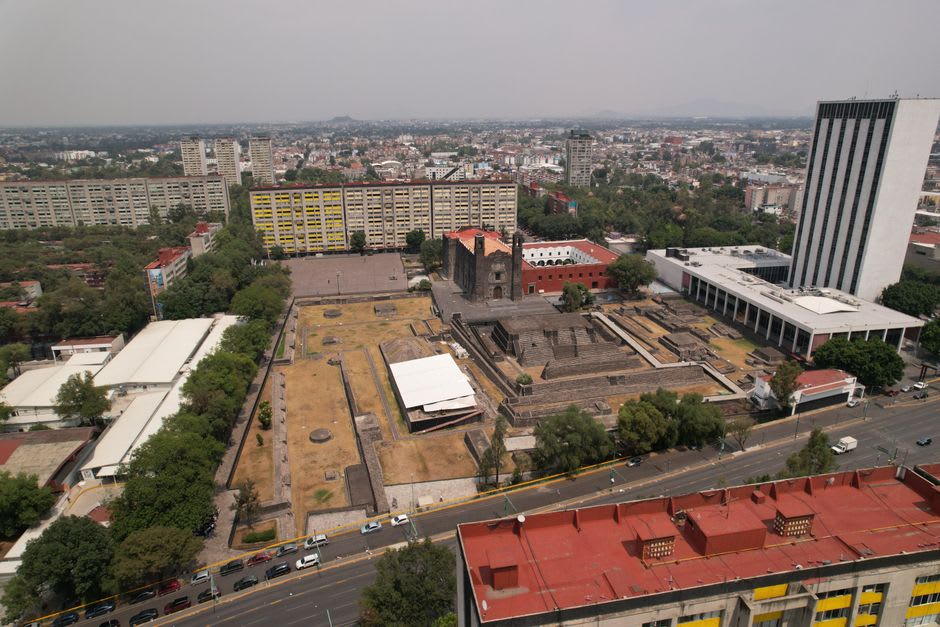
I went to Tlatelolco on a Tuesday morning in March, arriving by metro on the Tres Culturas station and walking the two minutes to the plaza with the specific slightly-too-alert feeling I get when I’m going to a place I’ve read about seriously and don’t know how I’ll find it. The metro exit opens onto a street that looks like any northern Mexico City street — convenience store, pharmacy, apartment blocks, the smell of breakfast tacos from a cart — and then you turn a corner and walk through an opening in a wall and you’re in the Plaza de las Tres Culturas.
There were four other people in the plaza. Two were taking photographs of the ruins. One was eating something from a bag. One was sitting on a bench looking at his phone. The sun was at that low angle that makes Mexico City’s thin high-altitude light very clear, and it was falling across the Aztec platforms and the stone church and the 1964 government building in the background and none of the four other people seemed to be processing any of it, and I stood there for a moment experiencing the particular disorientation of arriving somewhere important and finding it at rest.
What the Three Cultures Are
Tlatelolco was a city before the Spanish came. Not part of Tenochtitlán — a separate city on a separate island in the same lake, founded by the Mexica around 1337, which became over the next century one of the great commercial centers of pre-Columbian Mesoamerica. The market of Tlatelolco in 1519 was described by Bernal Díaz del Castillo, Cortés’s soldier-chronicler, as larger and better-organized than anything he had seen in Spain: sixty thousand people trading daily, every product from every region of the empire, the commerce controlled by a guild of merchants called the pochteca who had their own courts and laws. Tlatelolco was absorbed by Tenochtitlán after a political conflict in 1473 but retained its commercial preeminence.
After the conquest, the Aztec temples were demolished and the church of Santiago de Tlatelolco was built in 1609 using the same stones. This is not a metaphor or an exaggeration — the church is literally made from the material of the temples. In the plaza today, the archaeological ruins of the ceremonial center occupy the center ground: platforms, temple bases, the outlines of structures whose original heights you have to imagine. The church rises from the south side, solid and modest by colonial standards, the grey volcanic stone worn smooth. And on the north side of the plaza, the 1964 Secretaría de Relaciones Exteriores building, designed by Mario Pani in the modernist grammar of its moment — concrete, long horizontal windows, an institutional scale.
Three building styles, three historical moments, three cultural systems. The concept is neat. The reality is not neat at all.
October 2, 1968
The SRE building’s windows face the plaza. On the evening of October 2, 1968, the Plaza de las Tres Culturas was the site of a student protest organized by the Consejo Nacional de Huelga, the student strike committee that had been leading protests against the Díaz Ordaz government for months. The Olympics were ten days away. Mexico City had spent years and a great deal of money preparing to present itself to the world as a modern, stable, prosperous country. The government wanted the protests over.
What happened is not, even now, fully established. The army and the Olympia Battalion, a plainclothes paramilitary unit, surrounded the plaza. Shots were fired — who fired first is disputed. In the gunfire and the chaos that followed, an unknown number of protesters were killed. The official government count was 30 dead. Journalist Elena Poniatowska’s reconstruction in her book La noche de Tlatelolco placed the number much higher. The Mexican government classified documents related to the massacre for decades; researchers who eventually accessed them found evidence that suggests the real figure was in the hundreds. The full truth has not been established and may not be. The Mexican government did not formally acknowledge that a massacre occurred until 1998.
A memorial in the plaza marks the event: a simple plaque, some words, not large. It is placed in the northeast corner, near the church, somewhat apart from the main flow of the space. I read the plaque twice.
What struck me most, standing in the plaza on a quiet Tuesday morning, was the ordinariness of the space. The ruins are in good condition. The church is intact. The SRE building still functions as a government office. People cross the plaza without stopping. The metro is two minutes away. The coffee cart outside the gate was doing modest business. A place where the government killed students on the eve of the Olympics should have more weight on it than this. Either it does have weight and I was too recently arrived to feel it, or the weight has been absorbed into the city’s fabric in a way that requires more knowing than I have.
Getting There and What to Read
Tlatelolco is in the Cuauhtémoc borough of Mexico City, easily reached by metro to Tres Culturas on Line B, or by metrobús to Glorieta de Peralvillo. The plaza is free to enter and open during daylight hours. The archaeological zone has an entry point and a small interpretive museum; the museum is modest but worth fifteen minutes.
Read La noche de Tlatelolco by Elena Poniatowska before or after. It’s a collage of testimonies, a documentary novel made from the words of people who were in the plaza on October 2, and it is one of the essential books about Mexico City. It won’t make the plaza feel lighter, but it will make the quietness make more sense.