Tepito
"Every person I mentioned Tepito to in Mexico City said: 'Oh, I've never been there.' This eventually became the reason to go."
I asked perhaps fifteen people in Mexico City if they had ever been to Tepito. Fourteen said no. The fifteenth was Rodrigo, who grew up two blocks from the main market and offered to take me on a Tuesday morning at a time when the neighborhood is, in his words, working rather than performing. I went on a Tuesday.
The barrio bravo — brave neighborhood — is a self-designation, the kind of name a place gives itself when it knows the outside world regards it with a combination of fear and fascination that has more to do with the outside world’s anxieties than with lived reality. Tepito’s reputation in Mexico City is specific: not simply dangerous in the generic way that large-city neighborhoods get labeled, but a place with its own laws, its own customs, its own economy, its own devotional life. The chilangos who have never been there often seem to half-admire this separateness while using it as justification for never going. The logic has a certain coherence. I had been doing it myself for two years.
The Market
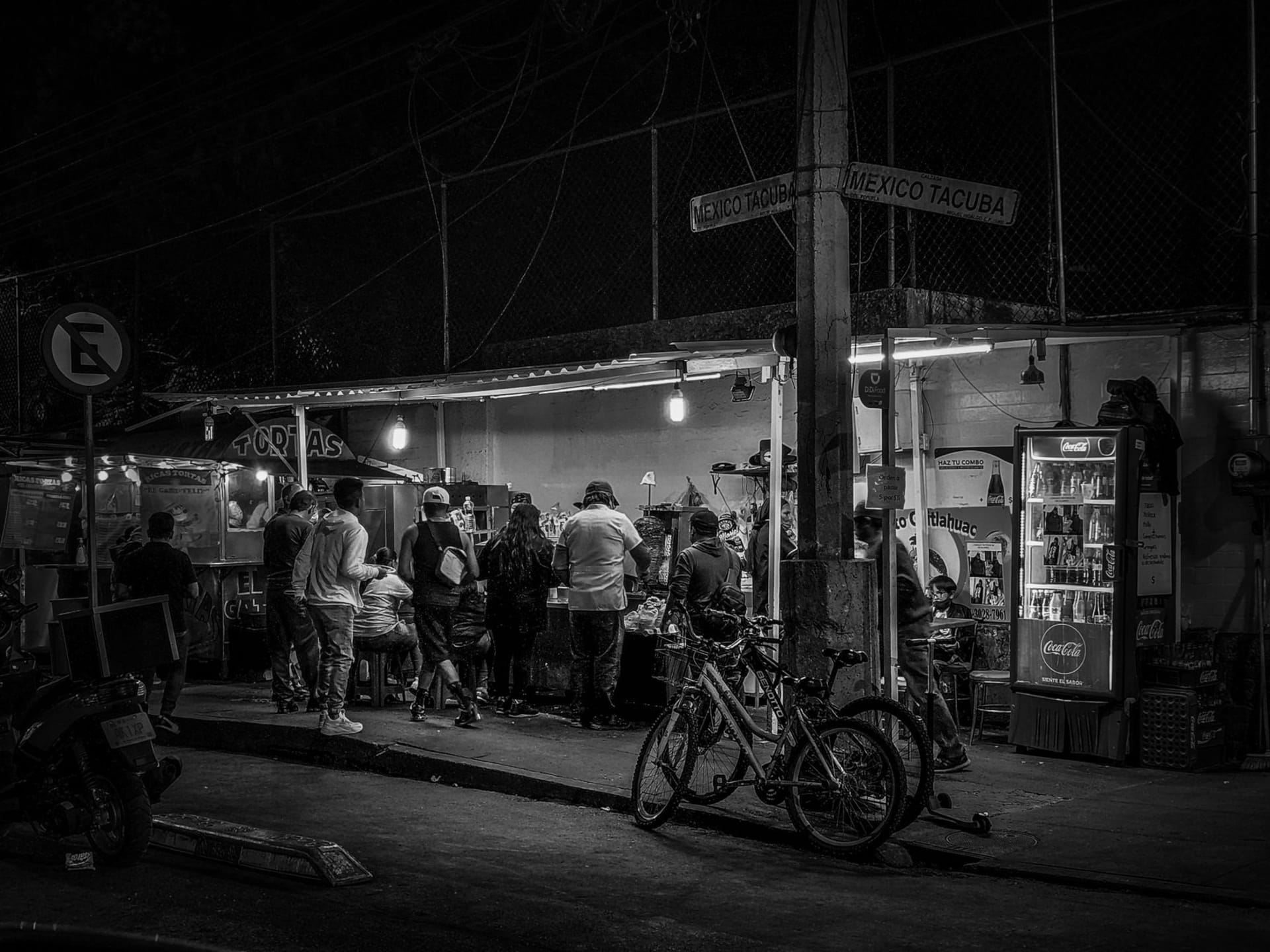
The Tepito market is not a single market. It is a district — roughly twenty square blocks of covered arcades and open-air tables organized into specialized sections that sell particular categories of goods: electronics in one section, clothing in another, the bootleg goods area that Mexico City residents invoke euphemistically as “the fayuca.” In the food section, which is where we started because Rodrigo had a specific taquería in mind, the market smells of masa and recaudo and the rendered fat of the carnitas trompo.
The carnitas tacos arrived in a basket lined with paper. The carnitas — Michoacán-style braised pork, cooked until the outside is crisp and the inside is soft enough to fall apart — had been going since three in the morning and it was now eight, which means five hours of finishing heat after the main cook. I ate four. Rodrigo ate six and seemed unimpressed with himself for it.
The market is chaotic in the productive sense: things are happening everywhere at once, and the overhead coverage — tarps, sheet metal, woven plastic — gives it a specific underground quality even in the middle of the morning. People move with the efficiency of people who know exactly where they are going. We were clearly the only people in the section who were looking rather than buying, and no one found this interesting enough to comment on.
In the covered electronics arcade, the scale of the operation becomes more legible: stall after stall selling phones, cables, speakers, laptop components, the entire supply chain of the informal digital economy visible in one arcade. The prices were better than anything I had seen in the formal retail sector. I bought a phone case and did not ask questions.

Santa Muerte
The altars are not optional in Tepito. They stand on the main streets, maintained by the residents of the buildings in front of which they sit, and the Santa Muerte — the folk saint of death, a skeletal figure robed in the colors appropriate to her different advocations — is present with a sincerity that has nothing to do with tourism.
Rodrigo explained the devotional logic while we walked. Santa Muerte is not officially recognized by the Catholic Church, which positions her in the space that Mexican folk religion has always occupied: parallel to official devotion, often coexisting with it, answering needs the institutional church doesn’t reach. Her devotees in Tepito are people for whom the official saints did not reliably intercede — for protection, for help with legal situations, for people whose lives operate at the margins of what official institutions cover. She is devotion for people who need something immediate and unconditional, which is not a romanticization of poverty but simply a description of what she offers.
The altars are maintained with candles, flowers, bottles of tobacco and alcohol, and personal objects — photographs, handwritten notes, small offerings specific to particular requests. Some are elaborate structures built over years; some are a robed figure in a wall niche with a few candles. All of them are clearly in active use. On the day I visited, a woman was changing the candles on an altar mid-morning with the focused attention of someone completing a necessary task.
Boxing and the Street
Three world boxing champions came from Tepito. This is not incidental to the neighborhood’s self-understanding. The boxing gym Rodrigo showed me — a converted ground floor on a side street, bags hanging from a steel frame, a ring in the back with worn canvas — was open at ten in the morning with four or five people training. The sport in Tepito is both a literal path out and an expression of the barrio identity that those who leave most often articulate when they describe where they’re from. The two things coexist without tension.
Walking out of Tepito at noon, back toward the historic center, I tried to account for what I had expected and not found. The neighborhood is exactly as complicated as its reputation — Rodrigo’s casual awareness of which streets to use and which times to be there was genuine expertise, not performative caution. But the barrio’s hospitality to someone moving through it correctly is also genuine. Both things are true and neither cancels the other, which is more or less what honest accounts of complicated places always conclude.