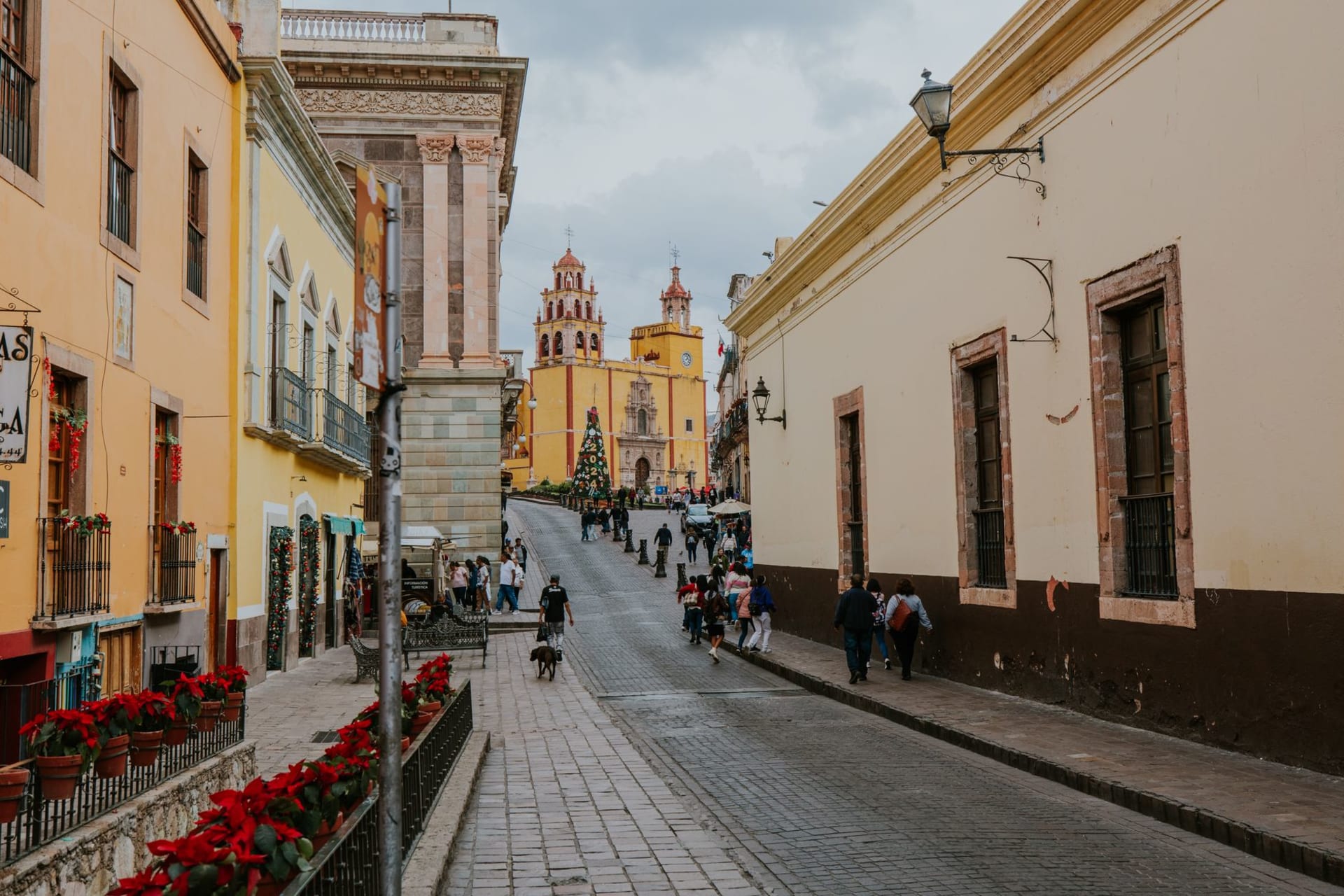
Centro Histórico
"The whole city is an archaeological site. Every street corner is built on something older."
I have walked the Centro Histórico more times than I can count now, and every time I come back to the same disorienting realization: the ground beneath me is not the ground. It is a crust, a thin colonial layer over the ruins of Tenochtitlan, the Aztec capital that Cortés systematically dismantled stone by stone and rebuilt as a Spanish city. Mexico City knows this about itself. The Templo Mayor — the great double pyramid of the Aztec world — sits partially excavated in the middle of the oldest neighborhood in the Americas, directly beside the Metropolitan Cathedral built with its stones. This is not ancient history displayed at a safe distance. It is the city’s living ontological condition.
I moved to Mexico in 2022 and the Centro was not where I started. The Centro is overwhelming on first encounter — loud, dense, chaotic in a way that defeats orientation. But I kept coming back, mostly on early mornings when the city was still half asleep and the Zócalo was being hosed down by workers in orange vests. I would come for the tacos de canasta outside the Metro Zócalo entrance — the baskets of steamed tortillas that vendors have been hauling on bicycles to this corner since at least the 1970s — and stay for three hours.
Tenochtitlan Beneath Your Feet
The Templo Mayor is the most important archaeological site in Mexico City, and it is not in a remote location. It is in the middle of the busiest neighborhood in the country, carved into the blocks immediately northeast of the cathedral. You pay the entrance, cross a threshold, and stand beside the base of a pyramid that was the ritual center of an empire of some millions of people.
What the site communicates, which no photograph manages, is the scale of the excavation relative to the surrounding city. The ruins sit several meters below street level — below the foundations of the colonial buildings that were built on top of them, below the sidewalk where vendors sell flagpoles and prayer candles. Standing at the edge of the site and looking down at the exposed ceremonial platform, the rain serpent heads, the skull racks, and the dedication offerings still in position, you understand viscerally that the city above is a fiction built over an older city. This is not a metaphor. It is geology.
The Museo del Templo Mayor adjacent to the site contains the Coyolxauhqui disc — the monumental carved stone depicting the moon goddess dismembered by her brother Huitzilopochtli, found by electrical workers in 1978 during a routine cable trench. The discovery prompted the excavation that uncovered the temple beneath colonial streets. The disc is 3.25 meters across, carved in a single stone, and the detail of the carving — the serpent belts, the eagle feathers, the bells at her cheeks — is as precise as anything in the Louvre. I have brought every visitor who has come to stay with us directly to this museum. No one has been unmoved.
Rivera on the Palace Walls
The Palacio Nacional occupies the entire eastern side of the Zócalo. It is the seat of the federal executive but also, in its central stairwell and second-floor corridor, the location of Diego Rivera’s great mural project — a panoramic history of Mexico from Aztec origins through the Revolution, painted between 1929 and 1951 in a scale that required decades and a scaffolding apparatus the size of a building.
I had seen reproductions of these murals, but reproductions do not communicate the thing itself. Rivera’s figures are larger than life and painted in a palette that reads differently in person: the blues are more saturated, the earth tones deeper, the carnage of the Conquest more explicit than reproductions suggest. The Aztec market scenes at Tlatelolco show a civilization in full — the cacao trade, the ritual specialists, the merchants and their goods — before the Conquest panels show its systematic destruction, Cortés on horseback, the burning, the drowning of worlds. The mural on the main stairwell does not editorialize. It presents the evidence and trusts you to draw the conclusion.
What I find remarkable is how little attention most people give it. Tourists enter, photograph the stairwell, and leave. The second-floor corridor — a long gallery of panels depicting Mexico’s post-independence history through to the 1910 Revolution — is often nearly empty. I spent forty minutes there once, following the narrative from left to right, recognizing faces I had only known from coins and textbooks. Juárez. Díaz. Zapata. Madero. It is a history lesson you walk through in a space the length of a city block.
The Palacio is free and open most mornings. Go on a weekday, early. The Zócalo in the morning light — the national flag raised at 8am in a military ceremony that stops traffic — is worth arriving for.
The Street at Six in the Morning
The Centro at dawn is a different city from the Centro at noon. The street-food infrastructure assembles in the dark. By six in the morning, the vendors outside the Metro Zócalo entrance have their oil drums going — the baskets of tacos de canasta, which are steamed rather than grilled, filled with frijoles refritos, chicharrón, papa con chorizo, and requeson. You pay by selecting from the basket. The tortillas are soft and slightly wet with steam, which is intentional. The price is minimal. I have eaten these tacos at least a hundred times and have never found them anything less than precisely right for that hour.
By seven, the women with comals have set up on the pedestrian stretches of Cinco de Mayo and Madero — quesadillas, tlayudas, huaraches griddled on the flat top while you wait. The mercados are already in full operation. La Merced in the morning is genuinely overwhelming: several city blocks of covered market stalls selling produce, spices, herbs, dried chiles, candies, piñatas, textiles, and everything else the city requires. Go with no agenda and follow your nose through the dried chile section, where the smell is ancient and narcotic and completely unlike anything in France.
The Mercado de la Merced is not a tourist market. It is the provisioning center of a city of twenty-two million people. You will be in the way. Navigate carefully, say permiso constantly, and do not stop abruptly in a corridor. The payoff is the density of sensory information — color, smell, noise, the specific chaos of a market that has been operating on variations of the same site since the colonial period.
For the afternoon: the streets of the Centro proper — Madero, Isabel la Católica, Uruguay — contain an extraordinary density of baroque architecture that most people walk past without looking up. The Casa de los Azulejos on Madero is an 18th-century palace covered in blue-and-white Talavera tile that now contains a Sanborn’s restaurant; the restaurant is unremarkable but the building requires a pause. The Palacio de Bellas Artes, the white marble opera house at the western edge of the Centro, has murals by Orozco, Siqueiros, and Rivera inside and sinks several centimeters per decade into the unstable lakebed beneath it. The city is slowly returning to the water. This fact seems to bother no one.
Getting there: The Zócalo metro station on Line 2 deposits you directly in the plaza. From Roma, Condesa, or Polanco, a taxi or Uber is fast and inexpensive. Most of the Centro is walkable from the metro.
When to go: September 15 — the eve of Independence Day — is the most extraordinary night in the Centro: a million people fill the Zócalo for the presidential Grito from the Palacio Nacional balcony. For calmer visits, weekday mornings from October to April are ideal. The Centro never closes but is safest and most atmospheric in daylight.