Ajijic / Lago de Chapala
"The pelicans come in to land like slow cargo planes, enormous and unhurried, and the lake catches the last light underneath them. I didn't expect Ajijic to do this to me."
I had resisted Ajijic for two years. Everyone I met who had been there either described it as a charming Mexican village or as an enormous colony of retired Americans and Canadians, and neither description made me feel I was missing something essential. I went eventually because I was in Guadalajara and the distance is short and I had a free morning, and I found it considerably more interesting than either description had suggested.
The Lago de Chapala is larger than it reads on a map. Mexico’s biggest lake is 80 kilometers long by 18 wide, and from the malecón in Ajijic you see a body of water with no visible far shore on clear days — the Sierra de Tapalpa on the south side is a grey-blue shape at the edge of visibility. The scale surprises. Mexico in my mental map is beaches and mountains and desert; I had underestimated the lake.
The Light on the Water
The light on Chapala in late afternoon is the reason photographers and painters started arriving here in the 1930s. It does something specific to this lake that I have not seen repeated: the water goes silver and gold simultaneously, the light coming in low across the surface and fragmenting, and the pelicans — and in winter there are thousands of American white pelicans on this lake, plus egrets and herons and cormorants and species I didn’t know the names of — the birds on the water are silhouetted against it and it’s frankly excessive.
I arrived on a Thursday in January and walked the malecón from east of the pier to west of the yacht club, which takes about thirty minutes at a slow pace, and then walked it again because the light was changing. An older woman with a folding table was selling uchepos near the bandstand — uchepos are the fresh corn tamales of Michoacán and western Jalisco, sweet and moist and very different from the masa tamales of central Mexico. They are wrapped in fresh corn husks and the filling is corn sweetened with sugar and spiced with rajas, and they taste like a memory of summer made into something edible.
I stood at the edge of the malecón eating uchepos and watching the pelicans. The pelicans land the way large aircraft land — slow, deliberate, the wings spread and angled, a controlled descent that ends with a brief skid on the water. They are enormous birds up close, the pouch under their bill bigger than it looks in photographs, and there were perhaps two hundred of them in the section of lake I could see. They arrive every winter from the breeding grounds in the northern Great Basin, cross something like 3,000 kilometers, and land on a lake in Jalisco. The route makes no logical sense to me and I find it deeply pleasing.

The Town Behind the Reputation
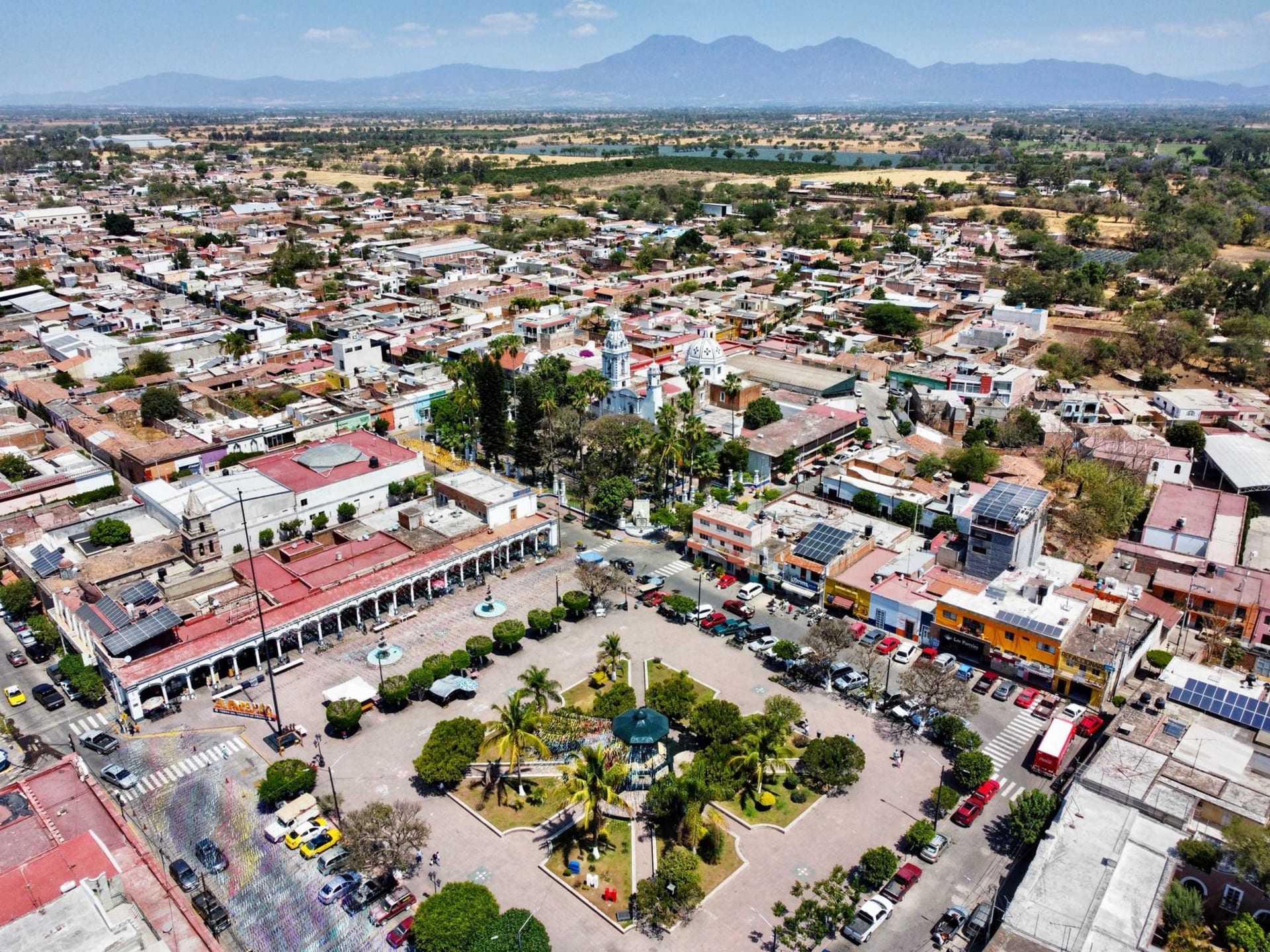
Ajijic has around 12,000 residents of whom a meaningful percentage are North American retirees. This is simply true. The town center contains coffee shops with English-language menus, a bookstore selling used paperbacks, art galleries with oils of the lake, and the specific retail infrastructure of a place where people come to live comfortably in retirement — pharmacies with English-speaking staff, restaurants serving Caesar salad.
It would be easy to find this depressing. I didn’t, particularly. What struck me was the degree to which the Mexican town continues underneath and around the expat overlay. The Tuesday market on the main road is a real market — produce vendors, chile vendors, a woman who makes and sells her own cheese, another who has nopales already prepared in plastic bags. The parish church on the plaza is a working parish church; a mass I walked past on Saturday evening had a full congregation that was not North American. The fishing boats on the lake are not decorative props — there are still families in Ajijic and the neighboring villages of Jocotepec and Tizapán el Alto who fish Chapala for charal and carp and a local endemic called the blanco.
The artists came first, in the 1930s and 40s — the American painter Sidney Lanier, D.H. Lawrence nearby in Chapala, later a generation of Mexican painters drawn by the light. The retirees followed the artists’ reputation. The sequence matters because it means the town’s cultural infrastructure — galleries, craft workshops, the light itself — was genuine before it became a selling point.
The Lake’s Troubled History
Lago de Chapala shrank dramatically over the twentieth century. Irrigation withdrawals, the diversion of the Lerma River, drought, and the lake’s use as a sink for industrial effluent from the Guadalajara metropolitan area reduced the lake to a fraction of its former depth by the early 2000s. Restoration efforts since then have partially reversed the decline, but the lake remains shallower than it was historically and its water quality is a genuine ongoing concern.
The pelicans don’t seem to care about any of this, or if they do, they haven’t told anyone.

Getting There
Ajijic is 50 kilometers southeast of Guadalajara, about an hour by car depending on traffic out of the city. Buses run from Guadalajara’s old bus terminal on Periférico; the service is frequent and cheap. Uber from Guadalajara works too and is not expensive if you’re sharing the cost. The malecón and town center are walkable; to get to the further parts of the lakeside — Jocotepec to the west, Chapala town to the east — you need a car or local bus.
Go in winter for the birds and the dry-season light. November through February is when the pelicans and migrant waterfowl are present, and when the temperatures on the lake are the most comfortable. July and August are humid and the lake has less appeal in the summer heat.