
El Oro
"I stood in front of the theatre for a while before going inside. I needed a moment to accept that it was real."
I found El Oro by accident, or as close to accident as anything is in the age of the internet. I was reading about the mining towns of the Estado de México and came across a photograph of a building that did not make sense in its context: an ornate Art Nouveau theatre, green ironwork, tiled facades, a mansard-influenced roofline, sitting on a quiet street in a mountain town of perhaps ten thousand people. I thought the image was misleading — that the photograph had been taken in Mexico City or Morelia or some other city of sufficient scale to justify such a building, and that the caption had been wrong. The caption was not wrong.
The Teatro Juárez of El Oro was built between 1907 and 1909 at the height of the town’s mining prosperity, when gold and silver extraction from the surrounding hills was producing enough wealth to contemplate culture. The Porfiriato — the long dictatorship of Porfirio Díaz, who governed Mexico from 1876 to 1911 — produced architecture across Mexico that punched dramatically above the scale of its context: grand railway stations in provincial cities, Baroque-inflected courthouses in mining towns, and in El Oro, this theatre, designed in the prevailing French-influenced mode of the era, completed just as the revolution that would end Díaz’s regime was beginning to stir. By the time the theatre was inaugurated, the world that commissioned it was already ending.
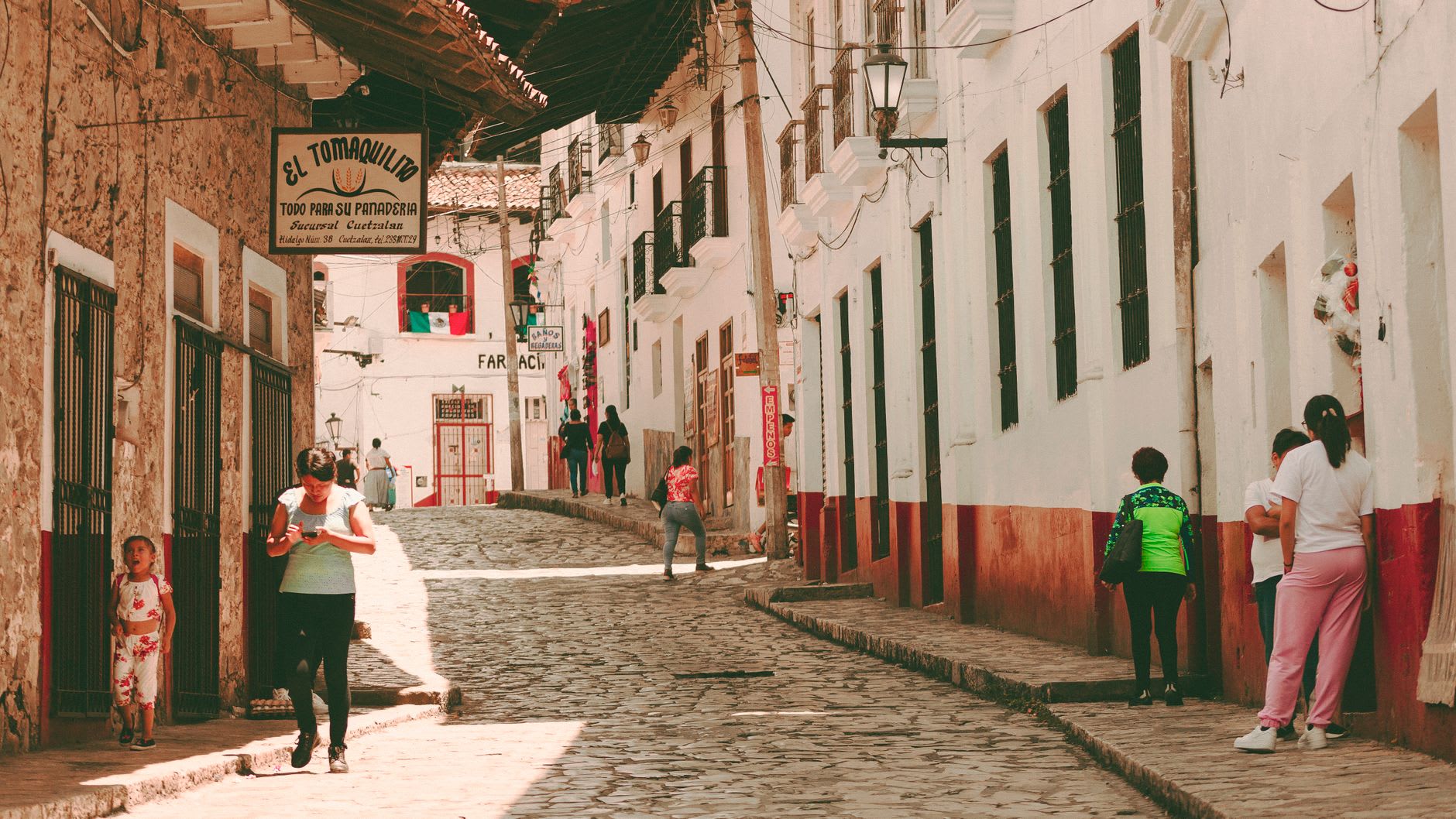
I went on a Thursday in February, arriving on the first bus from Toluca, in altitude cold — El Oro sits at 2,700 meters, higher than Mexico City, and in February that means mornings that require a proper coat and breath that comes out in small clouds. The streets of the centro were quiet in the way of small mountain towns at mid-morning: a few people at the market, a bakery with its metal door half-raised, a woman mopping the steps of the presidencia. The theatre appeared around a corner without warning, its facade incongruous and magnificent in the pale winter light.
The Theatre
The Teatro Juárez is not a ruin. This is important to establish. It has been maintained and restored through the decades that followed the mining collapse, and is still used — performances, civic events, the occasional film screening — by a town that has continued to regard it as an inheritance worth keeping. The interior is intact: an orchestra level, a balcony, boxes along the side walls, the painted ceiling largely preserved, the stage curtain dating from a restoration in the 1970s that was done with genuine care. The capacity is around 800, which is considerable for the current population of the town.
I paid a small entrance fee and was shown around by an older man who managed the building and had been doing so, he said, since 1989. He was not a trained guide in the formal sense but had absorbed the history of the theatre through decades of proximity to it and answered questions with the authority of someone who has considered these matters at length. The acoustics, he said, pointing up at the plasterwork ceiling, were the reason the theatre had been designed by the architect brought from Europe specifically for this project. The mine owners wanted the best. They got the best. And then the mines closed.
The exterior detail — the green ironwork balustrades, the tile panels between the windows, the carved stone framing of the entrance — is in the full Art Nouveau vocabulary of the period: organic curves, floral motifs, the rejection of historical revival styles in favor of a new ornamental language that was itself, within twenty years of the theatre’s construction, considered dated. I am not sure there is a building in Mexico that makes the tragedy of the Porfiriato more visible: so much ambition, so much imported taste, so precisely timed to be obsolete.
The Mines and the Museum
The Museo de Minería del Oro y la Plata de El Oro, housed in a former mine building about three blocks from the theatre, is a smaller enterprise with outsized rewards for anyone interested in the Belle Époque period in Mexico. The photographic collection is the highlight: prints from the first decade of the twentieth century showing the mines at peak operation, the British and American engineers who ran them (this was largely foreign capital, exploiting Mexican concessions under the Porfiriato’s favorable terms), the workers who descended every day into the shafts, and the town as it was when the theatre was new.
The photographs show a town that did not look much like El Oro as it exists today. There were more buildings, more commerce, more evidence of population. The mining operations employed several thousand people at peak production. After the revolution disrupted operations and silver and gold prices fell through the 1910s and 1920s, the population contracted. It has never fully recovered. What remains is a town of the right scale for a mountain community of modest agriculture and local commerce, plus one building that belongs to a different size and ambition entirely.
The mine shafts themselves — the entrances visible on the hillside above town — are not accessible, but the museum has a scale model and several of the original mining tools and documents that give a sense of the operation’s scale. There is one map, a hand-drawn survey from 1908, showing the full extent of the tunnel system under the hills. It covers an area far larger than the town above it. The town was the surface expression of a much larger subterranean world.
The cold at 2,700 meters is not dramatic cold — it is not Creel in January or the high passes of the Sierra Madre — but it is persistent in February, a dry mountain cold that settles into your shoulders and makes you grateful for the bakery near the presidencia that keeps its oven burning and sells pan de yema and empanadas de calabaza that you eat standing outside, the steam rising from the bag. I ate two empanadas in the street and then went back into the theatre to warm up, and the man who manages the building had made coffee, and we sat in the lobby and talked about the mining industry for an hour, which I had not planned but did not regret.
Getting there: El Oro is reached by second-class bus from Toluca’s main terminal (about 1h30-2h depending on route and stops). From Mexico City, take the bus to Toluca (1h15 from Observatorio) and then connect to El Oro. There is no direct service from Mexico City. Driving from Toluca takes about 1h on federal highway 55. The town has no regular accommodation beyond one modest posada; this is a day trip from Toluca, or from Mexico City via Toluca.
When to go: The theatre and museum are open year-round, Tuesday through Sunday. February through April and October through December for clear days with good light — the mountains surrounding El Oro produce afternoon clouds from May through September that obscure the views. Dress for altitude cold at any time of year; even in summer, evenings can drop to single digits Celsius at 2,700 meters.