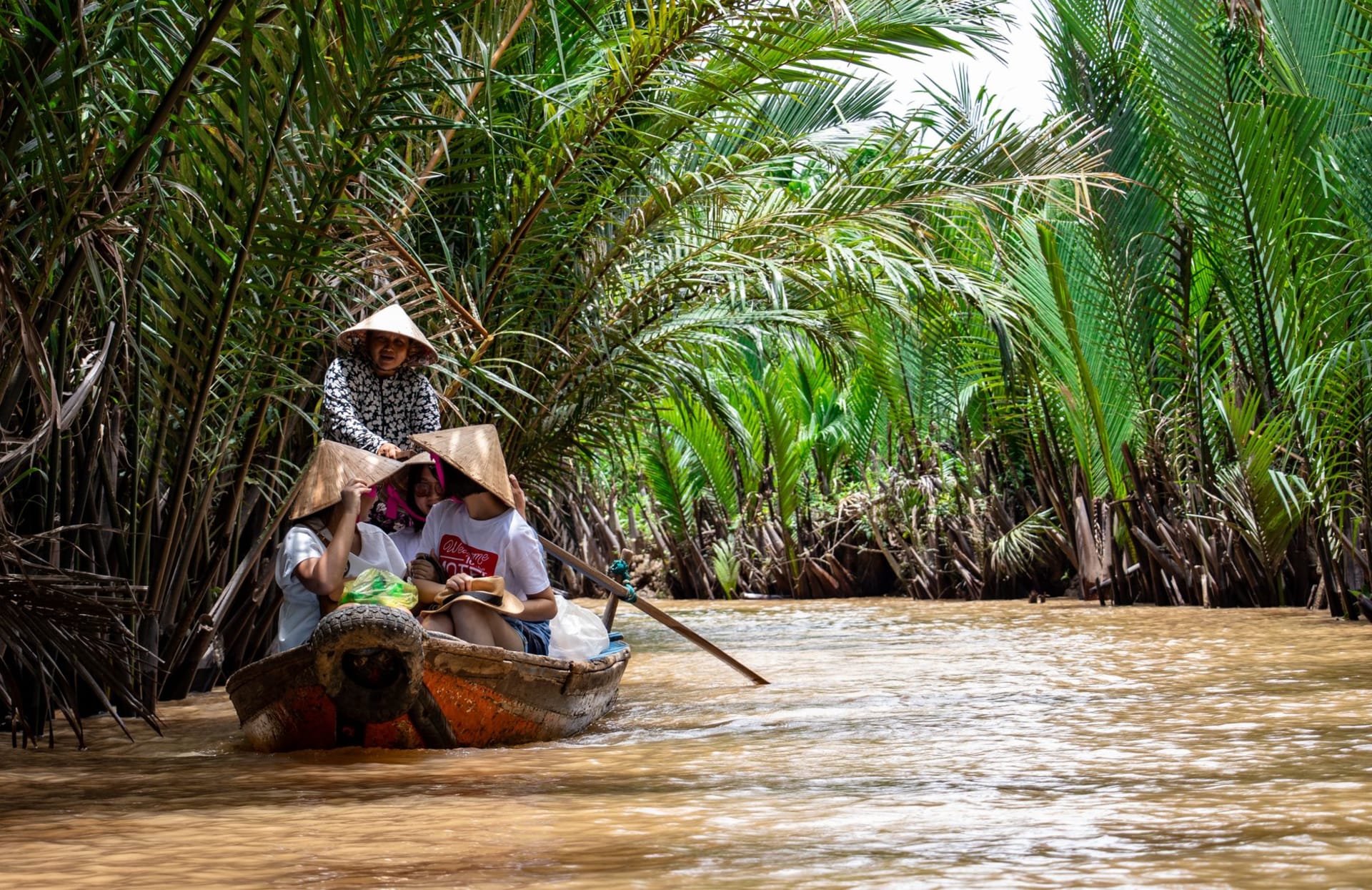
The public ferry from Vĩnh Long to the island of An Bình takes four minutes. By the time the propeller stops churning and you step off onto the mud-and-plank dock, the town you came from has already disappeared behind a screen of coconut palms. The island absorbs you. There are no cars, just narrow paths of packed earth and occasional concrete that thread through pomelo orchards and longan groves, past houses half-hidden behind screens of morning glory, beside channels too small to fit anything but a sampan.
I rented a bicycle from a family near the dock for a sum I’ve since forgotten, which tells you something about how much it cost. The youngest son pointed me vaguely westward and said something I took to mean “keep going until you have to turn back.” I followed paths that dead-ended at the river, turned and found new ones, crossed a bridge so narrow I had to carry the bicycle sidewise, and arrived at a floating restaurant built on bamboo poles over a channel where a woman was grilling nem nướng — pork skewers — over charcoal while a television behind her played a Vietnamese game show. I sat down and the whole structure swayed slightly.

The family I eventually stayed with kept a hammock between two coconut trees at the edge of their property and offered it to me after dinner with an earnestness that made refusal impossible. They fed me cá tai tượng — elephant ear fish — fried whole in a wok of hot oil until the flesh cooked through while the fins turned to a crisp, translucent lacework. You lay the fish on your plate, pull it apart with chopsticks, and wrap sections of the sweet white flesh in rice paper with mint, pickled carrot, and a sprig of perilla, then dip it in a sweet fish sauce. It’s the kind of dish that makes you trust a place completely.
The islands south of Vĩnh Long are technically several — An Bình, Bình Hòa Phước, and Đồng Phú among them — connected by the ferry system and by the informal bridges that families build between their properties. A good cyclist with a day to spare can circle the main island, stop for fruit bought direct from the orchard at prices that seem like a misprint, and be back at the dock before the last ferry. A better approach is to stay the night and do it again the next morning when the mist is still on the water and the birds are loud in the pomelo trees.

The town of Vĩnh Long itself is a useful base — decent guesthouses, a river market, a temple or two — but it’s the gateway rather than the destination. The destination is thirty meters from shore, across four minutes of brown water.
When to go: November through April for dry paths and easy cycling. March is particularly good — the longan trees are flowering, the air carries a faint sweetness, and the tourist numbers are low enough that you’ll often be the only foreigner on the island.